Tag: math rules

  • Math Skills in a Math Toolbox

    Math Skills in a Math Toolbox

    We don’t teach each new math skill just to have something to do during the next math lesson. And yet textbooks make it look like we do.
    Math skills are presented in bubbles called sections. The section doesn’t show how the math rule being taught connects to past or future lessons. Nor does it point out what previously learned skills or rules are currently being employed.

    Okay, it might note that this section is similar to the others in the chapter. But how often do you see a section point out how you’re going to use the skills you learned in a previous course?

    Kids rarely understand that each level of math is taught so that the tool that’s being practiced can be used later – in another math lesson or math situation.

    They don’t see the long term growth of math skills and math maturity – their math toolbox.

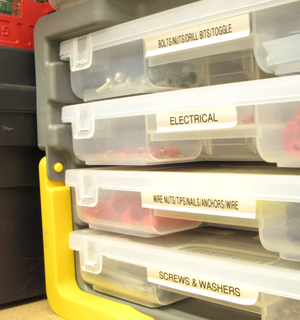
    Math skills are tools.

    Take a look in any man’s garage and you’ll see a plethora of tools.

    Point one out and ask the owner these things:

    1. What is this?
    2. Under which situations will it function (and under which won’t it)?
    3. In what situations would it be helpful to use?
    4. Do you have the confidence and ability to use it when you need to?
    5. Have you ever used it when there was something else that would’ve worked better?

    Chance are, he’ll have thorough answers for 1, 2 and 3. And for number 4 – he’ll look at you like you’re nuts and say, “Well, yeah!”

    For number 5, he’ll say, “Well, of course. Sometimes I’m not sure what will work best, so I just pick a tool that I know can work. If it turns out to not be the best tool for the job, it’s no big deal. It might have taken a little longer, but it still got the job done.”

    Tools accumulate – and add to each other.

    Mr. Garage Owner didn’t collect a whole bunch of tools that he’s clueless about. He likely wanted to build one thing and realized a tool could help. So he bought it.

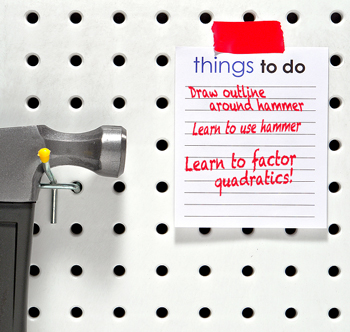
    He learned how to use it, then hung it on the wall. Probably on a pegboard with the shape of the tool outlined.

    Then he wanted to fix something else. He could have used his tool, but if he had another tool as well, it would make it even easier.

    So he bought another tool.

    Together with the first tool, he fixed his gadget then hung the new tool on the wall.

    He continued this way until his pegboard was full and he was building more tool storage space in the back yard.

    Now he knows each tool, when and how to use them, and confidently pulls them out each time it’s necessary.

    And if he chooses the wrong tool for the job, he gets over it quickly.

    Teach math like the kids are accumulating tools.

    When you start a new section in your math lesson, review the math rules that they previously learned. Show how the newest problems may (or may not) be solved with the old math skills alone.

    Present the new skill or math rule thoroughly. Be clear on what it is, how it can be used and under what circumstances. Also point out where it can’t ever be used. Like “adding to both sides” can’t work when there’s no equal sign.

    Point out some areas where the new math rule might be helpful. Point out some areas where the new rule might not be the best for the job, but it would still work.

    Show how to use the new math rule along with the old rules (pointing them out everywhere) to achieve results.

    Have them make a list of all the math skills they’ve learned – a pegboard outline – so they can be kept handy.

    Let them play.

    Math is typically thought of as the subject where “there’s only one way to do it.”
    BAH!

    Just like Mr. Garage Owner, using the non-optimal tool for the job still gets the job done. As long as it works (can’t run an electric drill in the rain, after all).

    So let them play. Turn your math lesson into a time where they can use any math rule they want. Let them discover their own confidence in choosing tools.

    And let them try out tools that might not be the best for the job.

    As they grow their math toolbox, they’ll grow in math maturity and confidence!

    Share your thoughts in the comments or on twitter/x.

    You might also like:
  • Rules Aren't Complete without the Details!

    Rules Aren't Complete without the Details!

    This is the 7th in the draft purge series where I’m throwing stuff out over a three week period.

    Rules often leave out the details.

    Don’t drink alcohol and drive a vehicle in public, simultaneously.
    Find a common denominator, when adding fractions.
    Do it to both sides of the equal sign.
    Multiplication comes before addition in arithmetic.
    Find a point using slope from another point on the line.

    Details!

    This article is a part of the 50 Word Friday series. Learn more about this strange, limited writing style here…

    Share your thoughts in the comments or on Twitter/X.

    You might also like:
  • Math Rules & Their Destruction of Education

    Math Rules & Their Destruction of Education

    We’ve trained kids to know that math is a set of specific, discrete rules that, when followed, yield the correct answer.

    They memorize math rules like:

    • Whatever you add to one side, you must add to the other.
    • FOIL
    • Distribute
    • PEMDAS
    • Plug in 1 for x (then 0, then -1)

    The rub is, that they don’t understand why the rules work. Which might not be a big deal – but the rules don’t always work!

    We got to see The Math Rules in action.

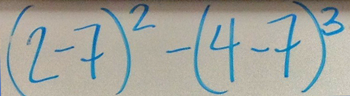
    For two days, in my #PowerMath class (officially Developmental Math – the class two levels below College Algebra), we’ve been working on this problem:

    The goals were these:

    1. Practice and understand the order of operations.
    2. Compare this to working with variables.
    3. Learn to experiment with the math rules to discover how things work.

    What I saw was mind-boggling. I knew the skill level was low. But I had no idea the blind following of math rules was so widespread and detrimental.

    Goal #1: Practice and understand the order of operations.

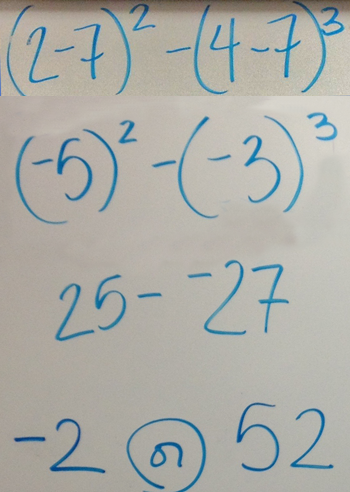
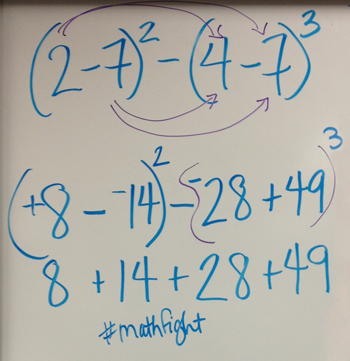
    When given the problem, and asked to coach me on various ways to do it, someone requested we use the order of operations and “do inside the parenthesis first.” So we did. They instructed me to write it like this:

    All was cool until the end when there was a bit of an argument on the final answer. So we listed them both as possibilities.

    Although the act of doing the arithmetic inside the parenthesis is valid, we had much discussion on the positive and negative signs running around.

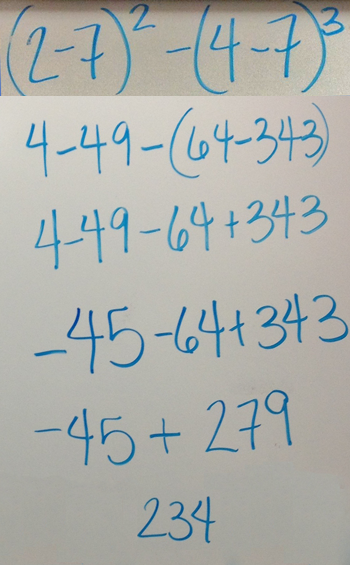
    I had encouraged everyone to chime in with their own ways to find the answer, and someone suggested that I do the exponents first. They coached me to write this:

    Alas, we had yet a different answer than the first two.

    This is a common mistake. But I was hoping that through other experimentation they would see how we could fix this.

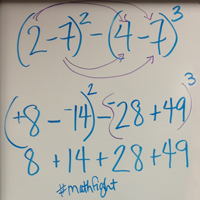
    Someone else pointed out that we could FOIL. I asked them to explain exactly what they meant by it and they told me how to draw the arrows:

    By the time we stopped, the class was in a full out #mathfight. Some students believed we needed to handle the exponents first, then do FOIL and others thought we should keep the exponents on the bits after we used FOIL. We decided to postpone this version until we worked out some of the others.

    The use of FOIL here doesn’t work because the two binomials are being raised to a power. Furthermore, they are being subtracted, not added.

    Goal #2: Compare this to working with variables.

    The comparison of real numbers to variables has three main points:

    1. Variables represent numbers.
    2. Any math rules you can apply to numbers you can also apply to variables.
    3. Any math rules you end up using on your variables, must also work with numbers.

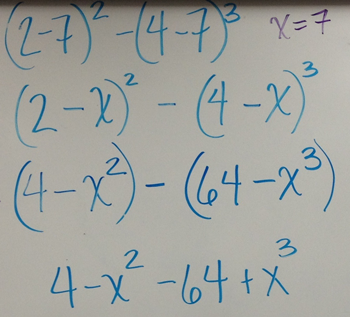
    To help illustrate this, I removed the 7’s in the problem and replaced them with x’s. Our initial tries were interesting.

    This experiment, as suggested by the students, applied the same “method” of squaring the inside pieces as one of the purely number versions above:

    At which point, someone suggested that we subtract 4 from both sides.

    Line #3 here is incorrect. Also, there is no “both sides” because there is no equals sign.

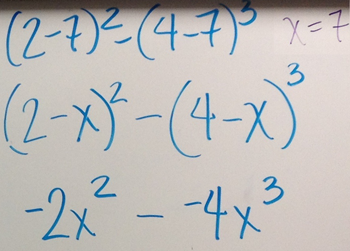
    We went to another part of the board to start over and give it a try like this:

    Here it was suggested that we set x=1.

    Since x=7 (by the design of the problem) it doesn’t follow that x=1. I believe the student was remembering graphing an equation where x is the dependent variable. Also, note that the last line is merely a permutation of the symbols in the expression – it is not equivalent to the previous line.

    Goal #3: Learn to experiment with the math rules to discover how things work.

    We have a rule in class:

    Until you decide differently, everyone is wrong. Even the teacher and textbook.

    So I don’t tell them when the answer is right. The skills they are learning are the middle of problems they’ll be solving in the future. They’ll never get confirmation that what they are doing is right or wrong.

    There’s no back-of-the-book solutions for the middle of a calculus problem.

    Checking themselves, and having confidence in the answers that they have confirmed, are vital.

    And yet they get highly frustrated with this.

    Why? Because they’ve been trained that they should follow the rules and the teacher or back-of-the-book will tell them if they’re right.

    And I’m refusing to play that game.

    The full and complete math rules, that go with those above, are:

    • Whatever you add to one side, you must add to the other, when you have an equation, not just an expression with no equals sign.
    • FOIL when you are multiplying two sums, not subtracting them.
    • Distribute exponents over products, not sums.
    • PEMDAS works only when you know what each term really means and how to use them.
    • Plug in 1 for x (then 0, then -1) when you are graphing an equation where x is the dependent variable.

    But those last bits – the ones in bold-italics – those are ignored. They see an exponent outside of a set of parenthesis, they want to put the exponent on the inside pieces. They see two sets of parenthesis, they want to FOIL.

    Handing out rules don’t work. Because students aren’t ever allowed to understand the rules in their entirety.

    Thoughts? Share them in the comments.

    Related articles