If you aren’t a “lifelong learner,” well, bummer for you. Because you’re dead.
But what exactly does it mean to learn?
What does real learning look like?
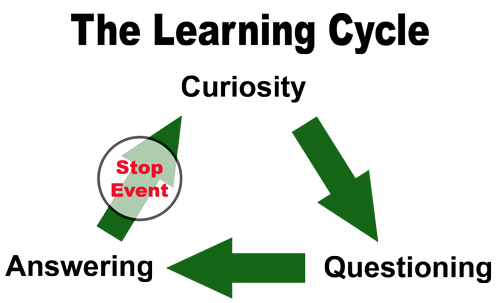
I’ve been watching people learn for over 20 years. Everyone goes through this learning cycle:
Curiosity
It all starts when you get curious.
“Hmm… I wonder…”
Questioning
And then you form curiosity into words.
“What is that?”
“How does it work?”
“Why?”
Answering
After the question is out there, someone answers it.
“What is that?”
“It’s a flower.”
You might answer it yourself. Or someone else chimes in to offer an answer.
And the answer could be all sorts of things.
The “right” answer (something that’s true)
The “wrong” answer #1 (something that’s false, but sounds good)
The “wrong” answer #2 (something that’s false, and obviously so)
The “I don’t know” answer (an open ended un-answer)
The learning cycle can continue.
After obtaining some sort of answer, you decide if you should go on or stop. Continued curiosity causes you to go through the learning cycle again. You start searching for deeper meaning.
“Hmm… What is that?”
“It’s a flower.”
“Oh. It’s funny looking for a flower. Hmm… I wonder…”
…
And the learning cycle can hit a stop event.
If you have enough information to satisfy your curiosity, you’ll likely stop the learning cycle. (Even if the answerer is ready to give more information.)
“Hmm… What’s that?”
“It’s a flower.”
“Oh. It’s pretty.”
But sometimes the stop event is damaging.
If you obtain an answer in a way that oppresses your natural curiosity, you’ll also stop.
And here’s where trouble starts.
“Hmm… What is that?”
“Really? Are you blind? It’s a flower.”
Or
“Hmm… What’s that?”
“We already went over this. It’s a flower.”
And if you encounter a damaging stop event, you’re likely to internalize it. You’re also likely to avoid that curiosity again.
What is your experience with your learning cycle? Share it in the comments or on twitter/x.
We don’t teach each new math skill just to have something to do during the next math lesson. And yet textbooks make it look like we do.
Math skills are presented in bubbles called sections. The section doesn’t show how the math rule being taught connects to past or future lessons. Nor does it point out what previously learned skills or rules are currently being employed.
Okay, it might note that this section is similar to the others in the chapter. But how often do you see a section point out how you’re going to use the skills you learned in a previous course?
Kids rarely understand that each level of math is taught so that the tool that’s being practiced can be used later – in another math lesson or math situation.
They don’t see the long term growth of math skills and math maturity – their math toolbox.
Math skills are tools.
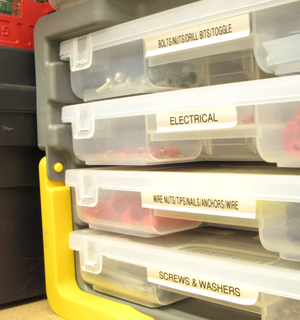
Take a look in any man’s garage and you’ll see a plethora of tools.
Point one out and ask the owner these things:
What is this?
Under which situations will it function (and under which won’t it)?
In what situations would it be helpful to use?
Do you have the confidence and ability to use it when you need to?
Have you ever used it when there was something else that would’ve worked better?
Chance are, he’ll have thorough answers for 1, 2 and 3. And for number 4 – he’ll look at you like you’re nuts and say, “Well, yeah!”
For number 5, he’ll say, “Well, of course. Sometimes I’m not sure what will work best, so I just pick a tool that I know can work. If it turns out to not be the best tool for the job, it’s no big deal. It might have taken a little longer, but it still got the job done.”
Tools accumulate – and add to each other.
Mr. Garage Owner didn’t collect a whole bunch of tools that he’s clueless about. He likely wanted to build one thing and realized a tool could help. So he bought it.
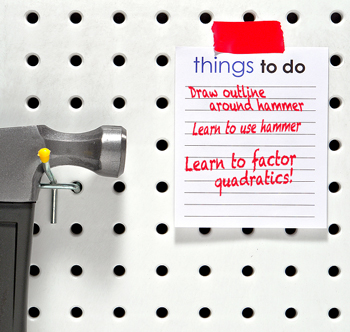
He learned how to use it, then hung it on the wall. Probably on a pegboard with the shape of the tool outlined.
Then he wanted to fix something else. He could have used his tool, but if he had another tool as well, it would make it even easier.
So he bought another tool.
Together with the first tool, he fixed his gadget then hung the new tool on the wall.
He continued this way until his pegboard was full and he was building more tool storage space in the back yard.
Now he knows each tool, when and how to use them, and confidently pulls them out each time it’s necessary.
And if he chooses the wrong tool for the job, he gets over it quickly.
Teach math like the kids are accumulating tools.
When you start a new section in your math lesson, review the math rules that they previously learned. Show how the newest problems may (or may not) be solved with the old math skills alone.
Present the new skill or math rule thoroughly. Be clear on what it is, how it can be used and under what circumstances. Also point out where it can’t ever be used. Like “adding to both sides” can’t work when there’s no equal sign.
Point out some areas where the new math rule might be helpful. Point out some areas where the new rule might not be the best for the job, but it would still work.
Show how to use the new math rule along with the old rules (pointing them out everywhere) to achieve results.
Have them make a list of all the math skills they’ve learned – a pegboard outline – so they can be kept handy.
Let them play.
Math is typically thought of as the subject where “there’s only one way to do it.”
BAH!
Just like Mr. Garage Owner, using the non-optimal tool for the job still gets the job done. As long as it works (can’t run an electric drill in the rain, after all).
So let them play. Turn your math lesson into a time where they can use any math rule they want. Let them discover their own confidence in choosing tools.
And let them try out tools that might not be the best for the job.
As they grow their math toolbox, they’ll grow in math maturity and confidence!
I just learned what the phrase “differentiated instruction” means. Jeanette Stein told me on #MathChat that for her, differentiated instruction is
Meeting kids where they are at to take them where they can go.
I love it!
So I read the article Jeanette shared from Teach-ology. Seems differentiated instruction is a fancy term for focusing on the individual students rather than the teacher.
I’ve been doing it for years!
The first few semesters I taught math (back in 1996), I would lecture. I mean straight up, lecture. But soon I learned that it wasn’t about me.
Over the next 16 years I watched the students. I quit spending so much time and energy on preparing lectures and much more time and energy thinking about the comments and questions I got from the students.
I learned that many of the “math rules” were merely tricks some clever person thought of as a mnemonic device. And that if these tricks are forced on certain students, they’ll likely never understand what’s really happening.
And most importantly, I’ve learned that creating a safe and inquiry based learning environment is the key to differentiated learning.
And there’s more!
In considering my classroom experiences, I’m finding many other instances and examples of differentiated instruction. So this is the first in a series on tactics to improve your own differentiated classroom. Here are the proposed topics/titles:
Eliminating the Fear – How to Engage Students without Calling on Them
Show Your Work! – What’s up with that?
Grading in a Differentiated Classroom – Why Teaching Math Is Harder than Giving Birth
“It’s Your Education!” – How to Empower Your Students
If Shakespeare Taught Math – How to Use Metaphors to Teach Math
If Picasso Taught Math – How to Use Drawings to Teach Math
How to Teach Your Students to Think Like a Mathematician
Wow – that’s rather ambitious of me, isn’t it?
I’ll shoot for these once a week and you can find a link to the series (this article) in the sidebar under “Quick References.”
If you have any requests or ideas, let me know in the comments. And don’t forget to share this series with your PLN on twitter!
This idea was inspired by something Tom with Leaving Work Behind wrote in an article about success months ago. He wrote:
Principles are timeless – techniques are not. Would you rather I give you a fish, or teach you to catch your own?
Here’s a week in the lives of Tom and me… “fishing”…
Monday
Bon: Hey, whatcha doing?
Tom: I’m fishing.
Why?
Because I’m hungry. You can eat fish.
Bon: I’m hungry too. Will you share your fish?
Tom: Sure!
Tuesday
Bon: I wonder where Tom is. I’m hungry.
Wednesday
Bon: Hey Tom!
Tom: Hi Bon!
Bon: I’m hungry. I haven’t eaten in two days. You weren’t here yesterday.
Tom: Well, I’m fishing now. Watch how I do it and if you ever need to, you can do it yourself.
Bon: Swell!
Thursday
Bon: I wonder where Tom is. I’m hungry. Good thing I watched him yesterday. Now I can catch my own fish.
<pause> Bon: What’s going on. I’m not catching any fish. And I’m doing it exactly as Tom did! I’m so hungry!
Friday
Bon: What’s up, Tom!
Tom: Hey Bon. How are you?
Bon: I’m SO hungry. I tried to fish yesterday but I couldn’t catch anything. And I was doing it exactly like you did.
Tom: That’s strange. How about this. I’ll let you do the fishing today. Together we’ll see what you’re doing and adjust it so it works for you.
Bon: That sounds great!
Saturday
Bon: Bummer. Tom’s not here. But I was successful catching fish yesterday so I’ll have no problem catching fish now!
Sunday
Bon: Hey Tom!
Tom: How’s it going Bon?
Bon: Excellent! Hey – wanna join me for lunch? I’ve caught enough fish for both of us!
Do you really want to teach someone to fish?
There’s a difference between teaching someone to fish and helping them learn to fish. In the case of Tom’s teaching medium – his website – he can only teach. Likewise, here at MathFour.com, my writings can merely teach.
But when you’re face to face with a student, teaching isn’t nearly as valuable as helping them discover.
Indeed, if you’re going to teach a child who really needs help learning, you might as well just give them the fish.
Do you teach your kids to fish – or help them learn?
This article is based on the talk “Improving Creativity with Technology” given at the University of Houston teachHouston T3 Regional Conference.
Traditionally we give a concept or algorithm to the students and ask them to memorize, understand and use it. And by “give” I mean we serve it to them well done, fully baked, nothing left to do but eat it.
Piaget’s research (and subsequently others) suggest that allowing students to discover or create the methods is more effective than handing them the method and asking them to take it, eat it, no questions asked.
But how do you let them discover it?
Since the math we teach in middle school and high school is based on real numbers, every concept can be demonstrated with “plain” numbers. Which means it can be discovered by playing with numbers.
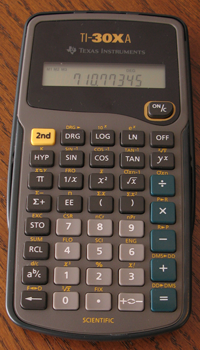
Calculators make this playing or experimentation fast – giving a student the ability to quickly see patterns and construct concepts.
Introduce the topic with numbers.
When you introduce a topic, give 10-20 “examples” of it with real numbers. Ask the students to play with them and notice any patterns they find.
Notice you’re creating an inquiry-based learning environment, an Inquiry Zone for Math Learning. Remember to maintain positive body language, ignore negativity, and super-validate what any student says.
Give the students the power!
Until the student decides differently, everyone is wrong. Even the teacher and textbook. They get to validate it for themselves – and they can do this with real numbers.
Ultimately, if they grow to be mathematicians, they’ll learn that verifying with lots of real numbers doesn’t mean “proving” it – but for the time being, this works fine.
Giving them this power lets them experiment as much as they need, and only as much as they need, to verify a concept for themselves.
Use the Play & Say method.
You’ve heard of the “Plug & Chug” method? You take a formula, plug in the numbers and chug through the arithmetic. Plug & Chug is a non-discovery based practice tool. The practice is good, mind you, but the formula is given, not discovered.
Remember, something discovered is more likely to be remembered than something given.
So use the “Play & Say” method. Each student plays with the numbers until he or she can say what the formula or concept is.
Caveats
If you’re trying to teach a concept with this and one student discovers a different formula or concept. Run with it – as long as it’s mathematically sound. Don’t discourage the discovery of anything, even something not on the current curriculum.
If a student gets frustrated, don’t force them to discover it themselves. Give them the concept or formula and encourage them to experiment later with it.
Suggestions
If you find there is a big difference in how much time each student takes, send the experiments home with them. Give them five minutes at the beginning of class to play – the students who realize they need more time will have done more the night before.
How will you do it? Share your thoughts and experiences in the comments.
In a previous article, I suggested two ways to introduce inquiry-based math instruction into your teaching structure. One of them was to create a safe discovery environment – an Inquiry Zone. This is where students could ask anything and not be held responsible for performance.
It can be a location or a time – or both. It can be announced or understood.
As the facilitator, here are some things to do to create the safe Inquiry Zone.
Maintain positive body language.
When a student asks a question, make sure your body language and facial expressions say, “Wow, that’s a very smart thing to ask.” Do this regardless of how you feel about the question personally.
Ignore negativity.
If other students laugh at a question, ignore them. Instead validate the asker and the question through words and body language. Chastising the negativity only validates it.
Super-validate every question.
Follow up every question with a similar or extended question. If you can’t think of one, say, “That’s really interesting. Let’s write it down so we can look it up on Google later.”
Post the rules.
Set up rules so that all the students know what inquiry really means in math. The rules I use are:
Until you decide differently, everyone is wrong. Even the teacher and textbook.
Every question is a great question.
These two rules build confidence. Not in getting the right answer, but in deciding what it means to be a right answer. If a kid gets to decide when the answer is right, they will ask more questions. Inquiry!
Be wrong – often.
Modeling this “wrongness” makes kids comfortable with it. The more comfortable they are with being wrong, the more likely they are to engage in inquiry.
You can be wrong by not knowing something or actually doing a problem wrong (doing your arithmetic wrong, for instance).
If you are normally perfect, fake it. Mess up. Do it for the kids.
Destroy the back of the book.
I’m not sure you can get away with this without being fired.
If you don’t mind getting fired from your teaching job, or if you homeschool, get the kids to rip out the back of the book – you know, the part with all the answers in it. And don’t let them talk you into letting them “check their answers” on the calculator. That’s just as damaging.
The more they get to decide if their own answer is right, the more they will ask. The more inquiry will happen!
Inquiry-based math instruction is the opposite of performance-based math instruction. And the research shows that inquiry-based math instruction is more effective than performance-based.
But performance is required if you’re teaching anywhere other than a homeschool. So what do you do?
You have to balance the requirement of performance with the need for discovery and inquiry-based learning. Which means you have to integrate discovery and inquiry-based elements into your math teaching.
You can do this formally or informally. You can say it out loud, or just do it. And which method you choose will depend on how much you are supported.
Set aside time for inquiry-based instruction.
Bring inquiry-based math instruction into your lessons by breaking up class time into “performance-for-tests learning time” and “discovery/inquiry-based learning time.”
You can have specific topics for the discovery learning time or even a “free math time” where there is no specific topic.
Make sure you keep the discovery topics independent from test based/performance-based topics. As much as you’re tempted, don’t connect the two. If the students connect them, acknowledge it briefly and keep moving.
Keeping them separate keeps the “must get the right answer” attitude out of the discovery time. This is very important.
For example, if you’re teaching multiplication this week in class, set aside the discovery time as patterns or geometry. This can be 5-10 minutes at the beginning of each class period or one day of the week devoted to it.
Create a safe discovery/inquiry zone.
If you want to include discovery in the regular curriculum, you have a little bit more of a challenge. Children learn early that performance is required in math classes. So they avoid being creative and asking questions. (See the research paper on that here.)
Which means you have to undo years of creativity-destruction to get them to participate in inquiry based activities. Depending on the students’ ages, you might have to start with introducing really goofy stuff to break them out of their comfort zone.
Let them wear fuzzy red hats and crazy glasses and tell tall math tales for the first few times. They’ll get warmed up to dig into some creative math inquiry. Anything’s easy when you’re wearing fuzzy red hats!
After a while they’ll be used to the safe environment and the inquiry-based math learning will start to flow from them.
Do both.
Ideally, you can have a “fun” time – where the math you have to do is set aside and you let the students dream about crazy math stuff. In addition, all your lessons involve the safe zone.
If you can make it work – do it. You’ll grow confident, adventurous, smart kids – the research supports it!
* Inquiry based math instruction is really the wrong term. Instruction means giving of something – in this case knowledge. It really should be inquiry based math learning. Teachers and parents are inquiry-based facilitators.
Feature image by philcampbell | Flickr.com | CC BY