
Tag: cognition

  • Toddlers Begin Counting at the Number 2 (not 1)

    Toddlers Begin Counting at the Number 2 (not 1)

    I had this grand idea when we got married and were hoping for kids – I would teach our children to count starting at 0.

    When Daughter was 15 months old, I decided we should start teaching to count with negatives.

    But I was wrong on both.

    And so is everyone else.

    Why do we teach toddlers to count?

    We practice counting 1-10 with our kids. We know (somehow) that before they’re official school age, they should know how to count to 10. And how proud we are as parents if they can count to 20!

    But these are just words.

    I can teach Daughter to memorize the Fibonacci sequence, but she’d no more know what that means than what counting to 10 means.

    In fact, I know this first hand because I used to count to 10 in Spanish. And I’d leave out ocho everytime!

    I saw a guy made fun of in Germany because he told a waitress he had fünf people in his party and held up four fingers. (She did it behind his back to another waitress – she wasn’t so rude to say it to his face. (Thank goodness; I would’ve had to go Texan on her.))

    We teach toddlers to count for the same reason that we teach them to say please, thank you, yes ma’am and no ma’am – because someday they’ll understand what it means. And in the meantime they can establish good habits.

    So where do they start understanding?

    Regardless if we teach a toddler to start counting with -5, 0 or 1, they start with 2.

    -5 to a toddler makes no sense. Teaching -5 to a toddler can only be dreamed up by a math teacher with no kids (i.e. me three years ago).

    0 is useless. Why would you even mention that you have zero? Maybe saying that there are zero cookies after she ate them all might work. But generally zero things can’t be seen and by the time you’re down to 0 cookies, there’s probably a meltdown in the works. And we all know there’s no learning during a meltdown.

    1 is just as useless. Why count things that are only one? They started with one mom, one dad, one dog, one couch, one bed, one bear,… Almost everything in their world is a single. The number “one” is just as useless to them as the words “the” or “a.”

    But 2 is interesting!

    Daughter was so amazed at the discovery that she had two SnackTraps. Not just the ordinary situation of a bowl of snacks but “TWO BOWLS!”

    As soon as multiple copies of things are in her world, she takes note. If you’re an identical twin, the first time your child sees you with your twin might be traumatic. My best friend is the daughter of a twin and she tells horrors stories of this discovery.

    This is an extreme, but consider all the pairs of things that kids can notice – two shoes (vs. only one that you can find when you’re freaking out and you’re late), two forks (when you’re begging for yours back from her because you’ve not eaten since breakfast), two cars (when you need to get in one and she insists on going in the other).

    And, toddlers really don’t start counting at 2. They don’t start their mathematical careers with counting at all! They start by recognizing multiples. And 2 is the first and fastest multiple.

    So what can you do?

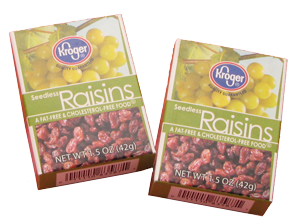
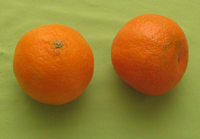
    Keep teaching your kids to count – they still need this skill, just like they need to memorize math facts. But also teach them to subitize (recognize amounts without counting them out). Hold up two of the same items and exclaim “TWO ORANGES!” Then go to another two items and exclaim, “TWO RAISINS!” Stick with one number at a time.

    Daughter is on “two,” so we’ll stick with that for a few months. We’ve got plenty of time.

    Related articles
  • Is Math a Four Letter Word?

    Is Math a Four Letter Word?

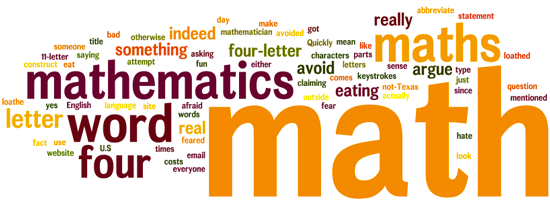
    It’s been mentioned more than a few times that ‘math’ is indeed a four letter word. Quickly after that’s said comes a look of, “So why are you claiming otherwise in your website title?!”

    I just got an email from someone asking the same question.

    Math isn’t a four letter word.

    When we type “math” we use four keystrokes. But we actually mean “mathematics” which has 11 letters. In some parts of not-Texas, outside the U.S., they abbreviate mathematics as maths. So really, math and maths are both 11-letter words!

    Math isn’t a four-letter word, either.

    The real statement of this site is that math isn’t a four-letter word. It isn’t a bad word. It isn’t something that should be feared, loathed or avoided. In fact, since everyone does it, it doesn’t make sense to fear, loathe or attempt to avoid it.

    It’s like saying, “I’m afraid to eat,” “I hate eating,” or “I avoid eating at all costs!”

    It’s something you do. You were born with it.

    Math is a four letter word.

    But indeed, yes. Math, the English language construct, has four characters:

    1. M
    2. A
    3. T
    4. H

    So I can’t really argue.

    Or I can argue all day.

    And THAT’s the real fun of being a mathematician!

    Related articles
  • Practicing Math Skills Early in Life Is a Brain Changing Event

    Practicing Math Skills Early in Life Is a Brain Changing Event

    Thanks to Will Summer who inspired this post with a retweet to me.

    Seems researchers have previously studied the differences in math skills among children vs. adolescents and grownups. Dr. Vinod Menon with has done new research on early math training that focused on kiddos who where merely one year apart.

    Turns out that in one year of math, the brain changes quite significantly!

    You can integrate early math learning into just about anything.

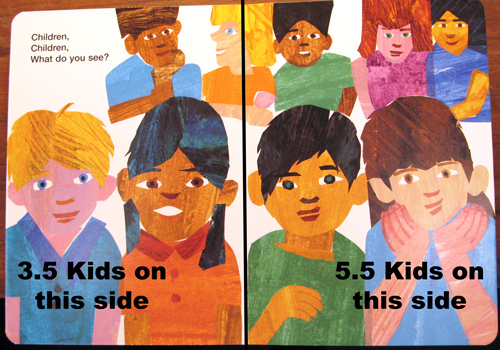
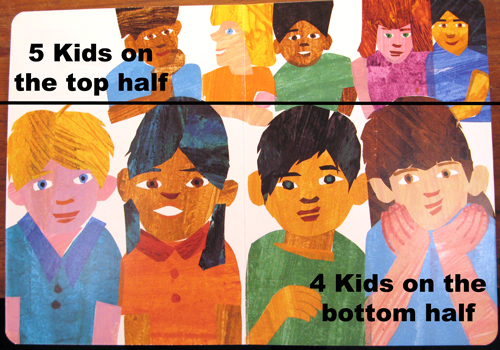
    Daughter is heavy into Brown Bear, Brown Bear by Bill Martin, Jr. and Eric Carle. This is not a math book. Nor does it pretend to be. But I’ve found a way to use it to develop math skills.

    When we arrive at the page with the children, we practice counting the kids. First in one direction, then in the other – as direction matters to kids. It isn’t inherent that if you count one way you’ll get the same number as if you count the other way.

    Sometimes we’ll count the top row of children and add it to the number of the bottom row. We can practice the commutative property by adding 5 + 4 = 9 and the adding 4 + 5 = 9.

    As an alternative twist, we’ll count and add the kids on the left page to the kids on the right page. This one gets fun, because that little blond girl is half and half!

    So we can now add fractions and practice the commutative property at the same time!

    What else?

    With Dr. Menon’s research, we now know how important it is to get started early with math learning. What other things can you do to start teaching math skills early?

    Related articles
  • How to Tell if Your Child Is a Top-Down Learner

    How to Tell if Your Child Is a Top-Down Learner

    Does your child struggle when you put him down in front of his math book? Are you frustrated in your attempts to get him to do math classwork or homework?

    Maybe he’s a top-down learner. If so, you might not know based on his current “regular” work. It will help in his education if you know he needs the big picture before the details – or the big theories before the steps.

    I remember learning to do derivatives when watching the foster kids that lived with us. I was eight. I’m a top-down learner. Here’s how to find out if your child is one too:

    How the “green beans” con works.

    My mom used to leave green beans open in a can on the table. We would walk by and eat them. If she put them on our plate, we would refuse them. So she got us to eat vegetables without asking us to, by just making them available.

    You can use the “green beans” con as a test.

    For math, put out the harder stuff. Find some books at Half Price Books or someplace cheap in your area. Open up the book. Sit and do some of the math yourself while mumbling aloud. Then walk away.

    If he sees his folks (or older sibs) working through those problems, he might be interested. Watch to see if he goes up to the book to check it out (steal a green bean). Be available to answer questions if he asks.

    If he can grasp some of  that “higher level” stuff, he’s probably be a top-down learner. He won’t want the building blocks until he sees the plans for the whole house. This could be the cause of some of the struggle and frustration – he’s been given the building blocks instead.

    Let him have the big stuff – start “allowing” him to do more of the advanced books. He’ll back up on his own to learn the “lesser” stuff so he can understand the big stuff better. You won’t have to force the work on him anymore.

    Share your experience with your top-down or bottom-up learning in the comments!

    Related articles
  • An Observation of Cardinals and Ordinals at the Playground

    An Observation of Cardinals and Ordinals at the Playground

    We were hanging at the playground on Mother’s day. Daughter had taken up with a cute little girl – a good playmate for the teeter-totter. I watched Daughter’s new friend do something interesting. She was “counting” some gumballs that had fallen off the sweetgum tree.

    Here’s what she said: ONE TWO THREE FOUR FIVE SIX SEVEN EIGHT

    I looked and there were ten gumballs. I watched her more and saw that while she was reciting the terms and pointing at the gumball pile, she wasn’t associating each number word with the next gumball in the pile.

    Developmentally, I’m not sure if this is okay or not. I wonder.

    Mathematically, I know that there’s still a disconnect with this girl and what numbers mean to her.

    There are two types of numbers.

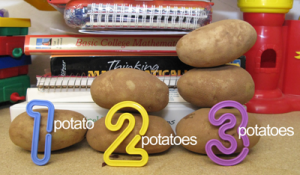
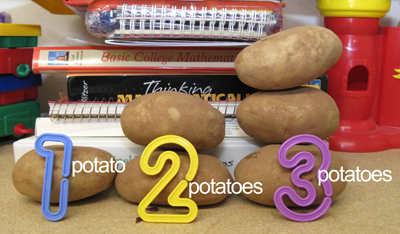
    In the realm of counting numbers, there are two types. Cardinals and ordinals. A cardinal number tells us how many we have. Like this:

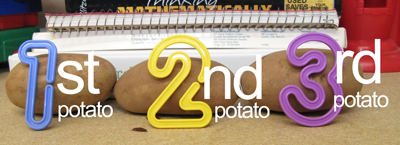
    And ordinal number tells us the order:

    When we count, we use both types of numbers.

    The group of gumballs has the cardinal number of 10. But to arrive at that cardinal number, to determine how many there are, the friend had to “order” them. She was trying to point to each one and assign it a position. “YOU, I label 1st, you are 2nd … and since you are 10th, I know I have 10 gumballs.”

    We grownups take advantage of this procedure. Indeed most people don’t know what cardinals and ordinals are.

    But knowing this when you teach counting is quite helpful. At home you can do something similar to the potatoes in the pictures above. At school, you can buy some great posters (I found one at Teacher’s Heaven last night) that demonstrate this.

    Will you change the way you think and talk about numbers?

  • How to Train the Brain to Understand the Transitive Property

    How to Train the Brain to Understand the Transitive Property

    Remember the ol’ “if A equals B and B equals C, then A equals C” deal? At parties it’s a great line to drop. In math, it’s officially called … cue music…

    The Transitive Property

    Saying it is fun, teaching it is curious, learning it can be weird.

    Grownups think it’s intuitive. But to a kid, it isn’t. It takes experience and experimentation to learn all the bits that we think are “common sense.”

    The transitive property is really thinking things through. Starting from one place and moving along through another and then arriving at a third place.

    There are many ways to help kids with this learning. Word problems simulate thinking stepping stones. But they can be rather stressful. If you do it through play, you reduce the stress that they face and give them skills they need to tackle advanced thinking, forever.

    This video shows a nifty “toy” from Discovery Toys that can get kiddos using those brain stepping stones.

    Notice the flow is

    1. Choose the number tile with the question number.
    2. Read and answer the question.
    3. Correspond the answer to the letter in the answer box.
    4. Put the number tile with the question number in the corresponding letter box.

    Thinking through from question number to answer letter while avoiding the pitfalls is the challenge.

    Have you played with these? How do you train your kids’ brains for the transitive property?

  • Two Reasons to Memorize Math Facts

    Two Reasons to Memorize Math Facts

    I learned my math facts by “singing” them while looking at flashcards.

    Having these facts ingrained with chanting or singing isn’t a bad idea. It might not “feel right” because we’re so into experiential learning these days. But if a kid can’t immediately access and use things like 8 x 7 = 56, he’s going to be slower than if he can.

    And if he’s slower, he might get frustrated and start to think that he’s not good at math.

    Also, knowing these cheap and dirty math facts helps with confidence. Even if a kid’s struggling with other things in math, knowing that he has this one thing (the “facts”) will help out.

    I fight this battle often. Some people feel that math facts shouldn’t be memorized. But there’s so much value in it.

    How about you? Which side of the fence are you on?

  • 5 Phases of Learning Math

    5 Phases of Learning Math

    This post is an answer to a question Michelle, a high school math teacher, sent. She writes:

    I explain a new concept then give an example and finally do an example with the class directing me on how to solve. What I have noticed is that the bulk of the questions occur during or after the chapter assessment. Most of the students’ questions are great questions. It’s just that the questions they are asking are ones they should have asked much earlier.

    Think of knowledge as a bag of shapes – all of which have different colors and textures. Once you get the bag, you have to sort through them. Some people want to count them, some people want to sort them by color, some by shape. Some people need to sort by texture. Some people need to sort by all three or just lay all of them out in rows to get a good look at them.

    Everyone sorts the bag of shapes differently. Likewise, everyone sorts information differently.

    Turns out, the bag of shapes isn’t the knowledge. It’s merely the information. And it takes each person “sorting” it in their own way to turn the information into knowledge.

    In teaching and learning math, I’ve noticed a cycle. I’ll use the bag of shapes to illustrate it:

    1. Exposure

    Exposure is usually in the form of lecture and examples done by the instructor. It can be the first time the student has seen it or the first time in a long while.

    This is where the student receives the closed bag of shapes.

    2. Activity

    Any activity following the exposure. This typically is in the form of homework or classwork practicing the concept and problems.

    This is the “peeking into” the bag of shapes. The student gets to remove a few of them and start looking at them.

    3. Settling

    Allowing the subconscious to work. The brain does this all on its own.

    Often mathematicians will go for long walks, go to the movies, hang out with their kids, talk to non-math people or do any number of non-math things to force the settling phase.

    Children don’t know how to force the settling phase, nor do they need to. It just happens between when they do the homework and when they start to study for the exam.

    In the bag-o-shapes analogy, this is where the students dumps all the shapes onto the floor and sorts them in various ways. It takes a while to get through all the shapes and see what kinds of sorting can be done.

    4. Re-engagement

    This is typically in the form of studying for the test and taking the test. It can be a heightened emotional situation where the learner is under stress.

    This is a revisit of the concepts. It becomes easier because the settling has occurred and the information (the bag of shapes) is already organized.

    The learner at this point will attempt to modify some of the conscious thinking to best fit with what the subconscious has done. The added stress will allow them to connect with what they’ve done better – as the “feeling” state induces a different type of learning.

    5. Application

    This is using the concepts for something else. This will often be the next class or next term of the math curriculum. If you learned graphing functions, you will likely use graphing functions in the future.

    To wrap up the analogy, this might be a student realizing that the bag of shapes is needed for something – not just a random bag of shapes. Therefore he can re-organize them to be of use in the new situation.

    Let the learning flow.

    This flow of learning is natural. It will happen and has to happen. The only thing you can do to artificially speed it up is cycle it more often.

    The students ask the good questions, as Michelle said, “during or after the chapter assessment.” This is in phase 4 – Re-engagement.

    Instead of going through a single cycle, do it two or three times. Like this:

    1. Monday: Lecture, chapter 1 (exposure)
    2. Monday: Classwork and homework, chapter 1 (activity)
    3. Friday: Test, chapter 1 (re-engagement)
    4. Monday: Lecture, chapter 2 (initial exposure to chapter 2 and application of chapter 1)
    5. Monday: Classwork and homework, chapter 2 (activity)
    6. Wednesday: Test, chapter 1 (yes – chapter ONE; re-engagement again)
    7. Friday: Test, chapter 2 (re-engagement)
    8. Monday: Lecture, chapter 3 (initial exposure to chapter 3 and application of chapters 1 and 2)
    9. Monday: Classwork and homework, chapter 3 (activity)
    10. Wednesday: Test, chapters 1 and 2 (re-engagement again)
    11. Friday: Test, chapter 3 (re-engagement)
    12. Monday: Lecture, chapter 4 (initial exposure to chapter 3 and application of chapters 1, 2 and 3)
    13. Monday: Classwork and homework, chapter 2 (activity)
    14. Wednesday: Test, chapters 1, 2 and 3 (re-engagement again)
    15. Friday: Test, chapter 4 (re-engagement)

    What do you think? Share your experiences with the cycle below in the comments.

    Thanks to Michelle for requesting this tip. Michelle is one of only two math teachers in a rural private school. She teaches Algebra I, II, Geometry and Calculus.

    Do you have a question? Ask it in the comments section.

  • 6 Techniques to Brain Training from a Pro Brain Trainer

    6 Techniques to Brain Training from a Pro Brain Trainer

    This is a guest post by Dr. Vicki Parker of The Brain Trainer.

    If your child has always done well in math but has recently had difficulty in one area of math, such as geometry, then tutoring on specific information may be helpful.

    However, if your child has struggled with math year after year, it may be time to look at underlying cognitive skills, the building blocks of thinking. The specific skills that drive math include

    • Attention
    • Memory
    • Visual processing
    • Logic and reasoning
    • Processing speed
    • Number fluency

    If there are weaknesses in any of these areas, there will be learning struggles.

    Attention is the ability to stay focused over time.

    Attention is important for math because you have to be able to focus and attend over time to information, especially as problems get more complex. You can tell if your child has trouble paying attention if he understands the concept of the problem but adds instead of multiplies, or subtracts instead of adds.

    A simple deck of playing cards can be magic for reinforcing cognitive skills. To build attentional skills, have your child raise his/her hand or hit a bell whenever s/he sees the targeted number or suite of card as you flip through a deck of playing or Uno ™ cards.

    To further challenge your child, s/he must say the targeted card or quickly add, subtract or multiply a number to the card. To build sustained attention, add another deck of cards.

    Memory is the ability to store and retrieve information.

    Memory is important to recall number facts and sequence. What’s your child’s ability to hold on to the first steps of a problem or the initial calculation?

    If she cannot hold this information long enough to move on to the next step of the problem, progression will be difficult. She may need to retrieve previously learned information from long-term memory to execute the problems at hand.

    Try showing your child a numbered card, then turning it over, hiding the number, then have your child say the card number. Present another card in the same way.

    Next, have your child remember the two numbers and then add the numbers. Repeat this process with two new cards at a time.

    As s/he gets better, have him/her work on serially adding in this sequence:

    1. See 1st number & hide
    2. See 2nd number & hide
    3. Add the two numbers

    The child will recall last number shown (not the sum), you will show & hide another card and the child will add this new number to the previous number recalled.

    Continue, but remember: don’t add the sum number, only the numbers presented visually.

    Visual processing is the ability to see and manipulate visual stimuli.

    Visual processing is helpful to see shape, size, and relationships. We use it to see groups, understand angles, and other activities in math.

    Quick matching of similar shapes or numbers is helpful here. You can make small tweaks to this activity by sorting by size with various sizes presented and the same for the orientation of the shape – a triangle upside down or at an angle matching a triangle presented in the vertical position.

    Logic and reasoning allows us to see patterns and trends.

    It allows us to order events. You need logic and reasoning to understand bigger concepts. When we decide what’s needed and how to set up a story problem we’re using logic and reasoning.

    Practice copying patterns with young children using such items as beads or blocks. You can even have fun and have them create a pattern for a crown, flower pot border or placemat for dinner.

    For older children, start a pattern and see if they can finish the pattern. This can be easily done with building blocks and Leggo’s ™.

    Processing speed is how efficiently and quickly we can process information.

    Processing speed is very important to be able to do the basics quickly and move to second or third steps.

    To work on processing speed, try timing your child working his/her way through various paper and pencil mazes. Your child will love the competition when you make it a race between multiple participants!

    Number fluency is recognition of written numbers.

    Number fluency is a coding process normally developed by age three or four. If we are delayed with recognition of numbers, it slows us down with calculation.

    You need two decks of cards for this fun task. Deal out one deck of cards, an equal amount of cards for each player. Use the second deck to flip the target cards over.

    The players must match the number on the card, being pulled from the second deck. The first person to get rid of all their cards by matching the numbers is the winner.

    To push number fluency that is more than visual recognition, have the participants say the number before they place their card on the target card and then the game moves on.

    Conclusion

    Knowing your child’s unique cognitive profile will help you understand their performance and take you one step closer to solving their math challenges.

    The good news is weak cognitive skills can improve if targeted and trained. Brain training is a type of mental exercise, carefully designed to stimulate the brain and make lasting changes in cognitive abilities.

    The idea is to improve one’s ability to learn, rather than focusing on one concept of math. It is analogous to learning how to play an instrument (which is a process) and not just a specific song (which is knowledge or data – one concept).

    Vicki Parker, Ph.D. is the founder and director of The Brain Trainer and writes for their blog.