Tag: book

  • Math Picture Book: One Grain of Rice

    Math Picture Book: One Grain of Rice

    This is part of the Math Picture Book series.
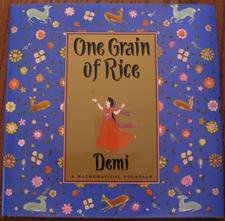
    My musical friend Christi Gell sent K8 and me a delightful math picture book recently. One Grain of Rice, by Demi, is both visually and mathematically beautiful.

    It’s exponentially better as you read it.

    And that’s not a figure of speech! One Grain of Rice is the story of a girl that asks for a simple reward for a good deed. She asks for a single grain of rice on the first day and for 30 days, double the amount of rice given on the previous day.

    I’ve heard this story told in a variety of ways, but the illustrations and scenario of this book make it appealing in ways that outshine all the rest.

    The illustrations have a gold-leaf feel about them. And Demi shows the quantity of rice very literally, down to multi-page foldouts showing exactly how many animals it takes to carry that day’s amount of rice!

    It starts small.

    Here you see her getting “help” carrying the rice from various animals on the 9th, 12th and 13th days.
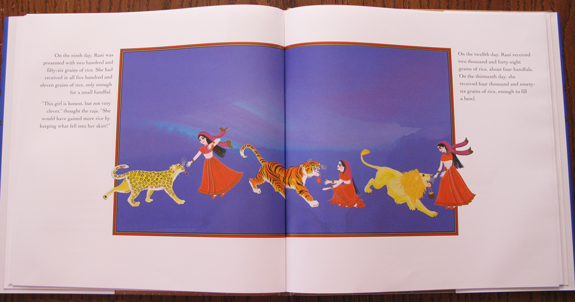
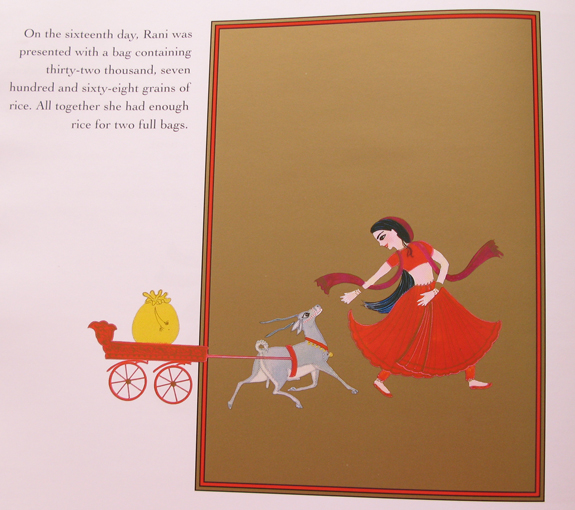
    And on the 16th day, she really needs this help!
    Soon the raja’s getting worried.
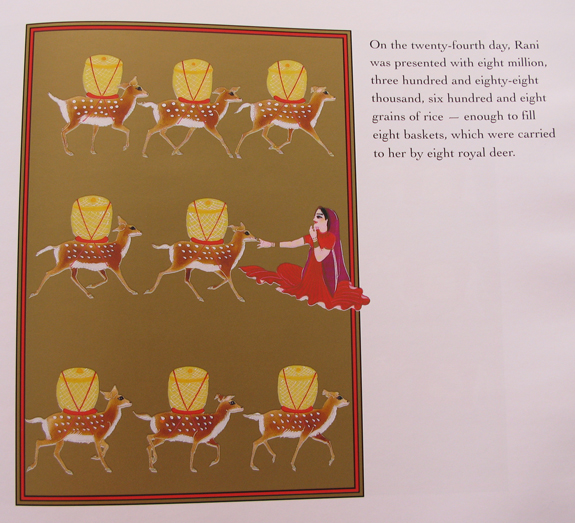
    By the 24th day, she’s needing to borrow deer from the raja to carry it!
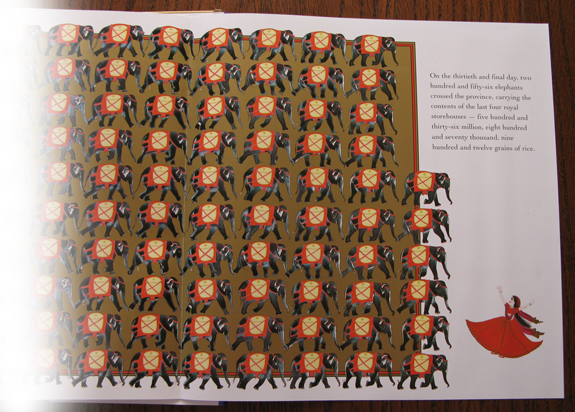
    By the 30th day, she needs 256 elephants to carry it all. And all 256 of them are shown in a gorgeous 4-page foldout!
    Don’t miss this math picture book!

    One Grain of Rice is also the tale of a greedy raja that learns a lesson through the cleverness of a girl. The magnificient illustrations help kids (and grownups) see the magnitude of exponential growth, without even putting that label on it.

    Head out now to get your own copy of the math picture book One Grain of Rice, by Demi. And send a copy to an artistic or mathematical friend too!

    Share your thoughts in the comments or on twitter/x.

    You might also like:
  • Math Picture Book: Perfect Square

    Math Picture Book: Perfect Square

    This is part of the Math Picture Book series.

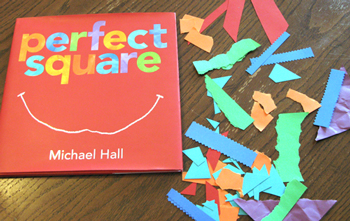
    I rounded the corner at Barns & Noble one day and and this beautiful math picture book looked me in the eyes.

    I just couldn’t resist buying Perfect Square by Michael Hall!

    And what a treat it was!

    It’s inspiration for math crafts, playing with color and patterns and talking about shapes – all in one neat little package!

    A happy little perfect square gets cut, torn and shredded over the course of a week. But this optimistic shape uses the “abuse” to make itself into new and fun things each time.

    Construction paper and scissors…

    I made a bunch of squares from construction paper to start. With each page, I replicated the images.

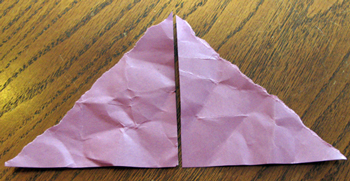
    One day the square gets cut into two triangles and crumpled up. So it makes itself into a mountain. This one was fairly easy.

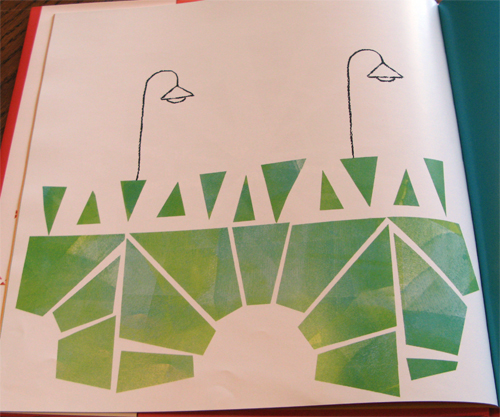
    Another day it was shattered, so it made itself into a bridge. The shattering resulted in 24 pieces – each a triangle or trapezoid. It was especially hard to do, so I’m sharing a picture of the bridge in this math picture book.

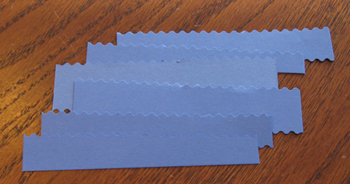
    Another day, Perfect Square was cut into ribbons with crinkle shears and makes itself into a river. Long thin “mostly” rectangles were fun to do when I found my old scrapbooking scissors.

    Are you ready to play?

    I had a great time cutting each shape and seeing how I could replicate the images in the math picture book, Perfect Square. Some were easy, some were hard.

    What can you do? What can your kids do? I’ll bet their creative minds go all over the place!

    Share in the comments or on twitter/x.
    You might also like:
  • Math Picture Book: The Grapes of Math

    Math Picture Book: The Grapes of Math

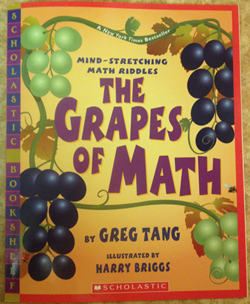
    When I stumbled upon the math picture book, The Grapes of Math by Greg Tang and Harry Briggs, I was more than a little impressed.

    This book has three great elements:

    The images are colorful and fun!

    The first thing you see in this math picture book are the bright but simple images. Looking at them you feel like you’ve stepped into the surreal world of those old View-Master reels.

    The rhymes are catchy and cute!

    I’m all about iambic pentameter. Well, I really don’t know exactly what that is, but it sounds like it means bouncy poetry.

    And that’s what this math picture book has!

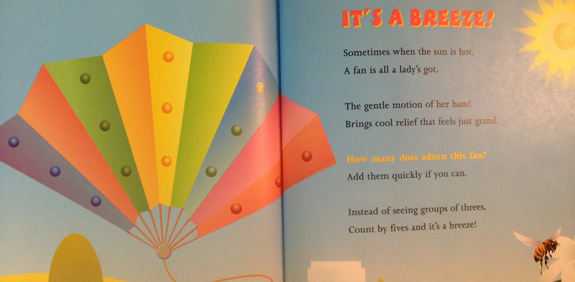
    While scallops on the beach look great,
    I’d rather see them on my plate.

    Unfortunately it’s their loss,
    They swim their best in butter sauce.

    Oh, but the counting’s even better!

    Each page has objects (fruit, bugs, dice, etc.) spread out so that children can experiment with different ways to “see” how many there are. You can subitize, group, multiply, subtract – or do them all!

    The answer key in the back helps you understand the intent of the authors.

    But I recommend you try various ways yourself before turning to the back. Some of their methods were very different than what I came up with.

    And you can try it at home!

    There are 16 different pictures and riddles to practice on. But it doesn’t have to stop there.

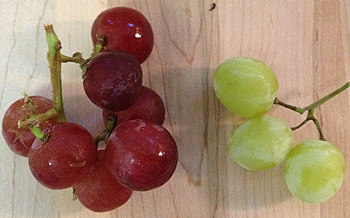
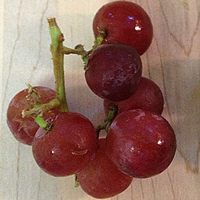
    You can do your own playing at home. Check out the grapes I did here:

    How will you use the math picture book, The Grapes of Math? Share in the comments or on twitter/x.
    You might also like:
  • Math Picture Book – Blockhead: The Life of Fibonacci

    Math Picture Book – Blockhead: The Life of Fibonacci

    This is part of the Teaching Math with Picture Books series.

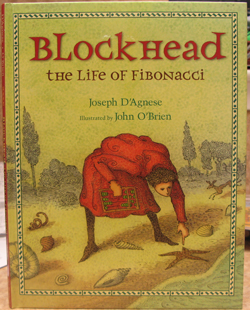
    After publishing my recommendation of You Can Count on Monsters, a reader emailed an equally compelling suggestion: Blockhead: The Life of Fibonacci, by Joseph D’Agnese.

    Armed with my new Barnes & Noble membership card, I scurried down to the bookstore to get it.

    It’s not just math.

    Intertwined in this tale of the great mathematician Fibonacci, are fun historical facts and a coming of age story.

    I learned the approximate time Arabic numerals started making their way to Italy and when the Leaning Tower was built.

    D’Agnese has Fibonacci narrate the story. Through his eyes we see the difficulties of a smart boy with moxie. He struggles, but doesn’t let the ridicule interrupt his dreams.

    And there’s plenty of math, too!

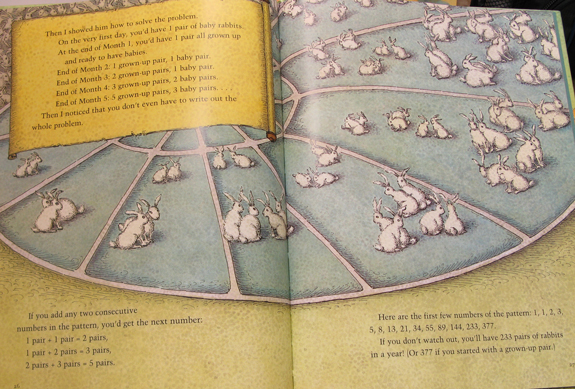
    Of course no picture book on Fibonacci would be complete without the rabbits. Illustrator John O’Brien doesn’t disappoint:

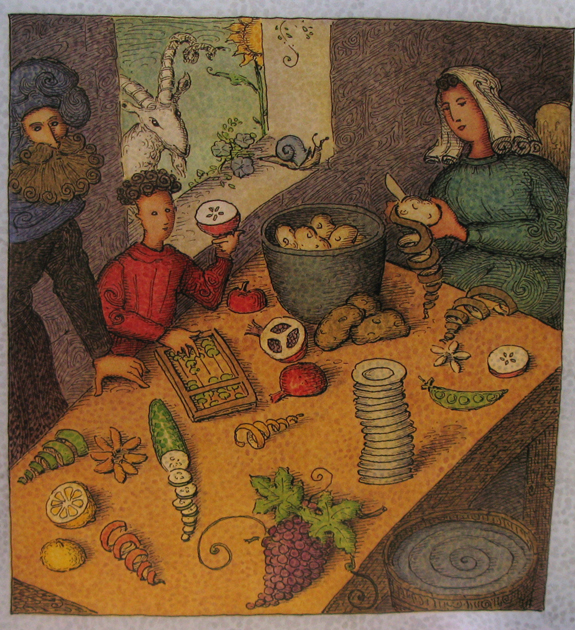
    And there’s math filtered in the images all over the place. Here’s an obvious one:

    Brilliantly, they’ve included a “Can you find…” page at the back to encourage and support children and parents in finding the beautiful countables.

    They even offer ways to find math in your own kitchen and backyard!

    Your turn…

    Go grab Blockhead: The Life of Fibonacci at your library or bookstore. Enjoy it alone or with kids – it’s great either way.

    And do share your thoughts in the comments and on twitter.

    P.S. Writing this inspired me to think of a way to remember how to spell Fibonacci. Acci & Fred were friends until one day bad Fred told a Fib On Acci.

    Related articles
  • Math Picture Book: Sir Cumference and the Great Knight of Angleland

    Math Picture Book: Sir Cumference and the Great Knight of Angleland

    This is part of the Teaching Math with Picture Books series.

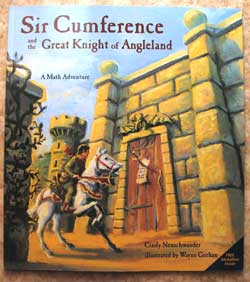
    The math picture book Sir Cumference and the Great Knight of Angleland appealed to me because of the punny title – and the promise of wordplay was certainly fulfilled!

    This fun little gem of a book is only one in a series of Sir Cumference books by Cindy Neuschwander.

    Enjoying the puns with the math…

    Radius is the son of Sir Cumference and Lady Di of Ameter. (See what I mean – the puns start on page one of this picture book!)

    He decides he’s old enough to take a quest and learns from his mentor, Sir D’grees (it’s side splitting, I tell ya!) about the missing King Lell.

    Radius is given a “medallion” by his parents to help him on his quest. No one really knows what the medallion is for, but it seems it might be helpful.

    Or at least cool to have while on a quest.

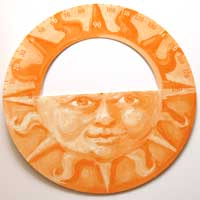
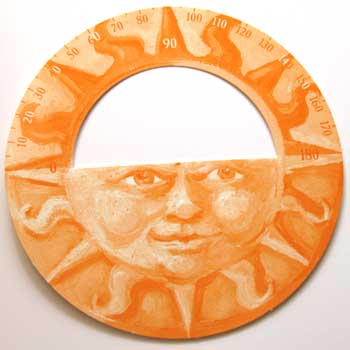
    As a treat to the reader, a laminated version of this medallion is included in the back of the picture book. It looks like this:

    More punny math fills the pages!

    Angles, degrees and all things geometry show up. And Neuschwander doesn’t write them out loud until the end, when Radius starts naming them.

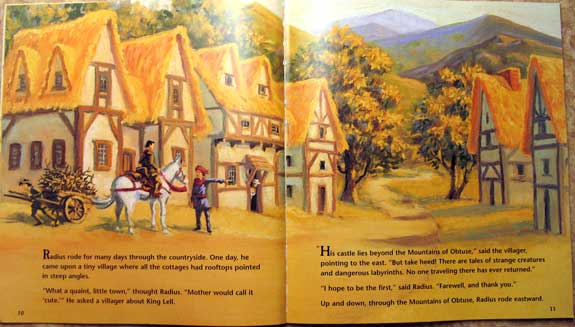
    Here you see the steep “cute” roofs of the village in the valley near the Mountains of Obtuse.

    Husband enjoyed paying attention, looking at the pictures, and trying to guess which person or thing would end up as a namesake for a geometry term. I think he enjoyed it more than K8!

    It’s worth a read – for fun or as a lesson!

    Read this picture book to enjoy (as we did) or use it to introduce or enhance your geometry lessons.

    And the final pun is the best!

    I won’t spoil it for you, though. Get it at the library or find Sir Cumference and the Great Knight of Angleland online. Read it. Enjoy it. You’ll see I’m right. (No pun intended!)

    Share your thoughts in the comments and make sure to tell your PLN on twitter!

    Related articles
  • Math Picture Book: 1+1=5 And Other Unlikely Additions

    Math Picture Book: 1+1=5 And Other Unlikely Additions

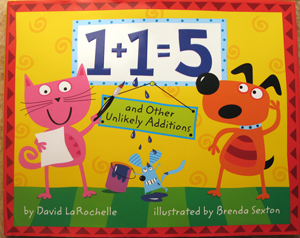
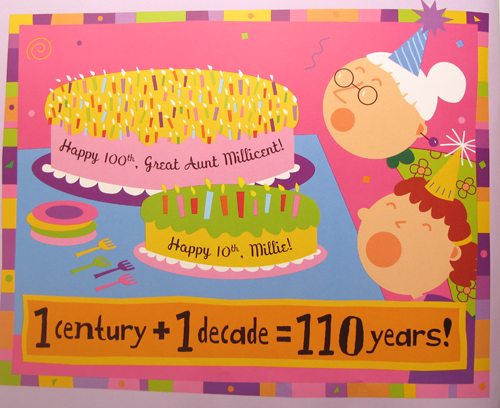
    This wonderful book caught my eye the other day in the bookstore: 1 + 1 = 5 And Other Unlikely Additions, by David LaRochelle.

    How could I not buy it?

    It’s colorful, fun and – the best part – unexpected!

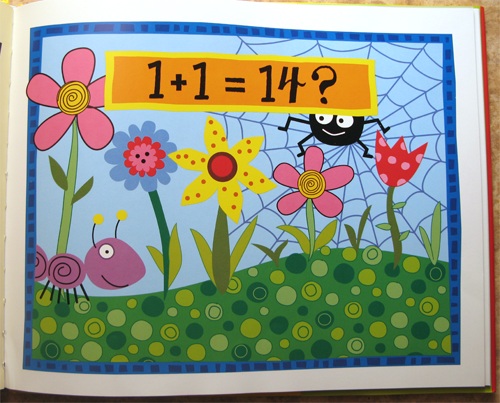
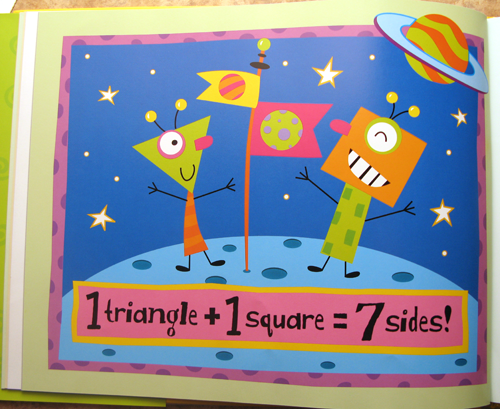
    Each page introduces a new way to look at 1 + 1.

    This book enforces the concept of units and place value. Like this page where 1+1=110.

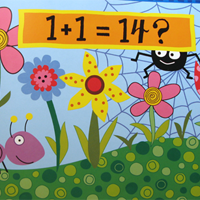
    It also gives parents and teachers the opportunity to talk about things like creepy crawlies – and their differences. Here’s a page where we see some differences in ants and spiders:

    And who could resist a discussion about shapes when you get to this one:

    When I read it to K8, Husband was enthralled. Clearly there’s fun stuff for all ages in this one!

    Click here to share this on Twitter/X. And when you find you love it as much as we do, tell everyone in the comments!

    Related articles
  • FIAR: See the World, Do the Math, Make an Apple Pie

    FIAR: See the World, Do the Math, Make an Apple Pie

    This post originally appeared on The HSBA Post on November 22, 2011.

    How to Make an Apple Pie and See the World by Marjorie Priceman is an “instructional” picture book that takes children on a journey through the world to pick up ingredients to make an apple pie.

    Lots of great shapes!

    An apple pie recipe is included in the back which has obvious math. But you can use the rest of the book for some math lessons as well!

    Here’s a set of math stimulators to share with your kids. Don’t forget that math is a discovery process; if your children are compelled to answer a question or not answer a question, that’s okay.

    Here are the questions and some hints and coaching tips for you, the parent.

    Find the shapes in the pictures.

    See if you can find circles, trapezoids, ovals and rectangles. Also identify the irregular shapes. Have your children trace them and see if they’re made up of regular shapes.

    How far is it from your house to Europe?

    Also ask: How fast will the ship have to go in order to get to Europe from your house in six days?

    How many Italian words do you think you would need to learn each day in order to speak Italian?

    How many words are there in an average Italian’s vocabulary? How many words do you need to be considered fluent in Italian?

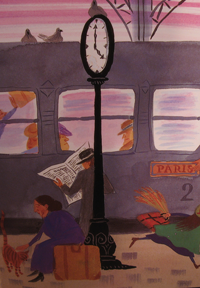
    What time does your train leave Italy?

    Notice the time on the clock.

    This one encourages children to look at the pictures as well as the text. Also ask, “How far is it to France from Italy?” And to take it farther, “What time would you arrive in France?”

    How far is Sri Lanka from France?

    Pull out an atlas or globe to get some geography lessons. Also ask, “Which route do you think is the fastest to get there? Which would be the most fun?”

    If you were to make two apple pies, how many apples should you pick from the apple tree?

    This is what many students would call a trick question. In the book, she picks 8 apples so that she and her friends can enjoy 3 and use 5 to make the pie.

    It takes some thought for a child to realize you only need 5 apples for the pie, so you’re not doubling the amount you pick. You have to double the amount for the pie (2 x 5) then add the 3 apples for the friends to enjoy.

    Looking at the recipe, how much of each ingredient would you need if you made two pies?

    This question allows them to double everything on the recipe. You can also triple or quadruple or get into fractions by asking, “What if you made one regular sized pie and one mini pie – how much of each ingredient would you need then?”

    What’s next?

    You can use the book How to Make an Apple Pie and See the World and the math stimulators in your Five in a Row math day or integrate it into any other math curriculum. Also try using the same line of questioning with other picture books you have.

    Oh – and don’t forget to share how it went in the comments!

  • FIAR: Doing Math with The Pumpkin Runner

    FIAR: Doing Math with The Pumpkin Runner

    This post originally appeared on The HSBA Post on October 20, 2011.

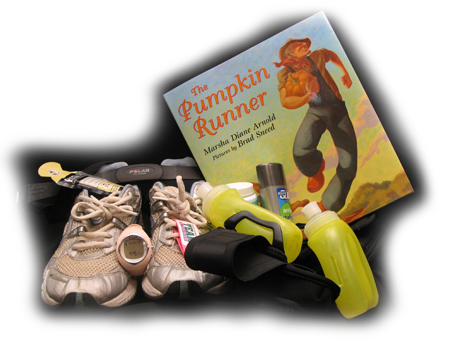
    The Pumpkin Runner by Marsha Diane Arnold (illustrated by Brad Sneed) is a sweet story about a man and his dog on a 900 km race across Australia. What’s nifty is that you can use this story in your math lessons! Below is a list of some questions to try.

    Filter all these questions before asking them of your children. Some children might find them more advanced and need some help and discussion. Others may dig right in.

    Use this downloadable list of math stimulators, if you want to give them to your kids without the tips.

    And keep in mind, math is a discovery process; you can get to the right answer in many ways.

    How old is Joshua?

    You can point out that he’d been running for 50 years and he started when he was 10 years old.

    How many generations of dogs did Joshua run with?

    When 10-year-old Joshua ran for the first time, he ran with an ancestor of Yellow Dog. The book says he started running with the “great-great-great-grandfather of Yellow Dog.”

    How old did each dog get? Is it possible that Joshua ever ran with more than one dog at the same time?

    How many pumpkins will Joshua need to run the race?

    Children might think about it this way: If one pumpkin gave Joshua enough energy to run 40 km (his very first run) how many pumpkins might he need to run 900 km in the race?

    Children can also count the number of pumpkins loaded in the Jeep. Allow your child to ponder, guess, speculate, or calculate the answer.

    What’s up with Damien Dodgerelle?

    He trained for the race for three months.

    • How many kilometers do you think he ran each day?
    • How many kilometers did he run total in this training time?
    • How long should it take him to run 900 km based on how he trained?

    How long did it take Joshua and Yellow Dog to finish the race?

    Joshua got to the finish line two days earlier than any previous winner. How many days do you think it took him? Why was he faster than everyone else?

    How much did each person “win”?

    When Joshua split the winnings, how much did each person get? If he only kept enough for new overalls and gum boots, how much do you think he might have given to Aunt Millie and Rancher Waudley?

    What’s next?

    You can use the book The Pumpkin Runner and the math stimulators in your Five in a Row math day or integrate it into any other math curriculum. Also try using the same line of questioning with other picture books you have.

    Oh – and don’t forget to share how it went in the comments!