Her question to me was, “Why wouldn’t you just rewrite the problem to focus on the appropriate concept?” She suggested that having students restate the problem in their own words without numbers would have them demonstrate that they know what is being asked of them.
Here is the original problem:
The Beebo bird lives in two places in the world. Some live in Texas and some live in Greece. Greek Beebos are about 20 inches high and weigh around seven pounds. There are about thirty-nine thousand Greek Beebos. The total weight of all the beebos in the world is 500,000 pounds. How much do the Texas Beebos weigh altogether?
Here is her suggested rewrite without numbers:
There are only two types of Beebos in the world, Greek and Texan. I know the weight of one Greek Beebo and I know how many Greek Beebos there are in the world. I need to find out how much the Texan Beebos weigh altogether.
On the outset, this seems great. If your kid does this:
It’s more likely your student will do this (especially if they’re struggling or you’re a hired tutor):
Notice the struggle and strain? And notice that both videos show the same thing – the “student” (me) just reading the problem and replacing the numbers with “I know how much…”
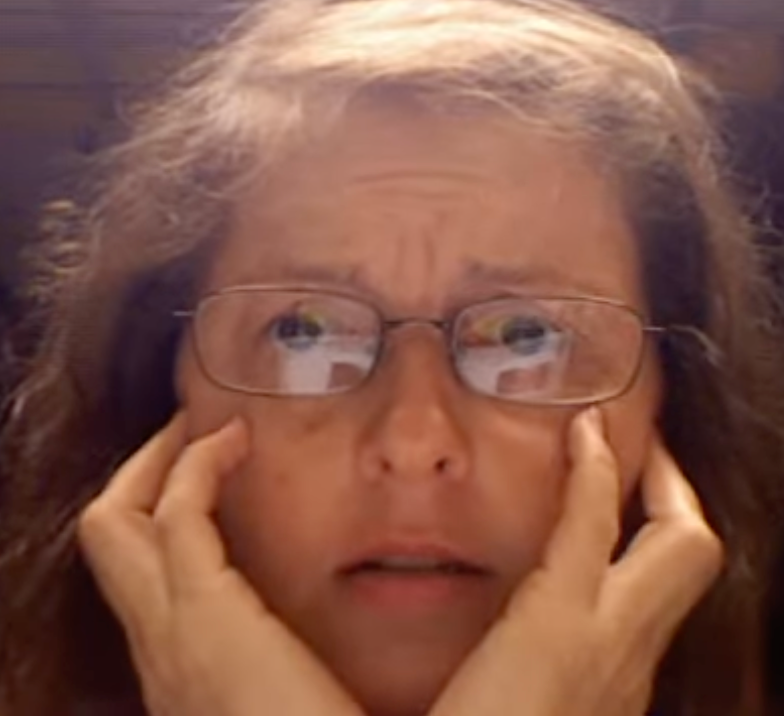
Watch students carefully. Listen to their intonations, watch their faces, watch their bodies. Whether you’re in a classroom or one on one, watch! If they got it, you can see it. If their little foreheads are wrinkled and they are tense – stop. They don’t have it. They are guessing. Go back. Try something else.
I bought a handful of math texts at Half Price Books this weekend. I opened up a Basic Mathematics text and the first thing that caught my eye was the intro titled “To the Student: Success in Mathematics.”
“Really?” thought I. As I read it, I grew more and more agitated.
Have these folks spent any time inside a math classroom? Did they pay attention to the students? If so, they should know that the likelihood of a student to do what they suggested is downright ridiculous. So why do we tell students to do it? Why can’t we give them tips that they can and will do? Like these:
If you feel comfortable asking questions in class, do it. If not, write your questions down to ask later. You don’t have to ask the instructor, especially if he or she is intimidating. Find a tutor or go to the school’s math lab instead. You don’t have to work with someone you’re uncomfortable with.
Read the stuff inside the gray boxes. We know it’s likely you’ll not read the text, but the things inside the gray boxes are really helpful.
Before you start on your homework assignment, do something physical or something you can do well. Run a mile, do a load of laundry or play tennis for a half hour. This will remind you of the things you are good at and get your endorphins flowing. It will help you be confident during your homework time.
Absorb the lectures, don’t copy them. If you can do it, try to just watch. See how the teacher thinks through a problem. You will gain more from this than from frantically trying to copy everything.
If you do take lecture notes, don’t dwell on notes that you can’t figure out. Many times you mis-copy or mis-write things the teacher wrote or said. If it doesn’t make sense, move on.
Tear out the back of this book (the part with all the answers) and burn it. It is important that you build your confidence. Checking your work with the magical back of the book just gives you a crutch. And don’t use a calculator to “check your work.” That’s just another crutch.
Do the first two problems in every section and subsection. If you can do those, do the last two. If you can do those too, continue to the next subsection. Math isn’t a spectator sport, but it isn’t an elliptical machine either. Do all the problems if you need the practice. And if you have it down, move on.
Give it a shot. Let the students know that what they want to do is okay to do. Let’s quit giving them the B.S. that’s been passed down to us over the last few decades. It’s time to go Math Book 2.0.
Whatcha think? What’d I miss? Let me know in the comments.
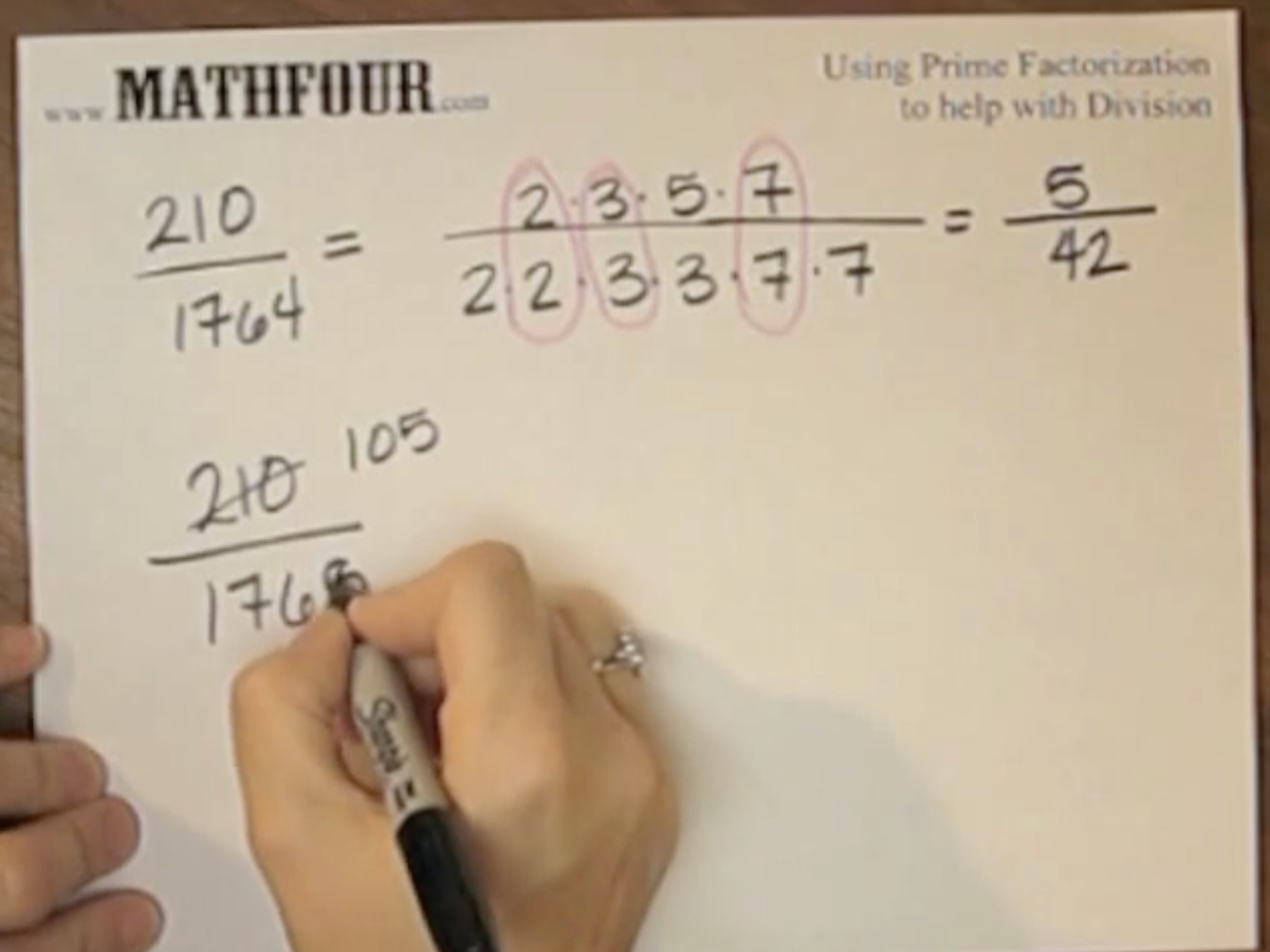
I previously posted about prime factors and about using them in multiplication. Now we’ve got fractions to handle.
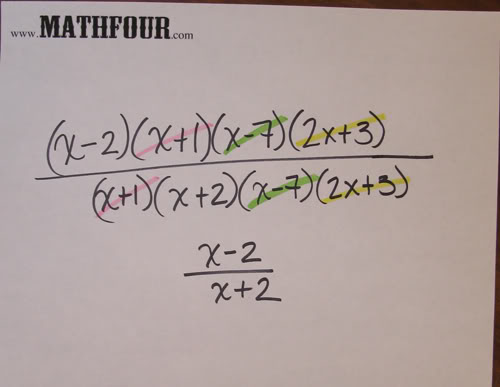
Before we get in too deep, first let me note the main reason why we do this with arithmetic. In algebra, students will be asked to take a rational expression, factor it and reduce it like this:
If they are familiar with how factoring works with numbers, this will be normal to them.
I also find that reducing factors in this neat and clean way helps a lot. In this video I showed the first few steps of reducing the fraction a sloppier way after I did it the “neat” way:
Here’s one that’s a little more complex:
Will be helpful to show your kids? Is there something I’m missing? Share with us in the comments.
This post is by request from @corrincross on Twitter.
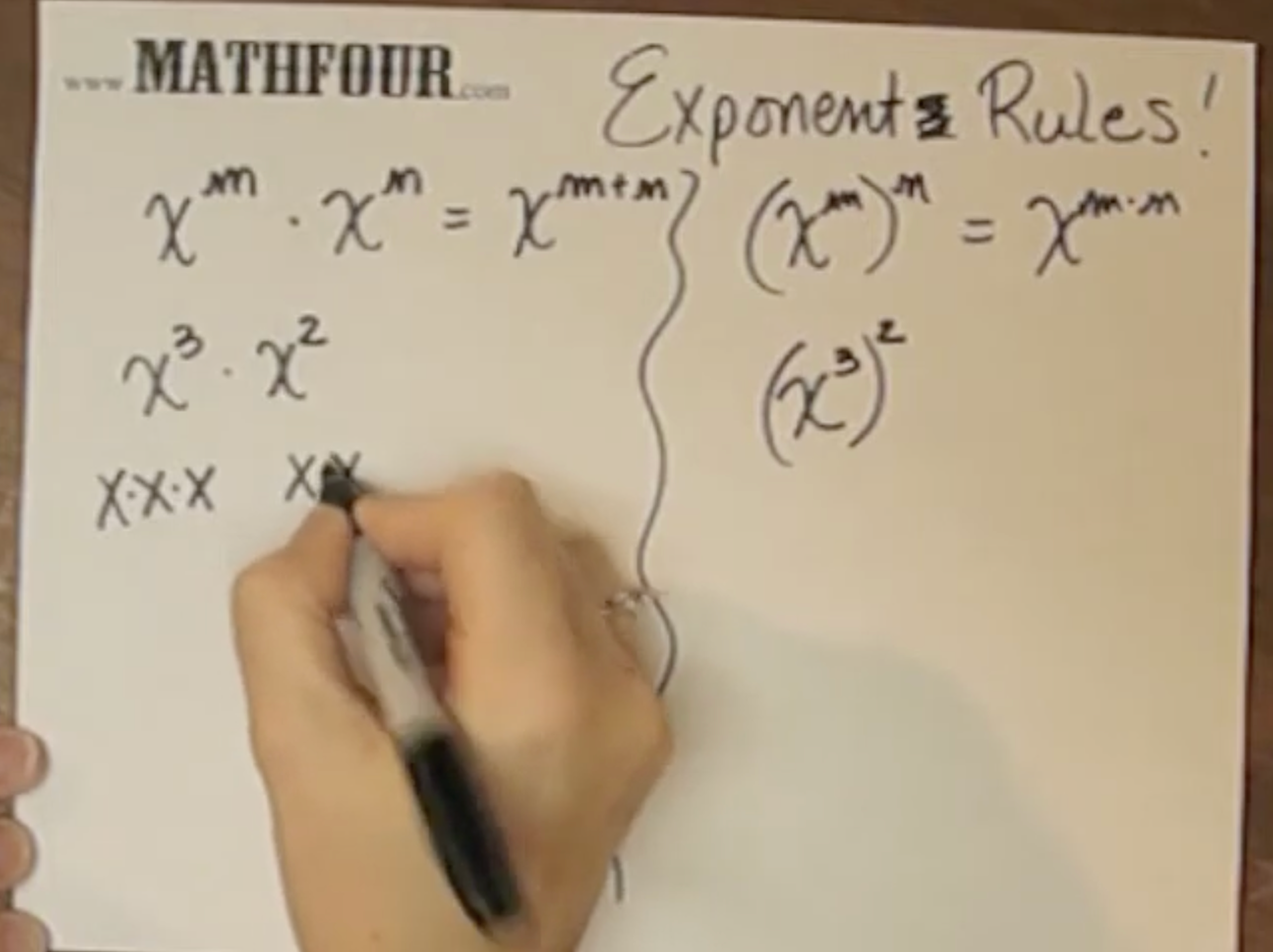
Exponent rules are hard. Well, they are hard to remember, anyhow. But there’s an easy way that won’t make your brain ooze – and that’s doing a mini-experiment each time you have to deal with them.
First remember what an exponent really is. It’s a shortcut for multiplication. Check it out:
Notice that there are really only two rules that get you screwed up: when to multiply the tiny buggers and when to add them. Here’s how I teach this (and how I remember it myself!):
So the new rules are and .
And then what about those negative exponents? Again, you can’t remember a rule unless you remember what they heck is really going on. We go back to adding in this video to explain the similarity between the two shortcuts of multiplication and exponents:
Can you use this in your classrooms? Share your thoughts in the comments.
Thanks to Corrin Cross (@corrincross on Twitter) for requesting this post. Corrin is a Secondary Ed student with a math major and music minor at the University of Regina in Saskatchewan, Canada.
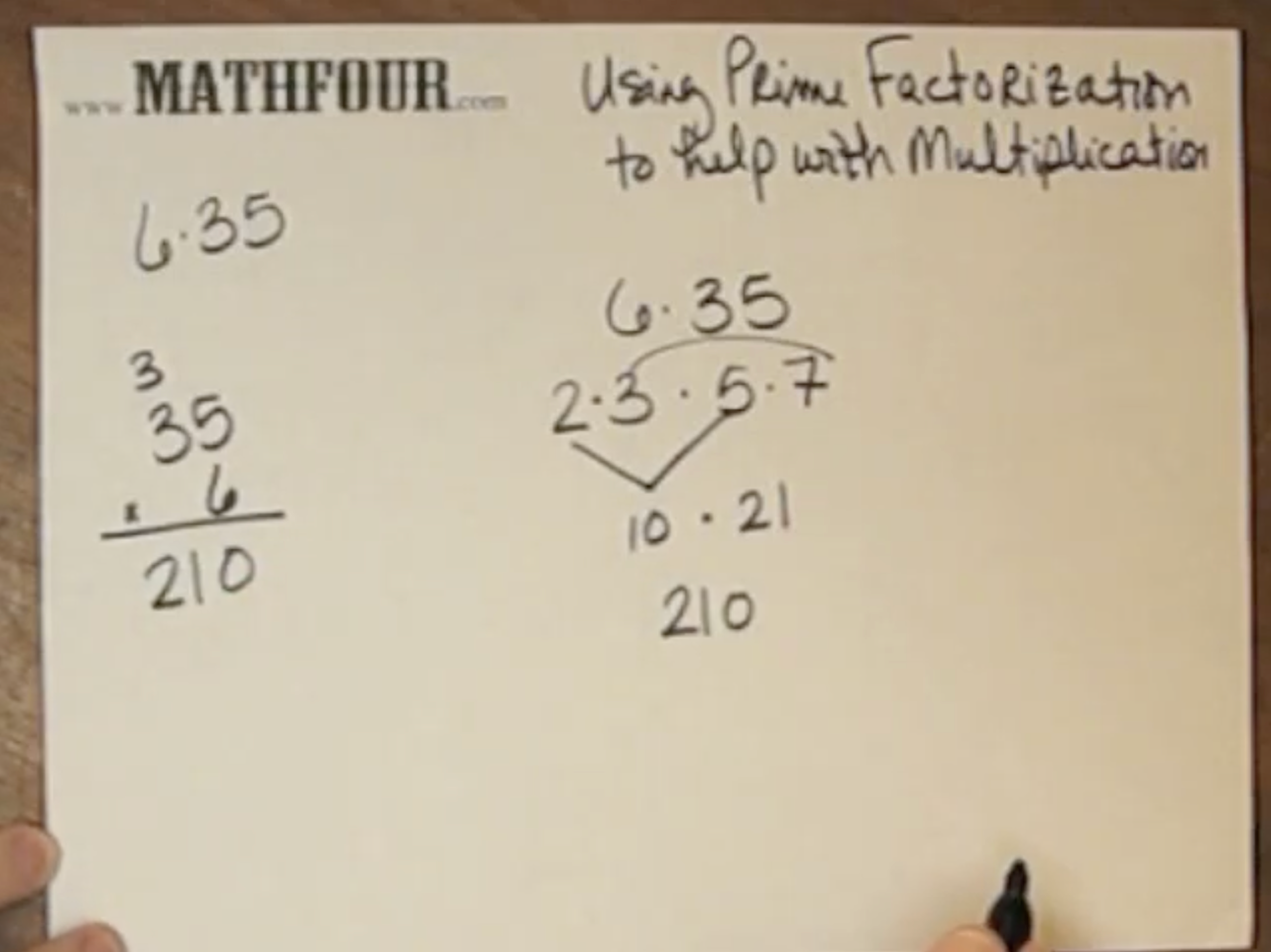
Alright, you might not win friends with this, but the more you can do arithmetic in your head… well… okay, you can’t influence people with it either. Regardless, it’s handy to know and helps with multiplication.
Here’s one that’s a little more challenging. The key is that you can combine the bits to something you’re more comfortable doing. I don’t like multiplying nines, so I avoid those.
Can you use this? Why or why not? Ha ha, just kidding – no essay questions here! – but if you do find a use for this, or if this annoys you, let me know in the comments.
Factoring is traditionally considered an “f-word” for students of math. But it sometimes has its good sides (which I’ll show over the next couple of days).
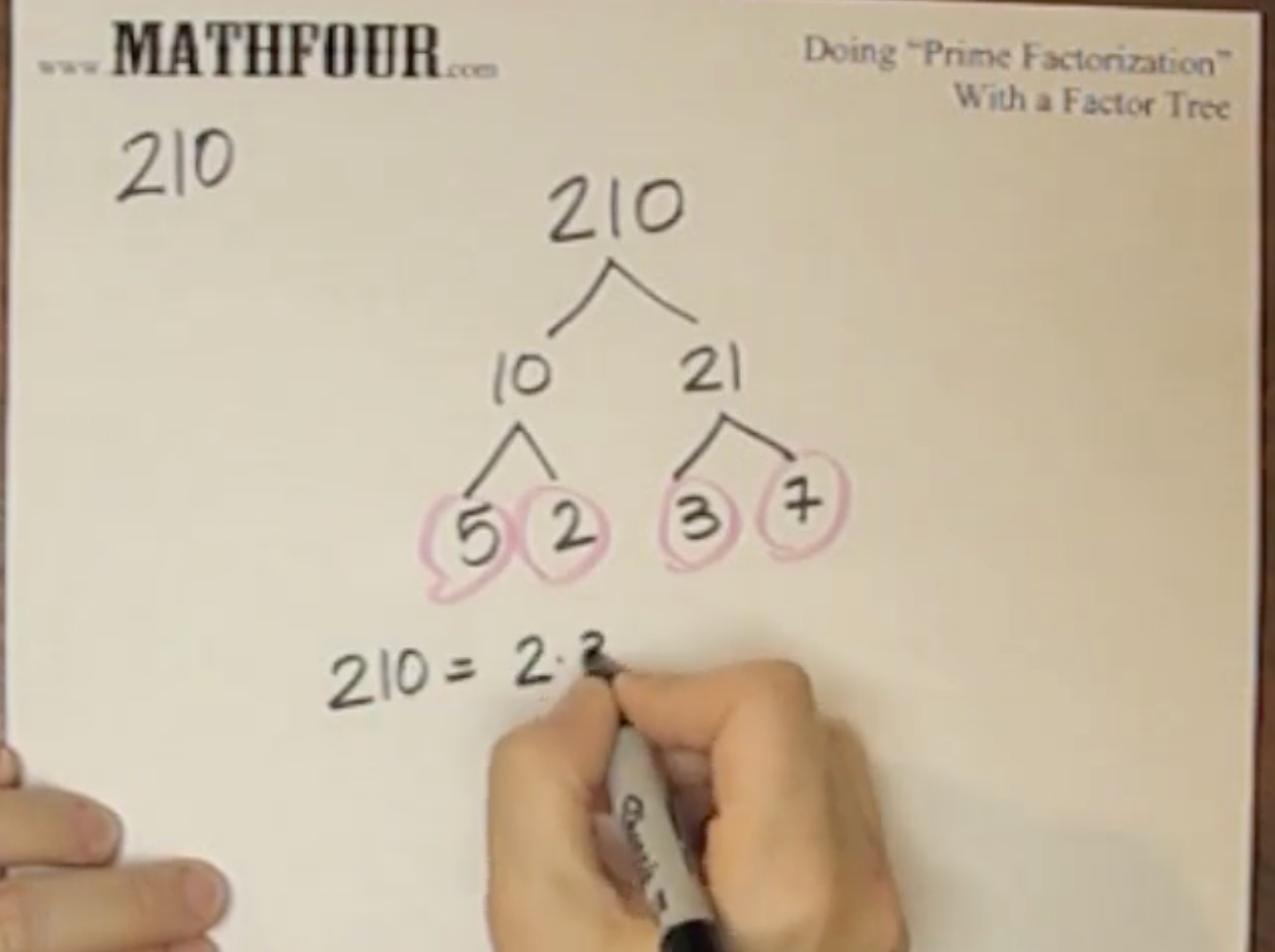
In the meantime, I’ll show the two ways (that I know) to factor numbers.
This method’s called a factor tree:
You don’t have to put the primes in order for it to be “right.” But it helps for later things.
Here’s another tree:
Here’s another way to factor using an upside division bar-type thing:
Remember, we don’t factor for the sake of factoring. This is only a tool to use when we do other stuff. You’ll see some of this in tomorrow’s post. Here’s one last example:
The way you factor is personal preference. Pick the one you like, or flip-flop. There’re no rules!
Share your preference (or a different way) in the comments!
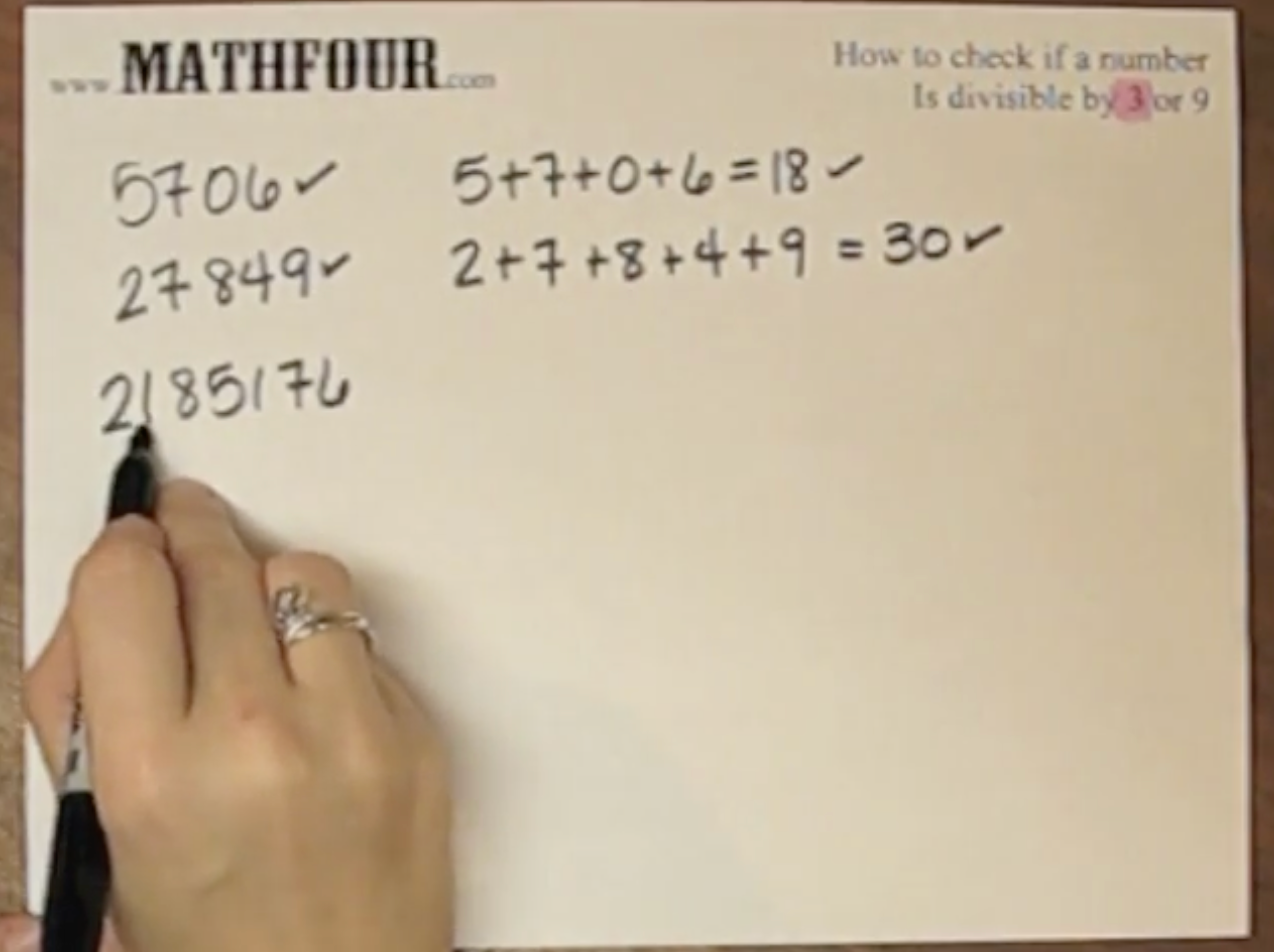
This is a trick that everyone should learn in the 3rd grade. If not, then at least by the 9th grade.
If you’re in the dark on this one, no big deal. Now’s the time to learn. If you’re a parent – this trick will win you points like crazy. Especially if you get to it before the teacher does.
So here’s how it works. For both 3 and 9, start by adding up the digits in the number. If the result is divisible by 3, then so’s the original number. If the result’s divisible also by 9, then… you guessed it… so’s the original number.
If your result is way to big to tell, do it again. Check out the videos for both:
Questions or comments? Leave them in the comment section below.
Do your students say they just wanna chuck it all with regard to math?
Are they sick of being a prisoner to the anxiety?
Help them declare their independence!
A great friend of mine is a technical trainer for an oilfield services company. He teaches a class called “Oilfield Math.”
I helped him develop this class and I had the privilege of attending the first class. At the end of the class, he offered to buy everyone a beer – so he passed out a $2 bill.
On the back of the $2 USD bill is an image of the signing of the Declaration of Independence of the US. He told everyone that they can either take the $2 and buy themselves a beer on him, or they can keep it as a token of their new found independence.
His class teaches math for the oilfield, and for life, using a discovery process. The independence he offers is the freedom from senseless algorithms (step by step procedures that look like magic) and people who say, “All you have to do is…”
I asked all the students in that first class sign mine. I still carry it. Although I’ve never been a prisoner like many people I’ve seen, this token reminds me that many are prisoners of the negativity.
Hand out personal independence to your kids.
Give each student their own $2 bill. They can write on it some freeing statements. They can write on it negative words that they never want to hear or say again. Or they can carry it blank. It’s their talisman.
If you answered yes to any of the above questions, this post is for you.
I’m not here to convince you to love math. I’m not even here to help you not hate it. But if you’ve got kids around, you gotta do something about your vocalization of this.
We want the next generation to be better than the previous generation – in everything. That’s our nature as parents and people.
In order to improve the next generation, the previous generations must either die or shut their traps. This is the case with racism, sexism, creed-ism and sexual orientation-ism. And it’s the case with anti-mathism, as well.
You certainly don’t want to die before your children finish their eduction, so you gotta learn to keep quiet.
Zip your lip for yourself.
Southwest Airlines tells you to put on your own oxygen mask before you help others put on theirs.
Your first step is to get yourself out of the habit of saying negative math things. This will make it easier when refraining from talking bad about math in front of kids.
If you’re math phobic, start doing this when you’re pregnant. If you will never have kids, do it anyway. Children are everywhere – you might’ve noticed.
The more you say it, the more you believe it. Which makes you say it even more.
Use this to your advantage, not your disadvantage. Every time you say, “I’m bad at math,” you get worse. You are the smartest person you know and you should believe whatever you say. Which means whatever your tell yourself will be true.
If your friends say they hate math in front of your children, correct them. Treat this behavior just as you would if your friend said the F-word.
Give them “the look.” Correct them with other words like, “Math has always been an interesting challenge for Aunt Sophie… right?”
Be an example.
Your children take to heart what you say. They want to be like you. If you hate math, they want to hate math too. Even if they really don’t.
So when you feel the words coming toward your lips, force something good to come out. If you can’t say, “Math is fun” without cringing, tell them something you are good at. Anything works. Even if it seems lame.
Instead of:
Kiddo: Awww! I have to do fraction homework today. I hate fractions. Grownup: I know, sweetheart. I never liked math either.
Try this instead:
Kiddo: Awww! I have to do fraction homework today. I hate fractions. Grownup: Well, I’m good at cooking chicken!
Kiddo will think you’re nuts, but won’t associate any negativity to math. And since he already thinks you’re nuts, you’re good to go.
Use distraction.
If finding something you’re good at doesn’t come quick enough, scream some random swearword and say, “Oh my goodness I can’t believe I forgot…” and run out of the room. Compose yourself, prepare a short sentence or two and go back into the room.
Some sentences to consider are:
Where were we Kiddo? Oh right, fractions. Well, fractions help us share things. If you, your dad and I want to share a pizza, we need fractions in order to divide it up. If you do your homework with fractions, I’ll let you divide up the pizza that we get at Chuck E Cheese’s on Saturday!
Fractions are interesting because they have two parts – a top and a bottom. You have a top and a bottom! Do your fractions and then we’ll wash your top and your bottom in the tub before dinner.
Avoid statements like, “Fractions are good for you.” Math shouldn’t be equated to vegetables. They’re good for you but you have to tolerate them. That may be your opinion, but remember were trying to improve the next generation.
So…
When negative math-speak comes to your tongue, say something else, anything else. Do it for you, do it for the children. Don’t die, but do shut your trap.