
There are tons of great products out there to help with teaching time. White board clocks, clocks with movable hands, games, etc.
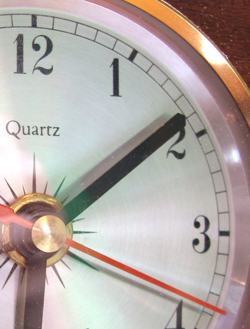
But teaching time isn’t only about telling time.
When we teach children how to tell time, we are merely giving them another “reading” skill. We’re teaching them how to interpret the hands on a clock.
We also teach them how to understand what time things happen during the day. With this we’re getting closer to giving them an appreciation of what time is. But we’re still not there.
We “spend” time like we spend money.
My friend, Paul Cunningham once told me he was, “time poor.” We all have the same amount of time in each day. So why would one person be “poor” with respect to time, while others are not?
Time is relative to the “must do” work.
Parkinson’s law is: “Work expands so as to fill the time available for its completion.”
Which also means that if you have something that must be accomplished, and extremely limited amount of time, then you figure out a way to get it done. Which sometimes means to do it at a less than perfect quality.
Grownups experience this all the time – with work and personal tasks.
Must do it.
Must do it fast.
So do it as best as you can and be done.
Kids are required to sleep. That’s about it. Daughter sleeps 10 hours each night and about 2 hours during nap. She’s got a whopping 12 hours every day to do just about anything else!
Of course she’s corralled in various places against her (very strong) will. But nevertheless, her only “work” is to learn.
Parkinson’s law allows her all the time she can to “perfectly” learn everything she can.
Time is relative to our age.
I remember as a child understanding that Christmas was two weeks away. As an adult I can calculate that two weeks to a five-year-old is equivalent to four months as a 40-year-old!
See… I’m 14,600 days old. My nephew is 730 days old. For me, Christmas is about \(\frac{14}{14,600}\) of my life away. For my nephew, Christmas is \(\frac{14}{730}\) of his life away!
There are two things going on when we anticipate something in the future. As shown above, there is the amount of time we have to wait as a fraction of the amount of time we’ve been alive.
And there is also the “habit” of waiting that gets established over time. I can wait two weeks (or even four months) because I’ve done it many many times before. A five year old rarely waits two weeks for anything!
Can we teach the full appreciation of time?
These subtleties and intricacies make time a very slippery subject. Teaching all these strange bits might not be doable. But it’s important as grownups that we know that they exist for us – and they don’t exist for them.
Some of us, like Paul Cunningham, have “less time” than others.
So when you teach time – either telling time or knowing what time things happen – don’t forget that there’s so much more. And when your child is able to grasp it – share it!
Oh, and share your thoughts on this in the comments. 🙂

Leave a Reply