Tag: time

  • Time Zone Math: Using the Fret & Grind Method

    Time Zone Math: Using the Fret & Grind Method

    It took me a long time to learn how to figure out what time it was in Los Angeles when it was at 7 AM in Houston.

    Notice on this time zone map that the numbers count in a very intuitive way across the US:
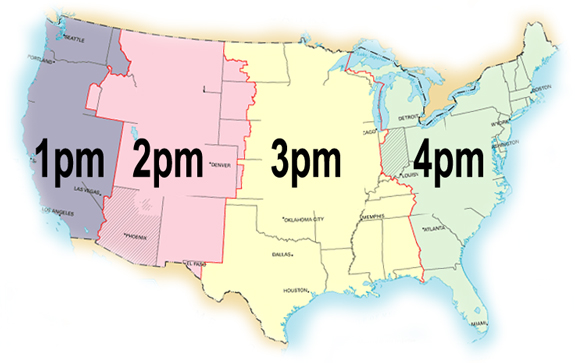
    This works just fine if you’re managing locally.

    Global time zones are more of a challenge.

    I used to send out a weekly newsletter. Generally it was set to arrive in people’s inboxes between 3 PM and 6 PM Thursdays — in their local time zone.

    Which means any changes that I had to do would have to happen before they got the e-mail at 3pm on Thursday.

    But not everybody lives in Texas. So my deadline was not 3 PM on Thursday, really. It was the first time anyone in the world encountered 3 PM Thursday.

    In order for me to make the deadline for a global audience, it was essential to figure out what time in Houston that is.

    Greenwich Mean Time -6

    According to the website Greenwich Mean Time:

    Greenwich Mean Time (GMT) was established in 1884 at the International Meridian Conference, when it was decided to place the Prime Meridian at Greenwich, England.

    All time zones range from GMT -12 hours GMT +12 hours. Houston is Greenwich Mean Time -6 hours. Which means it should be a rather easy exercise.

    All I have to do is add my six hours on the left side of the Meridian to the 12 hours on the right side to see that I’m 18 hours difference.

    I subtract 18 hours from 3 PM Thursday to arrive at 9 PM Wednesday as my true deadline.

    But we all know what happens when you say, “all you have to do is.”

    I used maps, charts and a lot of time.

    As I mentioned in the discussion of the book What Your Math Problem?, I often use very crude methods to solve problems.

    I opened up a world time zone map, started counting and making charts:
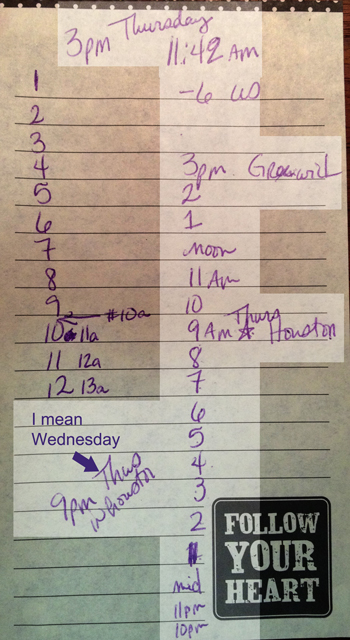
    I didn’t solve the problem traditionally.

    Often when grownups present math problems to kids, they’ve prepared. They demonstrate working a problem like I worked it above:

    Add my six hours on the negative side of Greenwich Mean Time to the 12 hours on the positive side. I’m 18 hours difference. Subtract 18 hours from 3 PM Thursday to arrive at 9 PM Wednesday as my true deadline.

    But that’s not the real way we do math. We often use the Fret & Grind method. Fret about what’s going on, grind out some rough sketches. Then fret some more…

    So why do we show kids the nice way?

    If they see the “all you have to do is” way, then they won’t gain the confidence to use the Fret & Grind method.

    And the Fret & Grind method is the best way — sometime the only way.

    How do you teach time zone math? Do you encourage Fret & Grind?

    Share your thoughts in the comments or on twitter/x.

    You might also like:
  • On Time? You Used Math!

    On Time? You Used Math!

    Are you ever on time? Are you always on time?

    Are you sometimes close to being on time?

    Chances are, you did math to make that happen.

    And you do a lot of math to be on time.

    If you have to be at work at 8:30, you might do math like this:

    8:30am – 30 minutes – 1 hour – (3 x 9 minutes) = 6:30am

    or

    be there at 8:30am – 30 minutes drive time – 1 hour get dressed time – (3 x 9 minute “snooze” on alarm) = set alarm for 6:30am

    Which means you did conversions (minutes to hours), approximations (a 9 minute snooze is basically 10 minutes), subtraction and multiplication.

    You might even do algebra to be on time.

    You might even do some “what can I give up to sleep more” algebra. It goes like this:

    7:00am + 30 minutes + 1 hour + 9 minutes + x = 8:30am

    or

    it is now 7:00am + 30 minutes drive time + 1 hour get dressed time + 9 minutes for the snooze button I really want to hit – x (approximately 9 or 10 minutes of something like washing hair, eating yogurt instead of eggs or shaving legs) = be there at 8:30am

    Notice this is also substitution!

    Use this to positively influence your children.

    The next time someone says, “I haven’t done math in years,” point out to them they do math all the time. In fact, they likely did math to get there on time!

    Especially point this out if you’re in earshot of a child.

    When kids hear how math is used effortlessly and frequently, it helps to demystify it. And when it’s demystified – they become more familiar and comfortable with it.

    And you know what that means? They’re more engaged!

    You might also like:
  • Time and Technology – Are we missing some math practice?

    Time and Technology – Are we missing some math practice?

    I’ve written before that teaching time isn’t only about telling time. And this morning I started thinking about it again.

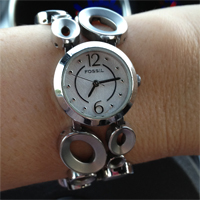
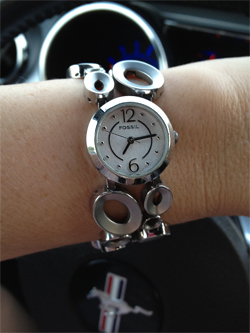
    I found my super fun circle watch from Fossil and put it on. I haven’t worn a watch in quite a while. So it’s fun wear it again.

    We don’t need to wear watches anymore.

    Well, except for fashion. Our mobile phones (even the “dumb” ones) keep time rather well.

    If you need the time, you dig out your phone. And if it’s too deep in your purse, you ask someone.

    And they tell you with words like, “It’s 8:23.”

    You never have to wonder.

    Do you recall this type of conversation:

    Kate: What time do you have?

    Wil: I show 10:15, but I’m usually about 5 minutes fast. So it’s really about ten after.

    Kate: Thanks!

    That phrase, do you have, is now obsolete. Everyone has the same time. It’s from Verizon, AT&T or TMobile. And they get it from the same place – the place that has the exact time.

    This means a lot for math.

    Nobody runs fast or slow. Also, we don’t have to add or subtract to get the real time.

    The time just is.

    20 years ago when your watch was six minutes fast, you had to do this to get the real time:

    1. Look at your watch.
    2. Figure out the time (the big hand’s on the …”).
    3. Subtract 6.

    You got to practice addition and subtraction – often!

    Which means our kids don’t get this benefit.

    Is it hurting them?

    What do you think? Share in the comments and don’t forget to tweet it out!

    Related articles
  • Teaching Time Isn’t Only About Telling Time

    Teaching Time Isn’t Only About Telling Time

    There are tons of great products out there to help with teaching time. White board clocks, clocks with movable hands, games, etc.

    But teaching time isn’t only about telling time.

    When we teach children how to tell time, we are merely giving them another “reading” skill. We’re teaching them how to interpret the hands on a clock.

    We also teach them how to understand what time things happen during the day. With this we’re getting closer to giving them an appreciation of what time is. But we’re still not there.

    We “spend” time like we spend money.

    My friend, Paul Cunningham once told me he was, “time poor.” We all have the same amount of time in each day. So why would one person be “poor” with respect to time, while others are not?

    Time is relative to the “must do” work.

    Parkinson’s law is: “Work expands so as to fill the time available for its completion.”

    Which also means that if you have something that must be accomplished, and extremely limited amount of time, then you figure out a way to get it done. Which sometimes means to do it at a less than perfect quality.

    Grownups experience this all the time – with work and personal tasks.

    Must do it.
    Must do it fast.

    So do it as best as you can and be done.

    Kids are required to sleep. That’s about it. Daughter sleeps 10 hours each night and about 2 hours during nap. She’s got a whopping 12 hours every day to do just about anything else!

    Of course she’s corralled in various places against her (very strong) will. But nevertheless, her only “work” is to learn.

    Parkinson’s law allows her all the time she can to “perfectly” learn everything she can.

    Time is relative to our age.

    I remember as a child understanding that Christmas was two weeks away. As an adult I can calculate that two weeks to a five-year-old is equivalent to four months as a 40-year-old!

    See… I’m 14,600 days old. My nephew is 730 days old. For me, Christmas is about \(\frac{14}{14,600}\) of my life away. For my nephew, Christmas is \(\frac{14}{730}\) of his life away!

    There are two things going on when we anticipate something in the future. As shown above, there is the amount of time we have to wait as a fraction of the amount of time we’ve been alive.

    And there is also the “habit” of waiting that gets established over time. I can wait two weeks (or even four months) because I’ve done it many many times before. A five year old rarely waits two weeks for anything!

    Can we teach the full appreciation of time?

    These subtleties and intricacies make time a very slippery subject. Teaching all these strange bits might not be doable. But it’s important as grownups that we know that they exist for us – and they don’t exist for them.

    Some of us, like Paul Cunningham, have “less time” than others.

    So when you teach time – either telling time or knowing what time things happen – don’t forget that there’s so much more. And when your child is able to grasp it – share it!

    Oh, and share your thoughts on this in the comments. 🙂

    Related articles