Tag: perimeter

  • Area of a Circle vs. Area of a Triangle

    Area of a Circle vs. Area of a Triangle

    Inspire your kids to think about how circles relate to triangles!

    I first saw this video over at MathFail. It’s cute, and I have to admit, kind of cool.

    But anything this simplistic always sends me into skeptical mode.

    Before we go any further, check it out:

    Do you believe it?

    This might be the question to start a discussion with a student. It’s certainly the first question that comes to my mind.

    If it were really this simple, wouldn’t we have used it to “prove” the formula for the area of a circle much earlier?

    What’s wrong with it?

    For the “proof” in the video to work, you have to assume (or believe) that the circumference is 2πr. This seems a bit cheesy to me, since that formula is as complex as the one we’re trying to prove. Not to mention quite closely related. But I’ll let this one go.

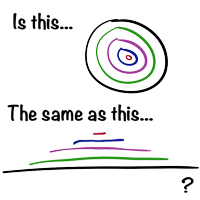
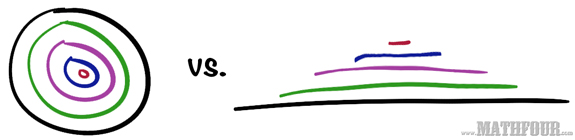
    The thing that really bothers me is that they use only a few chains — each of which has thickness.

    If you filled the inside of a circle (a disk) with concentric circles, none of those circles would have a thickness. In fact there’s an infinite number of those circles.

    Is it realistic to take each of those circles and fold them out and get a triangle?

    Can you use it to teach?

    I believe the makers of the video intended this to be a fun way to remember the area formula of a circle.

    But the video would be better used to allow students to ponder the relationship of a circle to an isosceles triangle.

    What do you think?

    Are you okay with this video? Are you as skeptical as I am, or am I a little too sensitive?

    Share your thoughts in the comments or on twitter/x!

    You might also like:
  • Perimeter and Area of Mommy’s Necklace

    Perimeter and Area of Mommy’s Necklace

    Written as part of the Count 10, Read 10 series.

    I noticed Daughter attempting to bejewel Husband with a strand of my faux pearls the other day. I watched, enthralled with the math learning taking place.

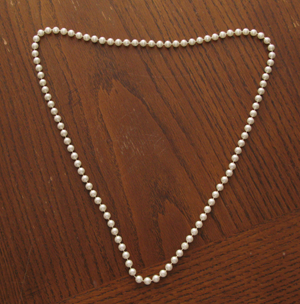
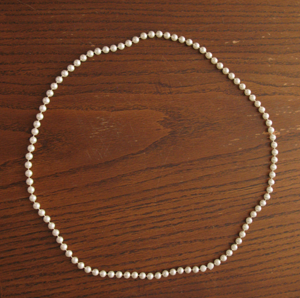
    She held the necklace in her hands – one on each side. Just about equal. So the space available for Husband’s head was almost non-existent. Like this:

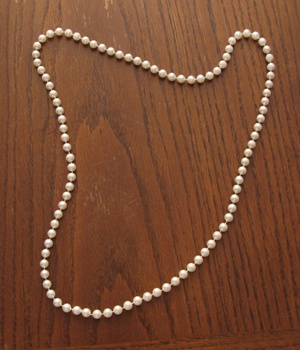
    If she were to hold the necklace at two points that were closer together, she would create a “dip” in the necklace where his head could fit. Like this:

    There’s an extended learning opportunity here!

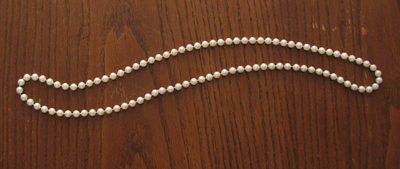
    This made me think of all the nifty things you can show about the relationship of perimeter to area and how you can have the same perimeter but change the area to all sorts of sizes.

    If you aren’t wearing a necklace, find some mardi-gras beads. Daughter has many strands, so I’m guessing your house might be littered with them as well. If not, join the club. Go buy some.

    Play with them in the bathtub or right before bed. (Make sure they give them up before going to sleep, though – it’s a strangulation hazard!)

    Move the necklace around on a flat surface (or on the bed) and let your child experiment with the ways the area changes. Ask questions like:

    • How much “stuff” can you fit inside the shape? (If there are blocks or other toys to act as “stuff,” use them.)
    • How much “stuff” can you fit inside the shape after you move it around?
    • Is that more or less “stuff” than you could fit inside it before?
    • Did the distance around the necklace change? (You can introduce the words perimeter and circumference.)
    • Can you make it into a square? A triangle?

    Be careful how much you do.

    Don’t forget, activities like this should be fun. For your child as well as you. So don’t get too in depth talking the math talk if it feels weird. Go with the flow.

    And let me know how that flow goes, would you? Share your thoughts in the comments.

    Related articles