This past Monday we had a great #mathchat via Twitter. The topic was: “If you could clear one misconception about mathematics and/or teaching it, what would it be?”
I was getting a bit frustrated that a couple of people kept bringing up the misconception that girls aren’t good at math. Even to the point of creating their own hashtag #girlsaregoodatmath2.
In my life, I’ve never heard anyone say this – in any other form than somebody complaining that people say it.
So here’s my response to everyone who keeps saying to me, “I wish people would stop saying, ‘Girls aren’t good at math.’”
What do you think? What will you say from here on out?
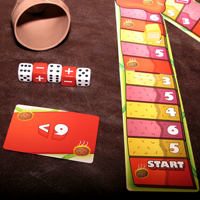
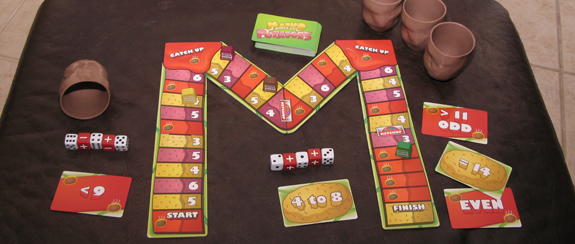
I was at my dad’s house the other day and decided to pull out my new Math’d Potatoes game to see how my super-gaming family liked it.
The kids in the house were too young to play, so my sister and I asked Aunt Linda and our stepmom to play with us.
They quickly claimed they were “math Neanderthals” but agreed to play anyway. My dad, an engineer, was asleep.
The game has simple rules.
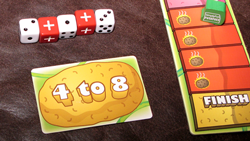
You play Math’d Potatoes by drawing a card, rolling five dice and making an expression that “satisfies” the card.
The card requests various types of “answers”:
Even or odd
Equal to a certain number
Between two numbers
Less than/greater than a certain number
Everybody got into it.
Aunt Linda and Louise (my pet name for my stepmom) both agreed that it was a fun math game. This is in spite of the fact that neither one of them like math, and Aunt Linda doesn’t even like to play games at all!
My dad saw the game the next morning.
I had intentionally not waken up my father to play with us the night before. My decision was validated the next morning.
My dad is an engineer, and as such tends to use the phrase “all you have to do is,” and the word “just.” He’s a very smart man, and I’ve learned lots from him through the years. And one of those lessons is: “Keep an engineer away from sensitive math learners.”
Sure enough, when he saw the game, he eagerly said, “What’s this? Are we going to play it?”
When I explained we played the night before he responded with, “Why didn’t you wake me? I totally would’ve won.”
Math learning is slowly build, and quickly destroyed.
When we were playing, Aunt Linda and Louise were both starting to warm to the idea of math. They were enjoying the game. My sister and I were holding back just a little to give them an opportunity to discovery their own skills. (We both experienced the engineer–math–dad super push growing up.)
So by the end of the game that night, they were excited, confident, and enjoying themselves.
Had I woken up my father to play the game, he certainly would have won. He might’ve turned it into a competition, or he might have tried to help a little too much.
Either way they would’ve lost interest. Their confidence would have been destroyed. And two beautiful, smart and happy women would have their, “I’m a math Neanderthal” thoughts validated.
You can use this with your children.
If you or your spouse are in a math related field, or was “always good at math,” be aware of your potential intimidation factor. Hold back. Don’t help. Allow discovery and confidence to come at its own slow and natural pace. Your children will learn math, in their own time.
Don’t force it, or you might destroy it.
Note: They sent me this game for free. This is not a review, per se, but still – you should know how I got it.
Is changing how you feel about math like changing who you are?
My Little Brother is a licensed professional counselor. He often tells me that you can change your attitude by changing your behavior.
Apparently the behavior-attitude door swings both ways. If you don’t want to do something because you feel frustrated, do it anyway and that will clear up the frustration.
So that’s how you can get your attitude and your child’s attitude aligned with positive feelings of math.
Because it’s easier said than done right? When you’re frustrated, or your children are frustrated, you’ve gotta say something. So you can’t “just stop.”
HOW do you quit saying “I hate math” (when you really do hate math)?
First, make a list of all the math things you do (download the handy helper here). Here’s a starter list for both you and your children:
I know how long it takes to get dressed and so I can calculate when I have to wake up in the morning.
I can figure out if our car is getting good gas mileage.
I can figure out if I have enough money saved to by a nice toy.
I know what I have in savings and if that’s enough to buy the fancy shoes I want.
I know how many minutes it takes me to walk to my friend’s house.
I know that riding my bike to my friend’s house is faster than walking.
I know that in the past I couldn’t reach the middle of the dinner table, and now I can – because my arms are longer.
I can figure out how much I’ve grown in the past year by looking at my growth chart.
Copy your list and put it on the refrigerator, in the bathrooms, on the front door and next to your bed. When you find your child or yourself wanting to say, “I hate math,” instead say, “I can do math because __” and fill in the blank with something from the list. If you need to, continue like this:
This particular math problem I’m working on is more challenging than what I already know, but it isn’t hard. I just have to figure it out. And since I’m smart enough to do all that other math, I can figure this out!
The behavior of changing what you say will have a positive affect on how you and your children feel about math!
If you’ve ever taught or tutored math you’ve encountered the question, “When am I ever going to use this?” Maybe even hundreds of times.
And no doubt you’ve tried the answers that you’ve heard your math teachers give:
You’ll need it in a future job.
You’ll want to balance your check book someday.
Blah, blah, blah.
I was on the Teachers.net chatboard last night and there’s a discussion in the math teachers section about how to answer this question.
I was horrified to read that some teachers actually respond with, “How about as homework, you find the answer to that question.”
Egad!
We all know it’s a discrationary tactic. We know that there are lots of good uses of math. And we’ve experienced our answers shot down with, “I’m not planning on doing a math job for a living, so I won’t need it,” or “I’ll hire a CPA to do my checkbook.”
There’s only one right answer to this question.
“You’ll never use the math I teach you. Ever.”
I offer $10 to anyone who can come back to me in 10 years and tell me that graphing functions (or whatever we are learning that day) has actually had an applicable use in their life.
Of course they’re horrified at this answer. They give me looks like, “What? Are you an alien here to invade our classroom. Did you eat the real Bon?” No teacher has ever been that honest.
Graphing functions is virtually useless as a real tool. As is most of what we teach.
I used to get phone numbers from men at bars with my amazing use of the quadratic formula, but that’s only something you can tell college students. And they don’t buy it anyway.
Teaching math is teaching brain exercises.
The reason we teach and learn graphing functions (or other math) is to exercise a part of the brain that we rarely get to use. A part that will get used sometime later in a weird way.
We’re building new paths in the brain. We’re carving a way to alternative problem solving that might one day be useful in solving interpersonal, business, automotive, or other type of problems we have.
I tell them that math class is a game. A fun time to escape once a day. This is a play time to stretch their brains and do something completely different.
And I certainly don’t pile pissiness upon pissiness with the attitude of “If you’re going to challenge me, small menial student, then I’m going to give you extra homework.” That really motivates students… to hate math.
How about you? How do you answer the question? Are you supporting future math happiness? Share your thoughts in the comments.
You’re at a a party. Someone asks you what you do. You say, “I’m an undertaker’s assistant. And what do you do?”
They say they teach English.
You say, “Oh wow. I have always HATED English. I can’t even read the street signs!”
The guy a few feet away overhears this and joins in the conversation: “I know, right! I tried to read and write stuff in high school, but it just never worked for me. I finally decided that English wasn’t my thing.”
You respond with: “Yeah, when I go to a restaurant I ask the waiter to explain everything. So many letters! I don’t understand how you teach such a dreadful subject. I’m so sorry for you.”
Have you ever done that? Seen it? No doubt you’ve seen with with math.
Why can you say, “I hate math” but not “I can’t read”?
Why is it acceptable, even cool, to be “bad at math” but those who can’t read or write stay in the proverbial closet?
It’s time to come out, y’all. If we can’t get people to stop saying “I hate math” then let’s water it down by saying “I hate <anything else>.”
The next time you’re at a party and someone tells you what they do, respond with, “Wow, I’m so sorry for you. I’ve always hated <field/career>. You must be miserable!”
The more we all do this, the more people will stop giving credence to the words “I hate…” Soon the phrase “I hate math” will be extinguished.
What do you think? Can you do it? Will it work? Share your thoughts in the comments.

![[50 Word Friday] A Vicious Cycle](https://mathfour.com/wp-content/uploads/2026/01/image-124.png)