The Order of Operations (OoO for short) is used everywhere in mathematics because it encompasses many of the foundational rules that we’ve agreed to follow.
Alas, students have been given the cheap and dirty version of it for years. “Here, memorize this thing about your Dear Aunt Sally!” What the heck?!
There are subtleties in the Order of Operations that every person over the age of seven should know.
The series begins today.
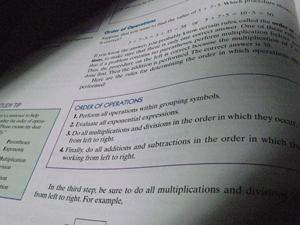
The order of operations is a set of rules – like the drivers’ handbook for math. If everyone follows the rules, we’ll all be safe. But if someone makes a bad turn, we could be looking at a crash.
But the Order of Operations is only a set of rules for arithmetic! It isn’t even the best practice when it comes to expressions involving a variable like x. I’ll cover what I mean in this weekly series.
Here are the proposed articles:
Intro and mnemonics
Parenthesis
Exponents
Exponents, Multiplication and Addition
Multiplication and Division
Addition, Subtraction and Conclusions
Exponents of Negative Numbers
Another Reason to Ban PEMDAS (aka parenthesis aren’t an operation)
Mnemonics for PEMDAS
Well, there’s one: PEMDAS (pronounced just like it looks). That’s what the cool kids in high school always said. It was the same kids who said “soh-cah-toa” – which I thought sounded really goofy.
And then there’s “Please Excuse My Dear Aunt Sally.” And of course “Piranhas Eat Mostly Decayed Antelope Skin.”
Do you wonder if your children should be using a calculator “at their age”? Are you a fan of calculators, but have friends who aren’t? Are your friends “into” calculators while you oppose them?
I often hear people say that children 50 years ago understood math concepts more quickly. Although our parents weren’t taking classes called algebra in the 7th grade, they were doing algebra in the 7th grade.
Algebra is arithmetic.
There are two fundamental and rarely understood facts about algebra:
Algebra is arithmetic with one or more numbers in disguise.
Algebra has exactly the same rules as arithmetic.
Which means if you can do arithmetic you already know how to do algebra!
Our parents or grandparents, 50 or even 30 years ago, weren’t using calculators. They had to apply all the rules of arithmetic to get the job done. Which means that they had to apply all the rules of algebra.
Teaching them a class called “Algebra” was much easier because of this.
What are the rules?
The basic rules that non-calculator users must apply are the distributive property and the order of operations. The distributive property is the thing that calculator use eliminates.
Children could get practice mentally multiplying things like 3 x 86 and do 3(80+6) = 240+18=268. With this practice, they are ready for 4x(3y+2z) = 12xy+8xz.
If they never have to multiply 3 x 86 in their head, they never get the experience of the distributive property. Which means teaching them 4x(3y+2z) = 12xy+8xz will cause anxiety and frustration. They see it as “magic” or “something you made up just to confuse me.”
Give them the tools they need.
Refuse to let students have the calculator. Let them have the tool of the distributive property for algebra before you teach them “Algebra”. Give them the benefit our parents and grandparents had!
You’ve taught what a function is. And the kids are starting to understand what the domain is all about.
But then they ask, “What’s the point in the range?”
As I wrote in a previous post, a function is a question with only one answer to a valid question. The domain is the set of all valid questions. The range of a function is the set of all answers you can get.
Simple? Sounds like it – but kids the world over still struggle with the question, what’s the point of the range?
To be or not to be a function.
Why is it important to know all the answers of an equation? It has to do with the equation being or not being a function.
If you have an equation like
you have more than one answer per question.
Here are some valid questions associated with this equation:
What is the square root of a number, specifically the number 1?
What is the square root of a number, specifically the number 1.69?
What is the square root of a number, specifically the number 4?
What is the square root of a number, specifically the number 9?
The answers to these questions are:
1 or -1
1.3 or -1.3
2 or -2
3 or -3
Notice that there is not “only one” answer to each question. So this equation isn’t a function!
But that’s no fun at all!
You can force an equation to be a function by limiting the answers.
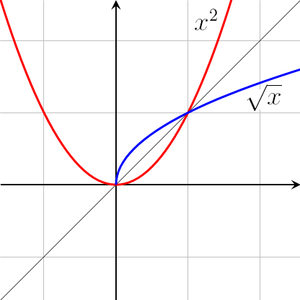
By limiting the answers (AKA limiting the range of a function) you can force an equation to be a function. So if we write
We have just limited the range of answers to be only the positive square roots of numbers.
The practical application for kids is the graphing.
In this image above it’s the blue curve:
You can see that we get only the “upper half” of the curve. If you look at “squishing” a function (like the garbage compactor in the movie Star Wars) you can see the range of a function (all y-values) becomes the vertical line:
The line starts at zero and goes up forever. (In the video it stops, but that’s only because I have a hard time displaying forever on a computer screen.)
The handy thing about knowing the range of a function before you graph is that you know how much space on the paper you need – or how small to make your units!
Does this help? Share your range of experiences with this in the comments! (And pardon the very bad pun.)
I mean: “What is three times a number (that number is four), plus two?”
The domain is all the possible questions:
What is three times a number (that number is five,) plus two?
What is three times a number (that number is six,) plus two?
What is three times a number (that number is seven,) plus two?
What is three times a number (that number is eight,) plus two?
<how long will I have to do this – Egad!>
Not only do the questions go on forever, but they also have all the fractions and decimals in between. And all the negative versions of those numbers (and zero).
So, what’s the point, you might ask. Looks like the questions go on forever and you can just pick any number.
The domain might not include all the numbers.
The two sticky points for the definition of “function” are bolded:
A function is a question with only one answer to a valid question.
The “valid question” part is where the domain comes in.
The numbers that make “valid” – meaning we actually can get some answer – are the numbers that aren’t negative.
Many functions have “all real numbers” as a domain. There are no limits on the things you can put in, other than numbers that aren’t imaginary or alligators.
For the most part, there are only two places where you have to be careful of limited domains. Those are
Numbers that cause a zero to turn up in the denominator
Numbers that cause negatives to turn up in square roots.
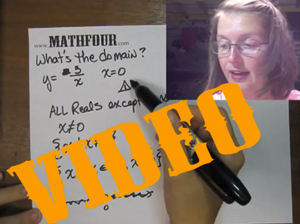
Here are two videos tackling each:
What do you think? Is this easier to teach when you consider “analyzing” the function rather than “solving” it? Share your thoughts and tips in the comments!
Other than being the most feared f-word in math teaching, a “function” is a question with only one answer.
Take the question: “How tall are you?”
We can change this to: “What’s the height of you?”
And if we wanted to compare your height to other people’s heights we can ask: “What’s the height of <insert person’s name here>?” This is the question template – the formula.
You can answer this question in inches, feet or cm, but the value of the answer remains unique, based on the person.
And that last little piece of the sentence is what makes the difference, based on the person.
The question changes with this little change. <cue music> This is the variable in the equation.
And we say, “Height is a function of the person.”
So where’s the fear come in?
As always, the notation is the kicker when it comes to teaching math.
Let’s change the question a little.
What’s the height of Enrique tomorrow if he grows three inches tonight?
Rather contrived, but work with me…
The question template is
What’s the height of <insert person’s name here> if he/she grows three inches tonight?
Which becomes
<height> = <height now> + 3
Or
H = N + 3
Egad!
And we haven’t even started with the f(x) stuff!
What’s this “domain” thing about?
I wrote the first sentence of this post a little too hastily. A function has only one answer if there’s a valid question.
If you ask, “How tall is love?” someone will laugh at you. Or think you’re from California.
Our question template included some specifics that you don’t normally get:
What’s the height of <insert person’s name here>?
If we instead ask, “What’s the height of x?” we would then have to ask: what kinds of things can we put in for x? Can we put concepts, like love? Or just objects? The kinds of things that you can put in for x is called the domain.
For our question, we would need to specify that x is a person.
What do you think? How does this feel when explaining it to your kids?
I was browsing through the book Family Math and found a nifty game called Hurkle. It goes a little something like this:
Someone picks a place on the coordinate plane (in secret) for Hurkle to live.
Others guess Hurkle’s home by giving coordinates and pointing out those coordinates.
When they are wrong, they are given a hint of which way to go (from their guess) to find Hurkle.
The coordinate “space” is around too.
This made me think of the conversation I had with a neighbor the other day while walking our children to the park. When Scotty beams someone in Star Trek, he needs coordinates. But those coordinates must be measured from some origin (0,0,0) in the universe to make any sense. So where’s the origin?
A student of mine long ago found that the origin was Earth. My neighbor argued it should be Vulcan – apparently they started the United Federation of Planets.
And we can find coordinates at work in board games.
With thoughts of these two in my mind, I wonder what ever happened to the game of Battleship. It’s a great game of coordinates along with logic. Once you hit a ship, you have to go in each direction to determine how big the ship is and in what direction.
I’m excited about looking around my world today for more coordinate systems. Where do you see them in your world? And how do you apply them in your teaching? Leave your thoughts and ideas in the comments.
Thanks to Kellie D for this question: “How do I know if a set is closed under the rule of addition, same question for multiplication?”
Closure under addition or multiplication is a concept from Abstract Algebra that’s taught in not-so-abstract Algebra classes. It can be intuitive, if taught properly.
You first have to start with two things: a set and an operation. A set is a bunch of things. Okay, the definition is fuller than that, but for general purposes, it’s a basket full of goodies.
An operation is a way to “combine” any two things in that basket.
You can’t speak of closure without having both of these together. In Abstract Algebra, this pair of things is called an Algebraic System. That’s a fancy math term that isn’t necessary to teach, but might be helpful if you need to look things up.
We say a set is closed under an operation if you can combine any two things and the result is back in the set. Notice that the definition has BOTH the words set and operation. You can’t just be closed under an operation – you gotta have the set to put it in context.
Example 1 – Kitchen Goodies
Suppose your basket of goodies is this: {flour, sugar, chocolate chips, baking powder, egg, butter}.
And your operation is this: “mix two things together in a bowl with a spoon.”
It isn’t mathematical, per se, but it’s a set and an operation.
So if you combine two things from the basket by mixing them together, what do you get? Yummy goodness for sure, right? But the result of the blend is not found in the basket as one of the things!
Mix sugar with butter and then look in the basket. Is it there as a single blob of buttery sweetness? Nope. So the set of goodies is not closed under the operation of mixing.
Note: the opposite of closed is “not closed.” The word “open” isn’t used here.
Example 2 – Math Stuff
Now you have another basket of goodies: all the even numbers (including positives and negatives and zero). We can write this in the fancy math way like this: { x | x is an even integer }
The operation is addition.
If you combine (add) two things from the basket (any two even numbers), what do you get?
8 + 24 = 32
Is it back in the basket, i.e. is the answer an even number? YES!
Try some more to make sure. Technically you should prove it, but usually your intuition is good enough – especially in a high school or undergraduate class.
So we write “the set of even numbers is closed under the operation of addition.” Again, notice that we have BOTH set and operation involved.
Example 3 – More Math Stuff
Here’s your set: all the integers (positive, negative and zero whole numbers).
And the operation: Division.
If you combine (divide) two things from the basket (integers), what do you get?
27 ÷ 3 = 9
Looks good, right? 9 is an integer. But what about 27 ÷ 2 = 13.5?
13.5 isn’t an integer because it has a decimal piece. Some bits (integers) when combined (divided) turn out to be in the basket (another integer). But not all do. And they ALL have to work in order for it to be called closed.
So this is NOT a closed system. Or we can write, “the set of integers is not closed under the operation of division.”
Example 4 – Even More Math Stuff
Set: {1, 5, 6, 7, 14}
Operation: addition.
Is it closed?
1 + 5 = 6 check!
5 + 6 = 11 oops! 11 isn’t in that set.
This set is not closed under the operation of addition. You might notice that a finite set (a set with only so much stuff) of regular numbers won’t ever be closed under addition – just add the two biggest numbers and you “bust” out of the set.
Going Beyond…
Your sets can be just about anything: real numbers, rationals (fraction-like numbers), whole numbers. They can even be bunches of matrices, polynomials, imaginary numbers, complex numbers or functions! The operations would be one of the normal operations that you would use on things in that set anyway.
Questions about how to teach this? Questions on how to learn it? Leave them in the comments.
This post is by request from @corrincross on Twitter.
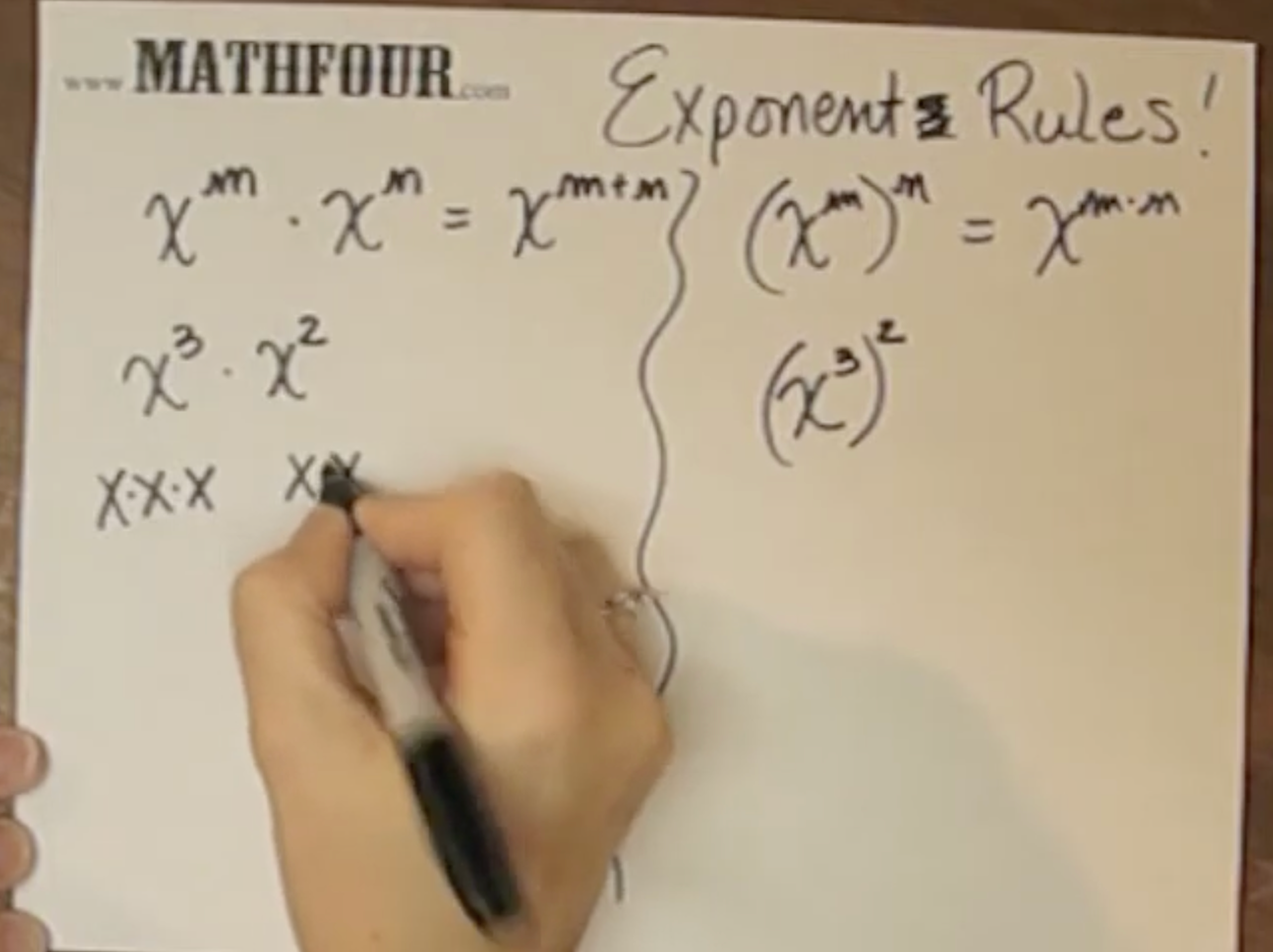
Exponent rules are hard. Well, they are hard to remember, anyhow. But there’s an easy way that won’t make your brain ooze – and that’s doing a mini-experiment each time you have to deal with them.
First remember what an exponent really is. It’s a shortcut for multiplication. Check it out:
Notice that there are really only two rules that get you screwed up: when to multiply the tiny buggers and when to add them. Here’s how I teach this (and how I remember it myself!):
So the new rules are and .
And then what about those negative exponents? Again, you can’t remember a rule unless you remember what they heck is really going on. We go back to adding in this video to explain the similarity between the two shortcuts of multiplication and exponents:
Can you use this in your classrooms? Share your thoughts in the comments.
Thanks to Corrin Cross (@corrincross on Twitter) for requesting this post. Corrin is a Secondary Ed student with a math major and music minor at the University of Regina in Saskatchewan, Canada.
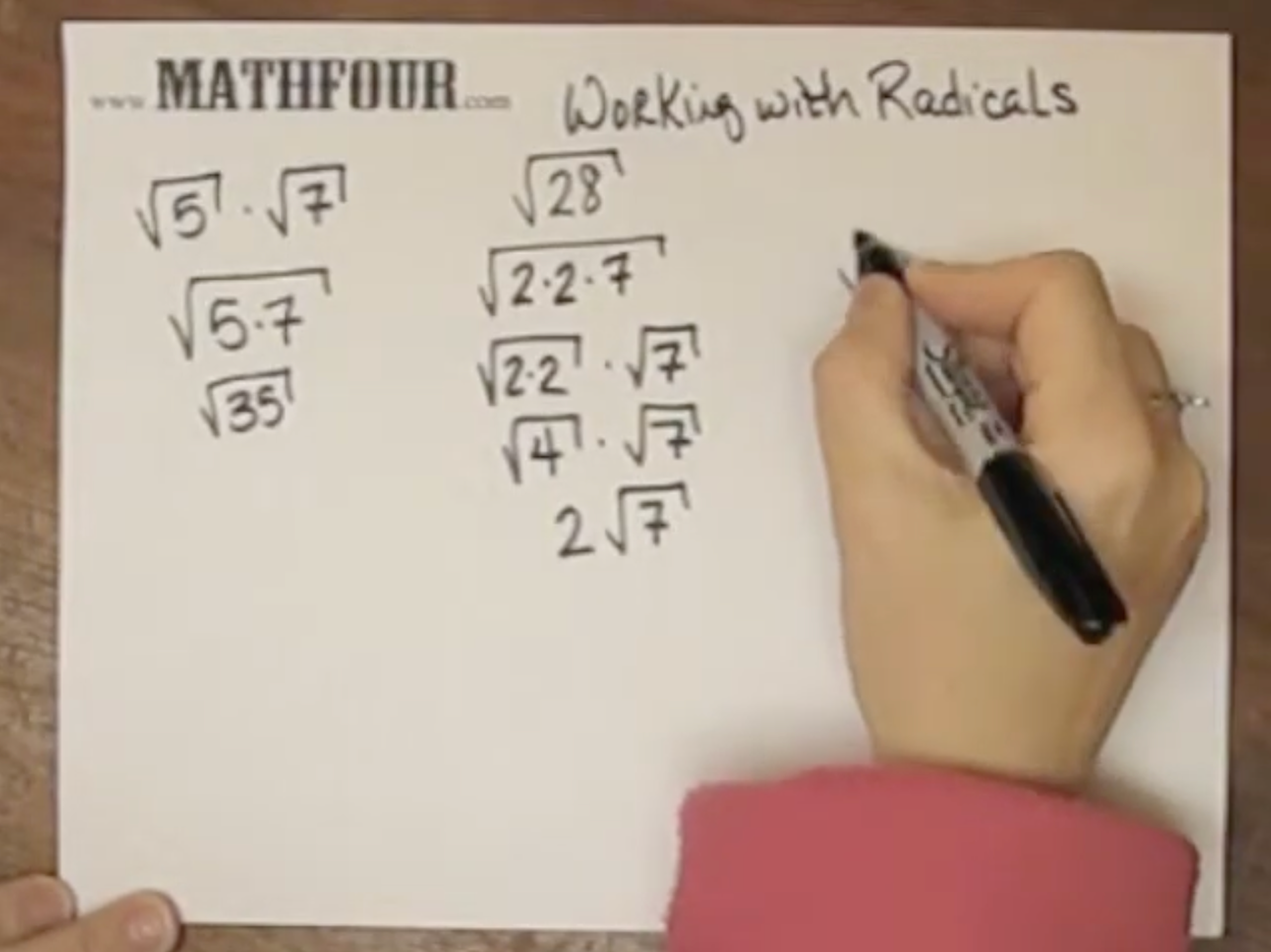
Square Roots (aka radicals) are part of the multiplication world. They have the same properties, but because they look weird – living in little “houses” – it is hard to grasp what they can do.
This is how the “houses” (the radicals) can “move”:
After that, you can work with multiple radicals:
It is important to note that this little trick works because it’s all multiplication, division and roots. If you have addition or subtraction in there, you’ve got yourself a challenge. Watch this to see how to deal with addition in the mix:
Thanks to jrobbo at MyMathForum.com for the inspiration for this post.
In the previous post, I explained some basics about base 12 counting. Since you’re back, clearly you’re a glutton for punishment (or your Algebra book is requiring you to do this).
Either way, here’s how to add in base 12:
And how to multiply:
I cheated a little here here, because to me this is the easiest way. If you need an example or two to do it “right,” post it in the comments and I’ll do a few for you.