Category: Algebra

  • 3 Places to See the Coordinate Plane in Action

    3 Places to See the Coordinate Plane in Action

    I was browsing through the book Family Math and found a nifty game called Hurkle. It goes a little something like this:

    1. Someone picks a place on the coordinate plane (in secret) for Hurkle to live.
    2. Others guess Hurkle’s home by giving coordinates and pointing out those coordinates.
    3. When they are wrong, they are given a hint of which way to go (from their guess) to find Hurkle.

    The coordinate “space” is around too.

    This made me think of the conversation I had with a neighbor the other day while walking our children to the park. When Scotty beams someone in Star Trek, he needs coordinates. But those coordinates must be measured from some origin (0,0,0) in the universe to make any sense. So where’s the origin?

    A student of mine long ago found that the origin was Earth. My neighbor argued it should be Vulcan – apparently they started the United Federation of Planets.

    And we can find coordinates at work in board games.

    With thoughts of these two in my mind, I wonder what ever happened to the game of Battleship. It’s a great game of coordinates along with logic. Once you hit a ship, you have to go in each direction to determine how big the ship is and in what direction.

    I’m excited about looking around my world today for more coordinate systems. Where do you see them in your world? And how do you apply them in your teaching? Leave your thoughts and ideas in the comments.

  • How To Teach Algebraic Closure

    How To Teach Algebraic Closure

    Thanks to Kellie D for this question: “How do I know if a set is closed under the rule of addition, same question for multiplication?”

    Closure under addition or multiplication is a concept from Abstract Algebra that’s taught in not-so-abstract Algebra classes. It can be intuitive, if taught properly.

    You first have to start with two things: a set and an operation. A set is a bunch of things. Okay, the definition is fuller than that, but for general purposes, it’s a basket full of goodies.

    An operation is a way to “combine” any two things in that basket.

    You can’t speak of closure without having both of these together. In Abstract Algebra, this pair of things is called an Algebraic System. That’s a fancy math term that isn’t necessary to teach, but might be helpful if you need to look things up.

    We say a set is closed under an operation if you can combine any two things and the result is back in the set. Notice that the definition has BOTH the words set and operation. You can’t just be closed under an operation – you gotta have the set to put it in context.

    Example 1 – Kitchen Goodies

    Suppose your basket of goodies is this: {flour, sugar, chocolate chips, baking powder, egg, butter}.

    And your operation is this: “mix two things together in a bowl with a spoon.”

    It isn’t mathematical, per se, but it’s a set and an operation.

    So if you combine two things from the basket by mixing them together, what do you get? Yummy goodness for sure, right? But the result of the blend is not found in the basket as one of the things!

    Mix sugar with butter and then look in the basket. Is it there as a single blob of buttery sweetness? Nope. So the set of goodies is not closed under the operation of mixing.

    Note: the opposite of closed is “not closed.” The word “open” isn’t used here.

    Example 2 – Math Stuff

    Now you have another basket of goodies: all the even numbers (including positives and negatives and zero). We can write this in the fancy math way like this: { x | x is an even integer }

    The operation is addition.

    If you combine (add) two things from the basket (any two even numbers), what do you get?

    8 + 24 = 32

    Is it back in the basket, i.e. is the answer an even number? YES!

    Try some more to make sure. Technically you should prove it, but usually your intuition is good enough – especially in a high school or undergraduate class.

    So we write “the set of even numbers is closed under the operation of addition.” Again, notice that we have BOTH set and operation involved.

    Example 3 – More Math Stuff

    Here’s your set: all the integers (positive, negative and zero whole numbers).

    And the operation: Division.

    If you combine (divide) two things from the basket (integers), what do you get?

    27 ÷ 3 = 9

    Looks good, right? 9 is an integer. But what about  27 ÷ 2 = 13.5?

    13.5 isn’t an integer because it has a decimal piece. Some bits (integers) when combined (divided) turn out to be in the basket (another integer). But not all do. And they ALL have to work in order for it to be called closed.

    So this is NOT a closed system. Or we can write, “the set of integers is not closed under the operation of division.”

    Example 4 – Even More Math Stuff

    Set: {1, 5, 6, 7, 14}

    Operation: addition.

    Is it closed?

    1 + 5 = 6 check!

    5 + 6 = 11 oops! 11 isn’t in that set.

    This set is not closed under the operation of addition. You might notice that a finite set (a set with only so much stuff) of regular numbers won’t ever be closed under addition – just add the two biggest numbers and you “bust” out of the set.

    Going Beyond…

    Your sets can be just about anything: real numbers, rationals (fraction-like numbers), whole numbers. They can even be bunches of matrices, polynomials, imaginary numbers, complex numbers or functions! The operations would be one of the normal operations that you would use on things in that set anyway.

    Questions about how to teach this? Questions on how to learn it? Leave them in the comments.

  • How to Remember Exponent Rules without Brain Ooze

    How to Remember Exponent Rules without Brain Ooze

    This post is by request from @corrincross on Twitter.

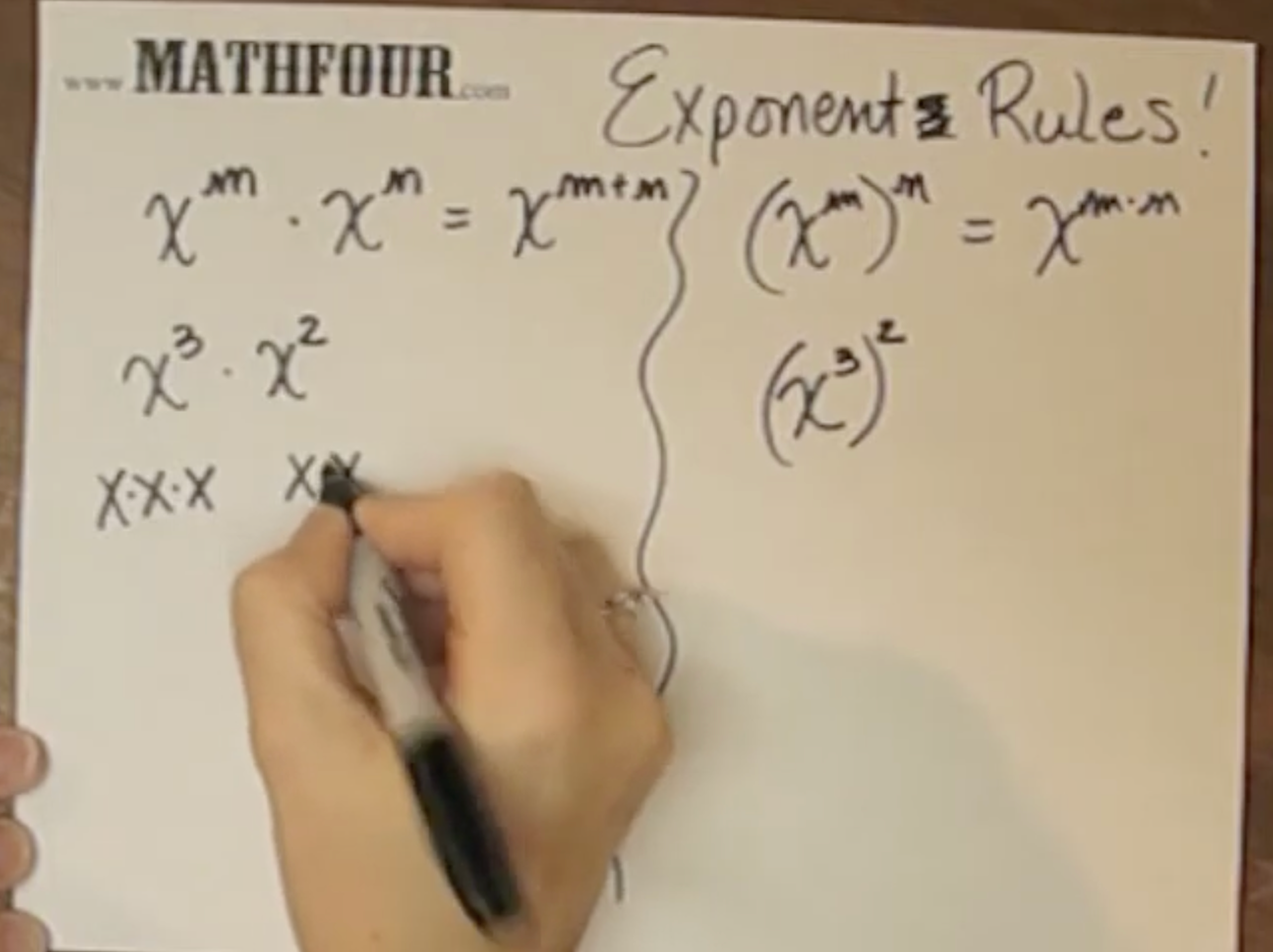
    Exponent rules are hard. Well, they are hard to remember, anyhow. But there’s an easy way that won’t make your brain ooze – and that’s doing a mini-experiment each time you have to deal with them.

    First remember what an exponent really is. It’s a shortcut for multiplication. Check it out:

    Notice that there are really only two rules that get you screwed up: when to multiply the tiny buggers and when to add them. Here’s how I teach this (and how I remember it myself!):

    So the new rules are x3x2=x3+2x^3 \cdot x^2 = x^{3+2} and (x3)2=x32(x^3)^2 = x^{3 \cdot 2}.

    And then what about those negative exponents? Again, you can’t remember a rule unless you remember what they heck is really going on. We go back to adding in this video to explain the similarity between the two shortcuts of multiplication and exponents:

    Can you use this in your classrooms? Share your thoughts in the comments.

    Thanks to Corrin Cross (@corrincross on Twitter) for requesting this post. Corrin is a Secondary Ed student with a math major and music minor at the University of Regina in Saskatchewan, Canada.

  • How and When You Can Manipulate Square Roots

    How and When You Can Manipulate Square Roots

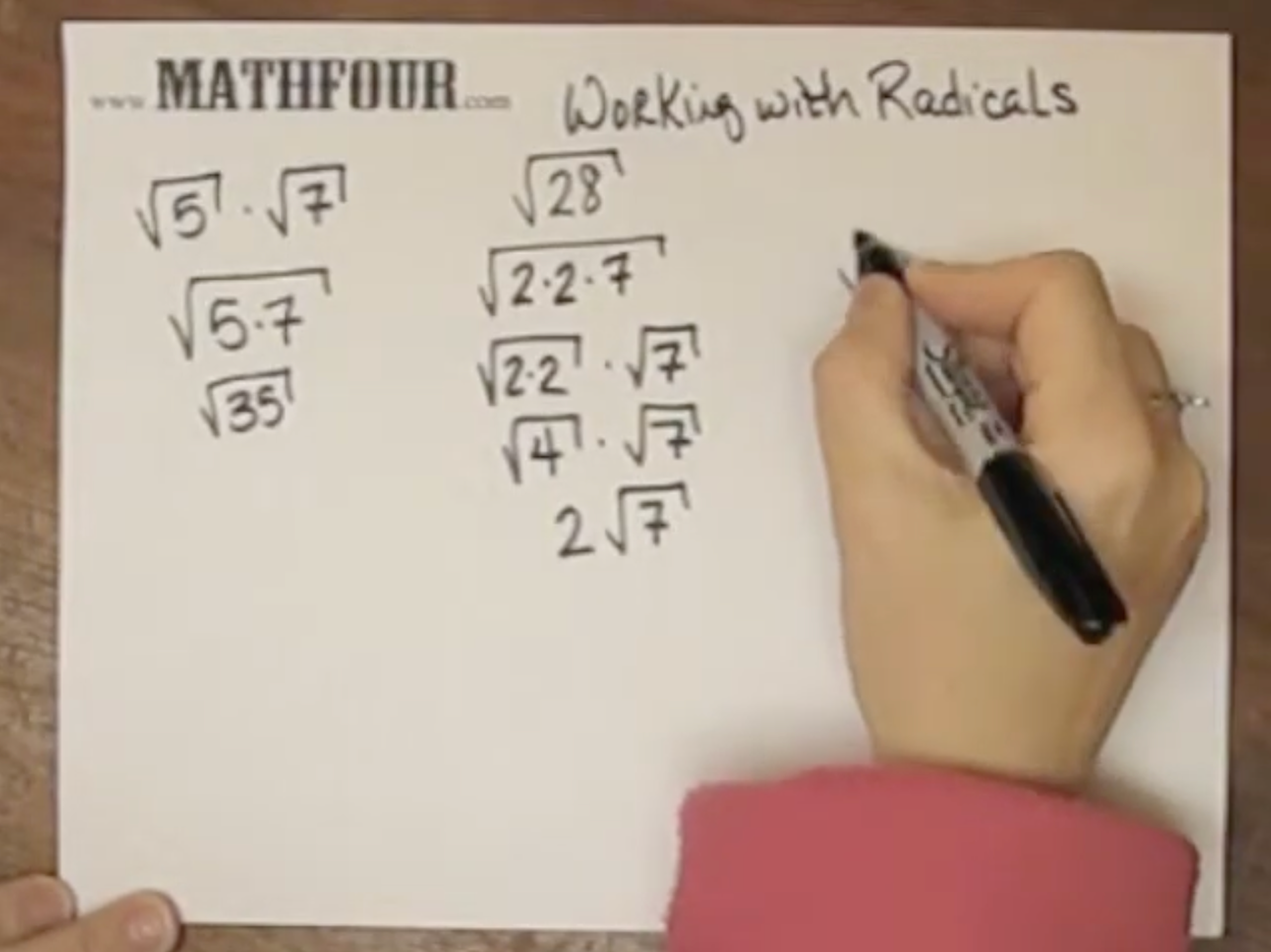
    Square Roots (aka radicals) are part of the multiplication world. They have the same properties, but because they look weird – living in little “houses” – it is hard to grasp what they can do.

    This is how the “houses” (the radicals) can “move”:

    After that, you can work with multiple radicals:

    It is important to note that this little trick works because it’s all multiplication, division and roots. If you have addition or subtraction in there, you’ve got yourself a challenge. Watch this to see how to deal with addition in the mix:

    Thanks to jrobbo at MyMathForum.com for the inspiration for this post.

  • How to Add and Multiply in Base 12

    How to Add and Multiply in Base 12

    In the previous post, I explained some basics about base 12 counting. Since you’re back, clearly you’re a glutton for punishment (or your Algebra book is requiring you to do this).

    Either way, here’s how to add in base 12:

    And how to multiply:

    I cheated a little here here, because to me this is the easiest way. If you need an example or two to do it “right,” post it in the comments and I’ll do a few for you.

    A big thanks goes out to Kellie for the question.

  • What Base 12 Means

    What Base 12 Means

    Algebra books seem to believe that base 12 is a good idea for humans to use. This is only in the case of that pianist in GATTACA that has 12 fingers. We have a base 10 system because we have 10 fingers. (This is why you’re allowed to count and do arithmetic on your hands.)

    Regardless of the general uselessness of a base 12 system, working with it is a good exercise in patience, alternate thinking and puzzle solving.

    Here’s how to “count” in base 12:

    But what if you want to get higher than you can count? For instance, what if some algebra book asks, “What’s after EE012?”

    Now check out how to switch a base 10 number (which is our way) into a base 12 number:

    Want more? Check out how to add and multiply in the next post.

    Thanks to Kellie for the inspiration for this post.

  • What the Heck Is the Zero Product Rule?

    What the Heck Is the Zero Product Rule?

    The fancy answer is, “For all numbers a and b, ab = 0 implies a = 0 or b = 0.”

    The less fancy, and still strange answer is: If two things multiply to get zero, one or both of them better be zero. Like this:

    Too much pixie dust, for my taste. What doesn’t work, for sure, is this:

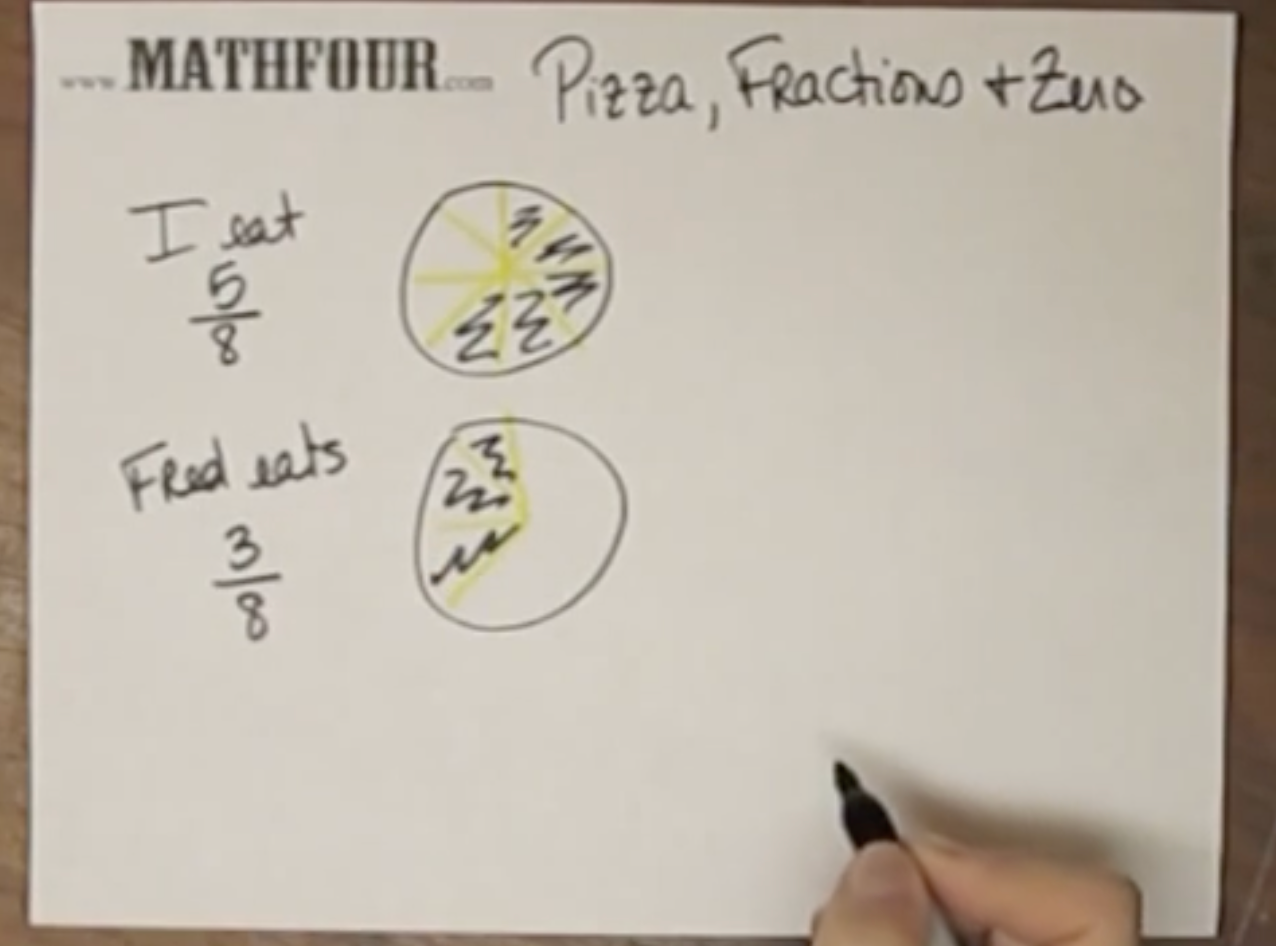
    So why does it work with zero and not three?!? To answer this, we need a little background on fractions and zero. And pizza – pizza’s always a good thing to add to math:

    Using the fact in the video above, the “foorp” in this video shows why it’s true:

    Special thanks to GFC at MyMathForum.com for inspiring this post.

  • Those Pesky Exponents – How to Distribute Exponents over Multiplication

    Those Pesky Exponents – How to Distribute Exponents over Multiplication

    Remember that you can distribute multiplication over addition? You can also distribute exponents over multiplication.

    Here’s how and why it works:

    And here it is written out “long ways” for an algebra problem. Remember, you can use the short version. I do the videos with the long version to help you remember why it works.

    Have any questions? Post them in the comments!

  • How to Use the Quadratic Formula to Never Factor Polynomials Again

    How to Use the Quadratic Formula to Never Factor Polynomials Again

    We learn to factor polynomials so we can solve for x. Stuff like

    3x2 + 2x – 1

    can be easily factored into

    (3x – 1)(x + 1)

    But some things aren’t so easy. And some things are just down right a pain in the bottom. Like this one:

    18x2 + 189x + 490

    “Just shoot me,” you might be thinking. But cool your jets, cowboy. Here’s the first tool you need to never factor polynomials again:

    I know – who wants to memorize that formula? But wait. If you use that one formula that you can memorize, you never have to factor polynomials again. Watch:

    So the factoring isn’t bad on that one, right? How about this one:

    And how about if you come across one of these. Wouldn’t it be nice to get rid of all guesswork:

    This has some disadvantages, of course. You see that there’s a lot more arithmetic. And there’s some things to look out for. But if you hate trial and error (like I do), then you might be willing to take the bad with that good.

    Whatcha think?

  • How and When to Cancel Things in Fractions

    How and When to Cancel Things in Fractions

    One of the common errors in algebra is canceling bits in fractions that can’t be canceled. To remember the rule, though, you don’t have to memorize anything. You only have to think of a plain arithmetic problem to compare it.

    To help you remember what’s allowed with problem:

    3x+42\frac{3x+4}{2}

    think about this simpler problem:

    8+42\frac{8+4}{2}

    Like this:

    And just to keep you straight, here are the requirements (and a couple of examples) for the fancy <cue music> “distributive property.”

    What do you think of this explanation? Post your thoughts in the comments.