Last night I had the privilege to meet and teach Eddie*, an ESL student from Mexico, at Literacy Advance of Houston. He was there to learn in the “Math and Your Life” class, as part of the “Math and…” class series.
I didn’t realize I was there to learn too.
I walked in prepared to discuss just about anything math related. And I’m glad that was the preparation I did.
Eddie was interested in something that I’ve long struggled with. And I’m guessing many children struggle with it, too.
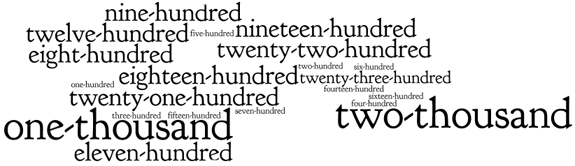
In English, the number 1600 is pronounced both as sixteen hundred and as one thousand six hundred. I still get these mixed up. Not when I stop and think about them, but when I casually and quickly throw them out.
Husband is often stunned when I tell him I saw a new suburban at the low low price of thirty-five hundred dollars. Of course I mean thirty-five thousand dollars!
It’s not just me, I guess.
I wonder how many other grown-ups still struggle with this. And how often we neglect to teach this to children.
We are quite accustomed, and comfortable, with teaching our youngsters to count from 1 to 10. Were amazingly proud when we can get them to count from 1 to 20.
Is that enough? Based on my conversation with Eddie last night, no.
Teach them skip counting with hundreds!
Why not use the 1-20 model with hundreds? Like this:
one hundred two hundred three hundred . . . eight hundred nine hundred one thousand eleven hundred twelve hundred thirteen hundred fourteen hundred . . . nineteen hundred two thousand twenty one hundred . . .
Teach them all sorts of counting!
I suggested in this article to count with your children by fractions. It never occurred to me to count by giant numbers.
What other ways should we teach children to count? Share your ideas in the comments.
*”Eddie” is used as a variable – i.e. his name has been changed because I didn’t ask his permission to talk about him.
Now that school’s officially in session, I’m really thinking about all the homeschooling moms who are taking on teaching math. I can’t help but see the similarities to something they’ve already done – given birth.
For each, I noticed that…
It’s darn scary.
Giving birth is pretty freaky. Especially if you’ve never seen or done it before. If you have the privilege of seeing another arrive in this world, it makes it easier. (I watched both my sisters and my best friend give birth!)
Teaching math might be a whole new world – and pretty strange if you’ve never done it. Dig back to some good math experiences you had as a child and draw on those.
It’s gonna happen no matter what.
Kids get born. They must. And they do. So you might as well make the best of it and enjoy the process the best you can – with a happy and positive pregnancy!
Kids learn math. They must. And they do. So you might as well make the best of it and encourage them in the best way – with a happy and positive math environment!
You get to choose how you do it!
You can give birth at home, in a hospital, with a doctor, with nobody, with drugs, without drugs… pretty much any way you want.
We’ve got more freedom now that we ever had. In Texas, where Betsy and I live, a homeschool is an independent private school. We get to teach in an unschooling way with lovely things like Math on the Level.
It may not go the way you want,
You’ve got a great plan. You know what to do and how to do it. You’ve taken the classes and my goodness! You’re in hard labor for 32 hours and you’re still at labor station -4.
You might think you have the best curriculum in the world. You’re all prepared. You start teaching an holy cow! Your sweet student couldn’t be less interested in everything you’re presenting.
…so be flexible.
Yes you’re frustrated. Remember the goal – a healthy child. Put away the frustrations and go for the C. Make it up by being a breastfeeding champion.
Likewise, you’re wanting a happy, healthy child. Choose a different curriculum. Let your child choose a different one. Experiment. Make it up by taking the crew to a great museum.
There are professionals for this.
Get a good ob/gyn, doula or midwife. You don’t have to go-it alone.
Get a tutor, enroll in a program like Kumon, join a homeschool co-op. You don’t have to go-it alone.
There is lots of information online.
With books like Betsy Dewey’s Birthright and sites like this one, there’s no reason to go into either blind.
It’s hard,
Giving birth is no piece of cake. However you choose to do it, you’re gonna have pain – in some way. Not to mention the nine months of puberty-like hormone swings!
Teaching math is a challenge. It’s not about conveying information, it’s about following a child’s natural curiosity and pointing out the math that happens along the way. Which means having to recognize math and the learning/curiosity style of another human. Not an easy task.
…and it’s worth it.
AH, the prize! When you are presented with a slimy little mini-human, you can’t help but think how cool it is!
And when a munchkin comes to you and says, “Did you know…” your heart fills with the glee of knowing that she extrapolated to get that – not just memorized it.
Are there more?
Any other similarities that I missed? Share them in the comments!
Betsy Dewey, my cousin, was a huge help and resource when I was pregnant with Daughter. She was pregnant with her second at the same time – that made it even cooler!
Betsy is an advocate of natural home birth and homeschooling. This article is written in honor of her and everyone else that listens to the beat of their family’s drum – and marches to it!
I had the pleasure of assisting Sarah Shah in her appearance on Great Day Houston yesterday.
While preparing for the show, I observed Sarah and the host, Deborah Duncan, in the makeup room having a conversation about math.
When I said to Sarah later, “that was an interesting math conversation,” she looked at me with anticipation, encouraging me to share what I heard. She had no idea I was referring to her conversation!
The math conversation was fully on-topic.
It was national thrift store day, and Sarah was going to share with GDH viewers some tips on shopping at resale shops. The topic of the show inspired their kibitzing behind-the-scenes about buying gold jewelry.
Deborah was talking about how there’s a difference (sometimes big) between the cost of the gold in a piece of jewelry, and the sale price.
The cost of craftsmanship should be close to its value.
Deborah was making the point that there’s value on the design of an object based on the workmanship that went into it. And this goes only so far.
Right now gold prices are around $1700 per ounce. Since an ounce is around 28 grams, gold is valued at about $60 per gram.
The QVC bracelet in the picture is 9 grams. It’s selling for $530 – pretty much exactly the value of the gold contained within.
If the value of gold for a 9 gram bracelet is around $530, charging $3000 for it means you’re paying about $2500 for the craftsmanship!
Unconscious math is all around.
Aqua And Gold Fractal by Sharon Apted
It was a wonderful experience to see two intelligent, educated women having a lively and entertaining conversation about math. It was quite disheartening, though, that Sarah didn’t even recognize it. In a previous life she was a physicist.
How many other conversations about math are ignored? How many people who claim they aren’t good at math have these conversations every day?
Look around at your conversations this week. How many of them are about math? Share your conversations in the comments. And with your kids!
Most parents aren’t professional mathematicians. But there are a few. This is the sixth in a series of interviews with mathematician parents with the goal of helping parents integrate math teaching into parenting.
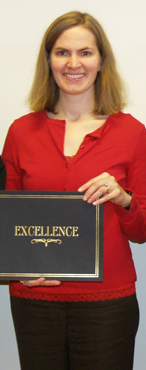
Jennifer here shown receiving recognition for being a Mississippi finalist for the Presidential Awards for Excellence in Mathematics and Science Teaching!
This week we visit with a high school math teacher in Mississippi. Jennifer Wilson, NBCT, teaches at Northwest Rankin High School, and is a Teachers Teaching with Technology (T3) instructor with Texas Instruments.
MathFour: Thanks so much, Jennifer for giving us your time. First, can you share a little about your degree and career?
Jennifer: I have a B.S. and an M.S. in mathematics. I have been teaching high school mathematics for 18 years.
MathFour: Tell me about your family – how many kids do you have and how old are they? Are any of them more or less interested in math than the others in the family?
Jennifer: I have two daughters who are 6 and 9. They are okay with math – but the 9 year old will tell everyone very quickly that her first love is reading.
MathFour: Do you have any worries about your girls academically? In particular, do you think they will do better in math than in other subjects because of your influence?
Jennifer: I feel very lucky to not be worried about my children academically. They love to learn. My husband and I both encourage their curiosity and try not to stifle their desire to ask why or come up with a different idea of how to do something, especially when the only good reason we can think of is “because I told you so”.
I think they will do well in math – but not necessarily better than other subjects. My husband and I both love to learn, and so the girls definitely recognize that desire and enjoy learning as well.
MathFour: That’s great! How do you play with your daughters? Do you view your playtime as different in any way than other “non-mathematician” parents?
Jennifer: We play games. I probably view play differently than a lot of parents – but probably similar to many teachers, no matter their subject of expertise. I am all about learning, and it is hard to turn that off, even at home.
MathFour: Do you think you speak with your daughters or behave differently than other parents because you have a math background?
Jennifer: Yes. Anytime some kind of math problem arises, I always ask the girls about their thinking, because I am very interested in how they arrive at answers.
At dinner, one daughter noticed that her tortilla chip was in the shape of a trapezoid, so we had a great conversation that night about trapezoids. We have a “pi” pie plate, so both girls already know a little bit about pi. They definitely call an “oval” an ellipse and a “diamond” a rhombus. They have called their blocks by the appropriate solid names, such as cylinders, prisms, and pyramids, since a very early age.
When the 9 year old missed a question on her state practice test about perspective drawing, instead of just telling her the correct answer, I got out the stash of Unifix cubes at our house to make her build the drawing with the cubes. She completely understood after doing so – and asked me to make up some more questions for her because she enjoyed working through the problems with the manipulatives. Both daughters play with my TI-Nspire™ CX handheld. They love making shapes, measuring their parts, and making them different colors.
MathFour: I had to google that one – fancy device!
Have you ever had either of your girls express negative thoughts about math? If not, how do you think you will handle it if that happens?
Jennifer: Not yet…I’m not sure I will handle it well. But I am hopeful that since my goal is not just calculating math but understanding math, they can at least appreciate my passion for it, and I will honor their passion for another subject, if the need arises.
MathFour: How do you think you’ll handle it if you find your self in disagreement with one of your children’s math teachers?
Jennifer: I’m not sure I will handle it well if it does happen, but so far, so good. I am lucky to teach in a great school district with great support for teachers at all levels, so I will keep my fingers crossed!
MathFour: Now to change direction a little to a more worldview of math. What do you see as the biggest challenge in math education today?
Jennifer: Having teachers who are experts in mathematics at all grade levels.
MathFour: What do you see great happening in the world of math education?
Jennifer: I see teachers who are willing to use technology to engage students in the learning and understanding of mathematics, teachers who are learning alongside students (often because of and through technology), and teachers who are willing to give up some of their control over the classroom to create a classroom that is truly interactive.
MathFour: What advice can you give to non-mathematician parents that might help them raise their kids to like and appreciate math.
Jennifer: I have been amazed at some of the mathematics that my students are learning in the computer games that they play. So while I realize that some students go overboard with the time that they spend in front of their electronic devices, find a way to encourage them to explore mathematics through tools that do interest them.
MathFour: Wonderful, Jennifer, thank you so much!
How ’bout You? It’s back to school time – do you have any questions for a super technology oriented math mom? Ask them in the comments!
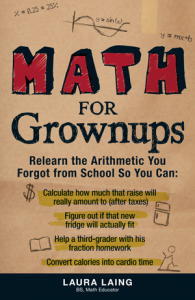
Today’s article is from Laura Laing, author of the book Math For Grownups and publisher of the website of the same name.
So you think you don’t use math on a daily basis? Think again.
You may not be solving for x, and the distance formula may not roll off the tip of your frontal lobe—mainly because you haven’t used it in years and years. But if you can put “parent” among your titles, you do math. I promise.
Just look at a typical day:
6:35 a.m.
Your darling daughter went to bed late last night. Seems that she couldn’t pull herself away from the most recent novel she’s devouring, and she had to finish, “just one chapter.” Problem is, she’s a bear to wake up when sleep deprived, and she’s got an 8:00 checkup at the pediatrician. She can usually get ready in about 45 minutes, and it takes 15 minutes to get to the doc’s office. How much longer can you let her sleep in?
9:03 a.m.
Check-up is done, and you’re waiting to pay the bill. You’ve got $33.65 in your wallet and a $25 co-pay. But after a morning of running errands, you’ve promised dear daughter lunch at the local fast food place. Should you use your cash for the co-pay or pay with plastic?
11:21 a.m.
At the grocery store, you’re deciding between three brands of ketchup. One is on sale for $2.27. For another, you have a 50¢ off coupon. And the third is a smaller container for only $1.49. Which one should you buy?
12:08 p.m.
At Burgers ‘R’ Us, your daughter has requested the chicken nuggets and a drink – no fries! You’d like to eat the fries that come with her kids’ meal, but you’re not sure you can afford the calories. Luckily, the restaurant has a handy sign displaying the caloric values for each menu item. What can you order to go with her fries that won’t force you to eat only carrot sticks for dinner?
1:31 p.m.
You need to fill up, and you have your choice of gas stations. One offers regular unleaded for $3.27 per gallon, plus a free car wash (a $10 value). Another offers $3.15 per gallon—no car wash. Which station offers the best deal?
2:47 p.m.
It’s time for your daughter to practice piano—a task that she hates. You thought the practicing contest that her teacher started would give her the motivation to practice every day. Nope. So today, she’s going to try to catch up on the days that she slacked off. She’s expected to practice a total of 15 minutes a day, but she’s only practiced a total of 25 minutes for the week. Her lesson is tomorrow. How many more minutes does she need to practice to please her teacher?
5:32 p.m.
Time for dinner, and you’re exhausted. Instead of making a meal from scratch, you decide to order from the local pizza joint. Your daughter wants plain cheese, your husband wants pepperoni and sausage and you want a veggie pizza. What’s the most cost-effective way to order dinner?
8:35 p.m.
Thankfully, your daughter has crashed early, meaning she can catch up on the sleep she lost last night. If you wake her up at 7:00 a.m., how much sleep will she have gotten?
Typical day? Perhaps. Typical math? Definitely.
So the next time you think, “I can’t do math,” keep in mind the number-based tasks that come across your path on a normal day. You might be surprised at what you accomplish without even thinking about it.
Where is the math in your day? Tell us in the comments!
Laura Laing is the author of Math for Grownups, a funny and accessible look at how the over-18 set uses math in everyday situations. While this post is not based exactly on a day out of her life, it could be. She is a freelance writer and the parent of a pre-teen in Baltimore.
Most parents aren’t professional mathematicians. But there are a few. This is the fifth in a series of interviews with mathematician parents with the goal of helping parents integrate math teaching into parenting.
MathFour: Thanks so much, David for taking the time to answer some questions. First, can you share some more about your degree and career? How long have you been in math?
David: I have a bachelor of science in mathematics with nearly 60 credits in honors level mathematics. I finished my degree in 1998, but have never been officially a mathematician. Instead, I teach mathematics in middle school and high school, and have recently moved into a new position as a learning specialist for technology.
MathFour: Tell me about your family – how many kids do you have and how old are they? How do your family members feel about math?
David: I have a wife, and a nearly 5 year old son. My wife found math to be painfully difficult for her entire career, but hides it well around our son. My son loves math. He recently confided in me that he knows math only slightly less than me, but that I know more technology, and he knows more science.
MathFour: How cute! And great that your wife tries to keep the math environment positive.
Do you have any worries about your son academically? In particular, do you think he will do better in math than in other subjects?
David: I have no concerns at all about my son academically. He is bright, creative, and independently minded. He will almost certainly do better in math than his other subjects. Today he ripped a book because the “binding was loose.” So we told him to find $11 dollars in his piggy bank. He pulled out five $2 coins and one $1 in about a minute, carefully counting by 2s for the first $10, and then adding another dollar.
MathFour: How do you play with your son? Do you inject math a lot?
David: I think we play ordinary games, with some exceptions. Certainly we include mathematical play in our sessions. We count everything, and introduce different ways of counting. We play dice games and practice adding small numbers. We stack blocks in patterns. I’ve also recently introduced a “how can we get this number game.” For example, “How can we get 5?” My son responded with “1 and 1 and 1 and 1 and 1 makes five. Hrmm. 2 and 3 makes five. 4 and 1 makes five.”
MathFour: Great game!
Do you think you speak with your son or behave differently than other parents because you have a math background?
David: Definitely. We spend much more time talking about numbers than other parents do.
MathFour: Has your son ever expressed negative thoughts about math?
David: I’ve not noticed any negative thoughts from my son on math, with the exception that he thinks I know more math than he does. He did ask me today about the odd, even pattern. “Why does it matter if a number is odd or even?” I told him it helped us know quickly if we could split the number into two equal parts. I don’t think he was terribly impressed by that explanation.
MathFour: LOL! I guess that is a little unimpressive.
Your son is almost five, so I’m guessing he’s not had many math teachers. Do you anticipate you’ll ever disagree with any of his math teachers? And what do you think you’ll do if that happens?
David: My son is just starting school. As I work at the same school as he will be attending, I will have to handle disagreements with his math teachers very carefully.
MathFour: Now to change direction a little to a more worldview of math. What do you see as the biggest challenge in math education today?
David: Mathematics, as it is usually taught, is neither interesting or relevant to students. Given that relevance and engagement are key to deep learning of a subject, it pretty much means that in most generations of people, the vast majority of them lack any functional numeracy.
MathFour: What do you see great happening in the world of math education?
David: These types of conversations are amazing in my mind. I love that I can speak my mind about problems in math education and not have everyone jump down my throat.
MathFour: What advice can you give to non-mathematician parents that might help them raise their kids to like and appreciate math.
David: Count lots. Play number games early. Treat learning mathematics as important as learning how to read. Spend time playing and learning early math with your kids. Don’t let your kids learn that worksheets and rote memorization are math.
MathFour: Wow, that was awesome, David! Thanks so much for your time and sharing with us.
How about You? What are your questions for David? Ask them in the comments. And don’t forget to check out all the great stuff on his website!
Most parents aren’t professional mathematicians. But there are a few. This is the fourth in a series of interviews with mathematician parents with the goal of helping parents integrate math teaching into parenting.
MathFour: Thanks so much, Marilyn for sharing some of you time with us. First, I’d like to ask about your background. What is your degree and career? How long have you been in math?
Marilyn: My bachelor of science degree is in mathematics. My master degree is in education with a concentration in mathematics and then an additional 30 hours of mathematics. I have been teaching mathematics for 21 years. I have taught grades 6 through 12. In addition I am now teaching on the college level at a local university for the past three years in the evenings while teaching high school during the day. Prior to teaching, I worked in government and banking for 10 years in the area of accounting.
MathFour: Wow, your life has been so full of math stuff! Tell me about your children. Are any of them more or less interested in math than the other children?
Marilyn: I have two children ages 23 and 18. My son, the oldest, has a degree in graphic design. His interest since elementary school has always been in art. Therefore he never showed an interest in mathematics and it was a bit of a struggle. My daughter has just graduated from high school and is going to college with a major in early childhood education. She has been much stronger in mathematics than her brother. But she doesn’t want to teach mathematics, of which I think she is really capable of.
MathFour: Did you have any worries about your children academically? In particular, did you think they will do better in math than in other subjects because of your influence?
I encourage them to do what they enjoy. I feel they have adequate mathematics skills and a good foundation due to my additional help provided at home. As a high school mathematics teacher, I have grown more concerned at the foundation that students are coming to high school with.
MathFour: How did you play with your kids? Did you incorporate math into your play?
Marilyn: We enjoyed playing board games such as checkers, chess, uno, sorry, playing cards. I wanted to use games that help thinking and reasoning skills. This made great family discussion times while having fun.
MathFour: Do you think you speak with your children or behave differently than other parents because you have a math background?
Marilyn: I have always spoken positively about mathematics. Many parents will say in front of children that they dislike mathematics or is not good at it. To me this almost like telling children that mathematics is something that is tolerated and should be dreaded and avoided whenever possible. As a mathematician I know how much mathematics is a gateway to many opportunities. This is one of the reasons that I list careers in my book, Math Attack.
MathFour: Have you ever had any of your children express negative thoughts about math and how did you handle it?
Marilyn: Yes, my children have spoken negatively from time to time, mostly during test times. I offer advice and encouragement. It is important to stay positive and listen to their concerns and make suggestions.
MathFour: Have you ever disagreed with one of your children’s math teachers? What happened and how did you handle it?
Marilyn: Yes, I have had a different method of solving math problems. I talked with my children and let them know that many math problems can be done in different ways. Actually I prefer for my children elementary and middle school teachers not know that I am a mathematics teacher. I didn’t want my children to be graded on a tougher standard than other students.
I experienced this growing up in a small town. My mother was a high school mathematics teacher, I felt looking back that I was graded on a tougher level and was expected to be extremely strong in mathematics. My sister experienced this also. She is an artist and doesn’t like mathematics.
MathFour: Now to change direction a little to a more worldview of math. What do you see as the biggest challenge in math education today?
Marilyn: I feel that many students do not have a strong foundation and understanding of mathematics. I have far too many high school students who do not have their times table and or addition facts memorized. Many mathematics textbooks cover too many topics. Studies have shown that the United States textbooks are thicker than other countries that are stronger in mathematics. It almost feels like a cram session.
By the time students get comfortable with a concept it is time to move onto something else. I feel this makes students feel less confident about their mathematics abilities. I think these feelings continue throughout the rest of their adult lives. Which leads to many adults going into careers that require as little mathematics as possible.
MathFour: What do you see great happening in the world of math education?
Marilyn: I think that it is good that a more hands on approach to teaching mathematics is now being used. Teachers are teaching to the different learning styles. I think that it is good that more high schools are requiring students to have more mathematics credit before graduating from high school. Many states require students to have three or four credits of high school mathematics. Also many of the mathematics curriculum are teaching with everyday life application.
MathFour: What advice can you give to non-mathematician parents that might help them raise their kids to like and appreciate math.
Marilyn: I would suggest to non-mathematician parents to speak positively about mathematics. Let their children understand that mathematics is like anything else – it takes practice and patience. Just as parents tell their children to practice at playing sports, they should feel that mathematics takes the same time and effort. Also parents should show their children positive ways they use mathematics in everyday activities such as sewing, cooking, planning a family trip, budgeting and grocery shopping.
Marilyn: It is a workbook for grades 6 through 12, after reading the biography paragraph, students must solve the math problems to see who the bio is about. The activities can also be used as a way to promote multicultural awareness and appreciation.
MathFour: I can’t wait to check it out! Thanks again for your time and sharing with us.
How about You? Got any questions for this week’s mathematician parent? Ask them in the comments and we’ll drag her in here to answer them.
Originally published as a guest post on MathForGrownups.com, a math blog by Laura Laing.
Guest Post: Grownups can learn new tricks!
Bon Crowder, another math evangelist
A couple of weeks ago, a fellow freelance writer wrote me about her foray into graduate school. She needed to brush up on some math skills, and she wasn’t sure how. I have a feeling that her questions weren’t unique. Whether you need to learn a little extra to help your kid with his homework or you need to take a math class to further your education, learning math again (or for the first time) can be daunting.
Luckily, my friend and fellow math blogger, Bon Crowder offered to write a guest post on this very topic. I swear, Bon and I were separated at graduation or something, because we approach math education in very similar ways. Plus she’s fun. (See? Math folks aren’t always boring and difficult to understand!)
I wanted to title this “Being a Great Adult Learner.”
But that’s dumb. All adults are great learners. If we weren’t, we’d be stumbling around, bumping into doors, starving and naked. We know how to learn, and the proof is that we’re still alive.
And dressed.
The question is “What makes you learn?”
1) You need confidence.
Confidence involves two things: feeling worthy and knowing you have the ability.
When people feel they’re entitled to something, they’re more likely to feel confident in getting it. Hang around any Best Buy service desk and you’ll see this in action. People say all kinds of strange things when trying to return a broken product, and these things are said with a sense of entitlement. BY GOLLY they’re going to get their way!
So how do you gain worthiness and ability? You’re worthy of it because you already have it. And you’re able to do it because you already do.
You have it all. It’s just hidden behind a wall of words you or someone else (or both) has told you for years. Now’s the time to ignore everybody, even yourself.
Because here’s the gosh-honest truth: There is not a single thing within a mathematician that is not within you.
You’ve done math since you were a kid. Even before you were in school. You knew at a deep level that if there was one toy and there was another kid around, you’d better run like the dickens to get it. There’s no dividing that toy evenly between kids.
You balance your checkbook (or you would be in jail right now), you probably have some rough idea of your gas mileage, and you know that if you have 12 people coming over, you’re going to have to double or triple that recipe for shepherds pie. You know math. Now’s the time to admit it.
So say this every night before your prayers. If you don’t pray at night, say it twice:
I do math. Today I woke up on time because I calculated how long it would take to get dressed. I knew how much money to spend because balanced my checkbook. I figured out how much weight I needed to lose – and I used math to do it.
Modify this statement to fit your lifestyle and run with it. Every night.
2) You need the right environment.
Once you’ve tapped in to the realization that you’re inherently good at math, you need the right learning environment.
This includes location, timing and the other people involved. If you have to drive too far away after working all day and all you get is a lousy quarter-pounder-with-cheese, you’re going to be tired, grumpy and irritable. If your class is full of teenagers fresh out of high school and the professor is 400 years old and believes in death by PowerPoint, things are not going to go well.
How do you know the right environment?
Look at all the learning experiences you’ve had through the years. List out the good ones and the bad ones. And then dig deep – what made the good ones good? Why were the bad ones so detrimental?
Include timing, location, student body, temperature in the room and details of the instructor. List out the attitude of the instructor, his/her teaching style, voice intonations – even how he wrote on the board.
Pick out the deal-breakers and the nice-to-haves and write them on a special piece of paper. This is your official “Environment Requirement” page. Laminate it, put it in Evernote, tatoo it to your bottom – whatever you do to keep it close so you can refer to it often.
How do you make sure your Environment Requirements are honored?
Here’s where that sense of entitlement comes back into play. If your class has a deal-breaker environment element, do something about it. Think, “If this were a faulty remote control that I bought at Best Buy, how would I handle it?”
Ask the instructor to manage the loud students better. Ask building maintenance to change the temp of the room (or bring a sweater). Don’t sign up for a class during a time when you’ll be tired, hungry and irritable.
And if you can’t change the environment – leave. Drop the class. Get your money back.
If it were a crappy remote control, that’s what you’d do, right?
You’re dressed…
And fed. You learn all the time. And you do math.
Now go find a class that fits and have fun!
Bon Crowder publishes www.MathFour.com, a math education site for parents. But that’s not all! Bon has launched a really, really, really cool initiative called Count 10, Read 10. While parents are encouraged to read to their infants, toddlers and preschoolers, we’re rarely encouraged to inject a little bit of math into the day. Bon will show you how. Take a look at her blog for more information on developing math literacy (or numeracy). I’ll be writing about this more in the coming months.
Questions or comments? Leave them in the comments section below!
Most parents aren’t professional mathematicians. But there are a few. This is the third in a series of interviews with mathematician parents with the goal of helping parents integrate math teaching into parenting.
I had the privilege of interviewing John Golden, a university math professor and publisher of Math Hombre, a website with clever and fun math content that’s new every week!
Just a sample: “As a bad beginning teacher, emulating David Letterman of all people, I realized that I loved teaching math.”
MathFour: Thanks for taking the time to answer some questions, John. First, what’s your degree and career? And how long have you been in math?
John: I have a PhD math in 1996, and am working as math ed faculty at GVSU a 25000 student public university in Michigan.
MathFour: Tell us about your children and how they feel about math.
John: Xavier – 11, a bit more positive about math than his sister, Ysabela – 12. Neither loves it.
MathFour: Do you have any worries about your children academically? In particular, do you think they will do better in math than in other subjects because of your influence?
John: They’re both decent problem solvers, but that doesn’t necessarily equip them to do school mathematics. Ysabela, for example, found out this year she wasn’t allowed to use her method to divide and had to use the standard algorithm.
We encourage them to follow their passions. Both are quite artistic, and Ysabela is an amazing reader. I do worry that I’ve emphasized understanding over grades to the point where they have no interest in academic success.
MathFour: How do you play with your kids? Do you play math things?
John: Lots of games: card, board, table. No video games other than some flash games on the computer. I love games for their math like nature, or math for its game-like nature, so I see it as connected.
MathFour: Do you think you speak with your children or behave differently than other parents because you have a math background?
John: Definitely. Distinguish between what they’re asked to do and what math is, talk about cool and interesting math connections, do think alouds when doing homework, etc.
MathFour: Have you ever had any of your children express negative thoughts about math and how did you handle it?
John: More than occasionally. I take it with a grain of salt because I hated math at this age, too – for being boring and repetitive. I talk about the importance or confirm the irrelevance of what they’re doing, and try to emphasize making sense, and help them make sense.
MathFour: Have you ever disagreed with one of your children’s math teachers?
John: I always volunteer in their classrooms and bring games and such into it. This year, my daughter’s middle school classroom didn’t have me until the end of the year to do algebra tiles, but that was a positive experience. I strongly respect teachers, whether I agree or disagree, and never feel like they’re doing anything other than what they think is best.
MathFour: Now to change direction a little to a more worldview of math. What do you see as the biggest challenge in math education today?
John: Irrelevance of school mathematics, anti-math culture, misunderstanding of what math is, professional/governmental insistence on teaching junk, high stakes tests that preserve bad pedagogy…
MathFour: Wow, that’s a lot. So what do you see great happening in the world of math education?
John: Internet networking, slow but growing awareness among new math teachers about better ways, leveraging of new technologies and opportunities for change because of bad test results.
MathFour: What advice can you give to non-mathematician parents that might help them raise their kids to like and appreciate math.
John: Give it a go themselves. If it didn’t the first time, try to make sense of it along with your kids if they learn it. Value thinking and communication over the right answer. Play games!
MathFour: Thanks so much, John! Great tips and insight.
How about you? What are some questions you have for a mathematician parent? Share them in the comments – I’ll try to get John in here to answer them.
Most parents aren’t professional mathematicians. But there are a few. This is the second in a series of interviews with mathematician parents with the goal of helping parents integrate math teaching into parenting.
I had the privilege of interviewing Caroline Mukisa, a math teacher and math blogger.
MathFour: Thanks for taking the time to chat, Caroline. First, what’s your degree and career? And how long have you been in math?
I’ve a Bachelors in Civil Engineering from Imperial College, University of London and a Post Graduate Certificate in Maths Education from Cambridge University. I taught maths to high school students in the UK, and I also ran a Kumon tuition centre before moving to the Middle East as an expat. I now run the Maths Insider website. My husband has a Bachelors in Maths also from Imperial and a Masters in Mathematical Modeling from Oxford University.
MathFour: Tell me about your family – how many kids do you have and how old are they? Are any of them more or less interested in math than the others?
Caroline: I’ve got four kids aged 11, 10, 4 and 2. My 10 year old son is very much the maths boffin, he’s memorized the first 300 digits of pi just for fun. His 11 year old sister is more of a problem solver. The younger two like counting and sorting but it’s too early to say if they’ve caught the maths bug yet!
MathFour: Do you have any worries about your children academically? In particular, do you think they will do better in math than in other subjects because of your influence?
Caroline: With maths, being a former maths teacher, I have a feel of how they’re each doing with that subject, whereas with the other subjects, it’s difficult to judge. For example, “Is that poem they wrote good for their age level?”
MathFour: How do you play with your kids? In particular, what kind of math play do you do compared with non-math play?
Caroline: We talk a lot about maths, we like showing them You Tube videos or Ted Talks related to maths or science, but we also try to expose them to different things like poetry, anthropology, and business.
MathFour: Do you think you speak with your children or behave differently than other parents because you have a math background?
Caroline: I’m not sure about that. I don’t talk about maths with my kids in front of other parents – I don’t want to appear to be “showing off” although my 10 yr old likes to “perform maths.”
MathFour: Have you ever had any of your children express negative thoughts about math and how did you handle it?
Caroline: Of course! There’s always days when maths homework is not appreciated, and although my 11 year old finds maths easy, I wouldn’t say she loves it – she likes that maths can help her do the things she likes, like Design and Technology and Science. It’s not a problem – kids shouldn’t be carbon copies of their parents.
MathFour: How is the interaction with your children’s math teachers?
Caroline: I usually let my kids teachers know early on about my and my husband’s maths background. We try to work with the kids teachers to help extend their maths but in the end we can supplement and support their maths ourselves at home.
MathFour: Now to change direction a little to a more worldview of math. What do you see as the biggest challenge in math education today?
Caroline: With the move away from rote learning towards practical maths, kids mental maths skills are declining. Parents need to make sure that they’re reinforcing those skills at home, since there’s not enough time allocated to fully learning them within the curriculum.
MathFour: What do you see great happening in the world of math education?
Caroline: I love that kids get to explore different practical applications of maths, with many teachers, using technology to present real-life math problems.
MathFour: What advice can you give to non-mathematician parents that might help them raise their kids to like and appreciate math.
Caroline: I think the key things are to stay positive about maths even if you hate it, try to spot something related to maths as often as you can. If your child is having problems with maths, act early and make sure their basic skills are solid. And of course, read MathFour and Maths Insider!
MathFour: Thanks so much for taking the time to answer our questions, Caroline!
How about you? Do you have any questions for a mathematician parent? Share them in the comments – I’ll bet Caroline will be around to answer them!