

Tag: logarithm

  • Midpoint Formula and Counting – Logarithmic Style

    Midpoint Formula and Counting – Logarithmic Style

    Download a printable version of this post here.

    I’ve never been a believer in the real number line. It just always felt wrong that between any two numbers, there’s another number. Sure, you can go between two things – but is there a number there?

    And then I think, “Well, add up the numbers you’re standing between and divide it by 2 – that’s the number between them.”

    But it still doesn’t feel right.

    I could be onto something, though.

    I listened to Episode #110 of Stuff To Blow Your Mind called “Is math a human invention or a human discovery?” They pointed out that tiny babies can perceive quantities.

    “Curious,” I thought.

    Then I peeked at their math series, in particular the article on What are Numbers? Which led me to Stanislas Dehaene and his appearance on RadioLab’s episode on Innate Numbers.

    Here’s the discussion.

    I was particularly interested when they noted (around minute 11) that we don’t naturally switch from logarithmic thinking to this 1-2-3-4-counting we do now!

    Around minute 12 in the audio, they consider the idea of midpoint. Dehaene notes that in logarithmic thinking, the midpoint between 1 and 9 isn’t 5, but 3.

    The midpoint between 1 and 9 is… 3?

    Here’s how we think of the middle: “What do I add to 1 twice to get 9?”

    We can add 4 to 1, twice, to get 9. So then we add it only once to get halfway there – and halfway there is 5.

    Graphically it can look like this:

    We could also use the fancy midpoint formula:

    \((x+y) \cdot \frac{1}{2} = (1+9) \cdot \frac{1}{2} = 10 \cdot \frac{1}{2} = 5\)

    Instead of adding, how about…

    Dehaene notes that logarithmic thinkers multiply to find the midpoint! Like this:

    These people think, “What do I multiply by 1 twice to get to 9?”

    So the new fancy formula can be seen as this:

    \((x \cdot y)^ {\frac{1}{2}} = (1 \cdot 9)^{\frac{1}{2}} = 9^{\frac{1}{2}} = 3 \)

    Whoa!

    Midpoint Formula Gone Wild!

    Look how the formula got adjusted:
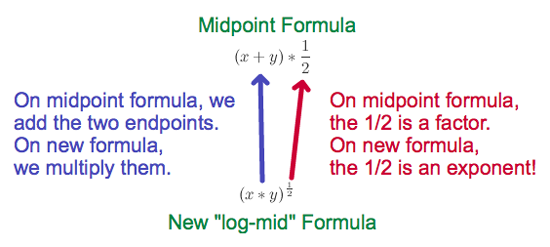
    (Of course this leads to a whole ‘nother discussion about how the square root is really just “half” with respect to multiplication. But that’s going a bit to far for this article)

    How about another “midpoint” example?

    What’s between 4 and 762?

    For “normal” folks, it’s:

    \((4+762) \cdot \frac{1}{2} = 766 \cdot \frac{1}{2} = 383 \)

    And for the more “natural,” logarithmic thinkers, it’s:

    \((4 \cdot 762)^ {\frac{1}{2}} = (3048)^{\frac{1}{2}} = 55 \)

    Like this:

    And the bigger the numbers, the more “ish” things become. And apparently, that’s okay!

    So maybe we do have it wrong.

    I’ve told thousands of students over the years that mathematicians just make this crap up. There’s no truth to that “mathematics is the universal language” hoo-ha that they feed you in the movies.

    Leopold Kronecker noted:

    God made the integers; all else is the work of man.

    And just maybe man has messed it up.

    So is there really a number between any two numbers? Or is there just something “sort of” between any two numbers?

    What does this mean to math learners?

    Okay – now the bottom line. What does this mean to grownups teaching math – and the kids learning math?

    These little super heros have amazing powers – right when they’re born!

    Well – one thing is that we grownups can lay off. Let the kids learn their own ways. Let them inquire, discover and develop their own methods for doing things.

    If they’re logarithmic thinkers (which they are from the start), let them ride that wave a while.

    Also, remember that we, the grownups, have been conditioned out of logarithmic thinking. Which means that their way (the natural way) seems wrong.

    But we are the ones who are wrong.

    So if your kids don’t believe what you’re feeding them. Let them doubt. They’ll learn enough eventually to pay their rent, balance their checkbook and meet their friends halfway.

    With or without our interruption.

    Buy Dehaene’s The Number Sense on Amazon.

    Share your thoughts in the comments or on twitter/x.

    You might also like:
  • The Order of Operations Explained: Exponents

    The Order of Operations Explained: Exponents

    This is the 3rd in the series The Order of Operations Explained. For the other articles in this series, click here to visit the introduction.

    Exponents are the second in the list for the Order of Operations (OoO).

    When we want to find the result of 32 x (2 + 7), we have no problem. We know to do parenthesis and then exponents, then multiplication.

    When you teach algebra, you’ll have to teach some distributing of exponents. But that’s still okay. And the rules of exponents are pretty straight up.

    So why a whole article on exponents?

    In the order of operations, the “Exponents” rule represents a bunch more than just superscripts or tiny numbers flying up and to the right of things.

    Roots are exponents, too!

    Tree Roots by Linda Allardice

    Not the ones from trees, but things like square roots and cube roots. Consider 9+2\sqrt9 + 2. You do the square root first because it qualified as an “exponent.”

    But if you had 9+2\sqrt{9+2}, the 9 + 2 is under the radical sign (the square root sign) so it’s bound together in the “Parenthesis” rule.

    This one isn’t that hard with arithmetic, but when you come to algebra and start “undoing” these things – it’s important to remember that roots fall into this category.

    Fractional exponents are exponents.

    This one seems pretty “duh” so it’s easy to see how they fall into the “E” of the order of operations. But what are fractional exponents really?

    912 means 99^\frac{1}{2} \text{ means }\sqrt9

    So fractional exponents are the same as roots.

    Note that some fractional exponents are roots and “plain” exponents all mixed up. Like this one:

    2723 means 2723 as well as (273)2.27^\frac{2}{3} \text{ means } \sqrt[3]{27^2} \text{ as well as } (\sqrt[3]{27})^2.

    This is a big fat full concept that needs a little more explaining. I’ll write more on these in another article.

    Logs fall under the E.

    Axe In Stump by caroline steinhauer

    As my algebra and computer math teacher in high school, Mrs. Kelley, used to tell us – logarithms are exponents. It took me a long time to figure out what the heck she meant. But when I did, I thought it was brilliant.

    This is a true statement: log39=2\log_3 9 = 2. Let’s analyze it.

    Based on the definition of logarithms, this means that 32 = 9. Which we know is true.

    Notice who the exponent is in this: 32 = 9: 2 is the exponent. And 2 is the same as log39\log_3 9 because the equals sign in log39=2\log_3 9 = 2 means “is the same as.” So the logarithm log39\log_3 9 is the exponent 2.

    Still with me? Either way, it’s okay. It’s a weird concept that I can go into detail in a video soon.

    The thing to remember here is that logarithms fall into the “Exponents” rule of the order of operations.

    So if you have log39+7\log_3 9 + 7, you have to do the log39\log_3 9 first and then add the 7 after.

    Want more on exponents?

    In the meantime, you can check out more than everything you always wanted to know about exponents on the Wikipedia Exponents page. Rebecca Zook created a great video on logarithms. And check out this explanation and problems to work on fractional exponents.

    And let me know what you think. Did I miss something?

    Related articles