The #PowerMath classes and I were taken with the videos done by Westerville South High School in Westerville, Ohio. Especially the polynomial factoring one called “Teach Me How to Factor.”
The students asked that I put together some optional homework for them on the videos. No sense in watching something that fun and not getting to practice it!
Check out the video. Below it, there’s a free downloadable collection of “homework” problems that match each of the polynomial factoring examples in the video.
And right below that, parents and teachers can get the teacher cheat sheet I created to get a whole bunch of fairly easy polynomial factoring examples.
I’ve been dying to check out the book You Can Count on Monsters for a while. My sweet niece, without knowing how much I wanted it, gave it to me for Christmas!
It’s a book about numbers.
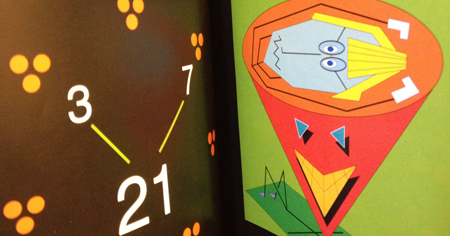
You Can Count on Monsters is a book that illustrates the numbers 1-100 in a very special way. Each of the prime numbers has an original “monster” that has a link to it. For instance, 2 has two eyes, 7 has a body with seven sides, and the edges of 19’s eyes – they total nineteen.
Each of the composite numbers is a blend of mosters from the prime numbers of its factorization.
So 14 is the 2-monster hanging around in the mouth of the 7-monster. The other composite numbers range from cute to crazy-hard-to-recognize (like the 72-monster).
For each number, you can examine the monster and see how it was created – what aspects of the monster correspond to the number.
Starting at the beginning seems to be the best bet. Jumping into the middle got me lost. When I began at 1 and then allowed the composite numbers to “grow” on each other, things made much more sense. And as the prime numbers get larger, it’s harder to tell what piece of the image to count.
Walking through it with a child will be very interesting too. Daughter is two, so she’s pretty much not interested in numbers higher than five. Although I can start using the terminology “composite numbers” and “prime numbers.”
You can use it as a template.
Making your own monsters is a fun, crafty way to explain prime numbers and composite numbers. Children would notice quickly that there aren’t many ways to represent 2 – drawing two sided figures is a bit of a challenge.
The obvious 2 monster has two circles, while the 3 monster has either three circles or is a triangle. But the bigger the prime numbers get, the more creative (and different from the book) you can get.
And how you put them together – well, that’s where the real fun is. There are so many different ways to create the composite numbers!
There is a drawback.
I was showing You Can Count on Monsters to my Ma. When I showed her the 6-monster she said, “That’s not counting.”
Indeed the images represent factorizations, not summations. Which means the image that involves 2 and 3 “officially” represents 6 but there are only 5 things “going on” in the picture.
She’s got a point.
What can you do?
Have you seen the book? Are your kids open to drawing number critters? And do you, or your kids, see it like Ma does?
As you wrap presents this holiday season, take a minute to notice the patterns in the wrapping paper. You might just find some math!
How does the paper come together in the back? Does it neatly match up, seamlessly? Or is it way off?
Are you able to scootch things a little so that you can get the paper to line up?
What happens when you use a different box?
Is this really math?
Absolutely!
Consider wallpaper: it has a pattern that repeats every so many inches. When you put wallpaper in your home it’s important to know how often it repeats so that you can match patterns in the corners and around windows, etc.
Patterned wrapping paper also repeats. Most people ignore it because they don’t think about matching the patterns in the back when wrapping gifts.
Unless they are particularly detail oriented, a perfectionist, or want to teach a little bit of math at home while wrapping presents…
Choose your wrapping paper to match your boxes!
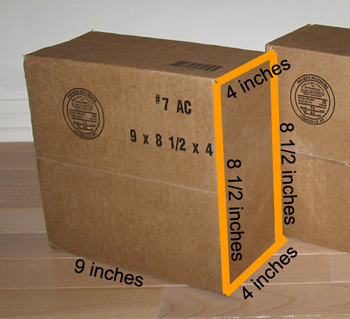
On this box your wrapping paper would go around 8 1/2 + 4 + 8 1/2 + 4 inches.
This means the wrapping paper would travel 25 inches before meeting back up with itself. So any wrapping paper that repeats after 5 inches or 25 inches will match back up in the back. Both 5 and 25 are factors of 25 – and that’s math!
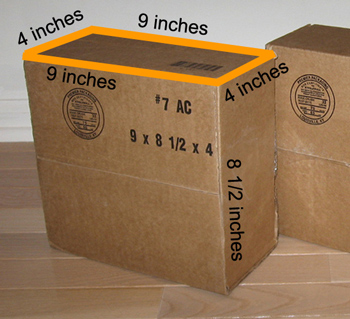
If you wrap the box the other way, instead, like this,
…the wrapping paper would travel 26 inches. Therefore any patterned wrapping paper that repeated after 2 inches, 13 inches or 26 inches would match in the back perfectly.
A box whose “wrap around” distance was 30 inches could use any wrapping paper that repeated after 2 inches, 3 inches, 5 inches, 6 inches, 10 inches, 15 inches or 30 inches. All those are factors of 30.
Choose your boxes to match your wrapping paper!
Or do it the other way – figure out how frequently your pattern repeats. Any box that has a girth of a multiple of this number can be wrapped perfectly. (Girth is the distance around the box – where you wrap the paper.)
For instance, if your wrapping paper repeated after 2 1/2 inches, you would look for boxes that have a girth of 2 1/2 inches (a tiny ring box), 5 inches, 7 1/2 inches, 10 inches. All the way up to giant boxes that have a girth of 314 1/2 inches.
Your turn!
How often does your favorite wrapping paper repeat? Have you found the perfect box/wrapping paper combination? Share your wrapping paper math discoveries in the comments!
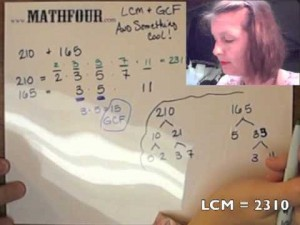
In a previous post, we learned that you don’t have to use a LCM (least common multiple) to find a common denominator to add fractions. In another post, we learned that you can use primes instead of the GCF (greatest common factor) to reduce fractions.
And now I’m going to demonstrate that finding the LCM and GCF of two numbers is still pretty cool.
Apologies for the glare on the video. I tried a different method and clearly it is inferior to the other method.
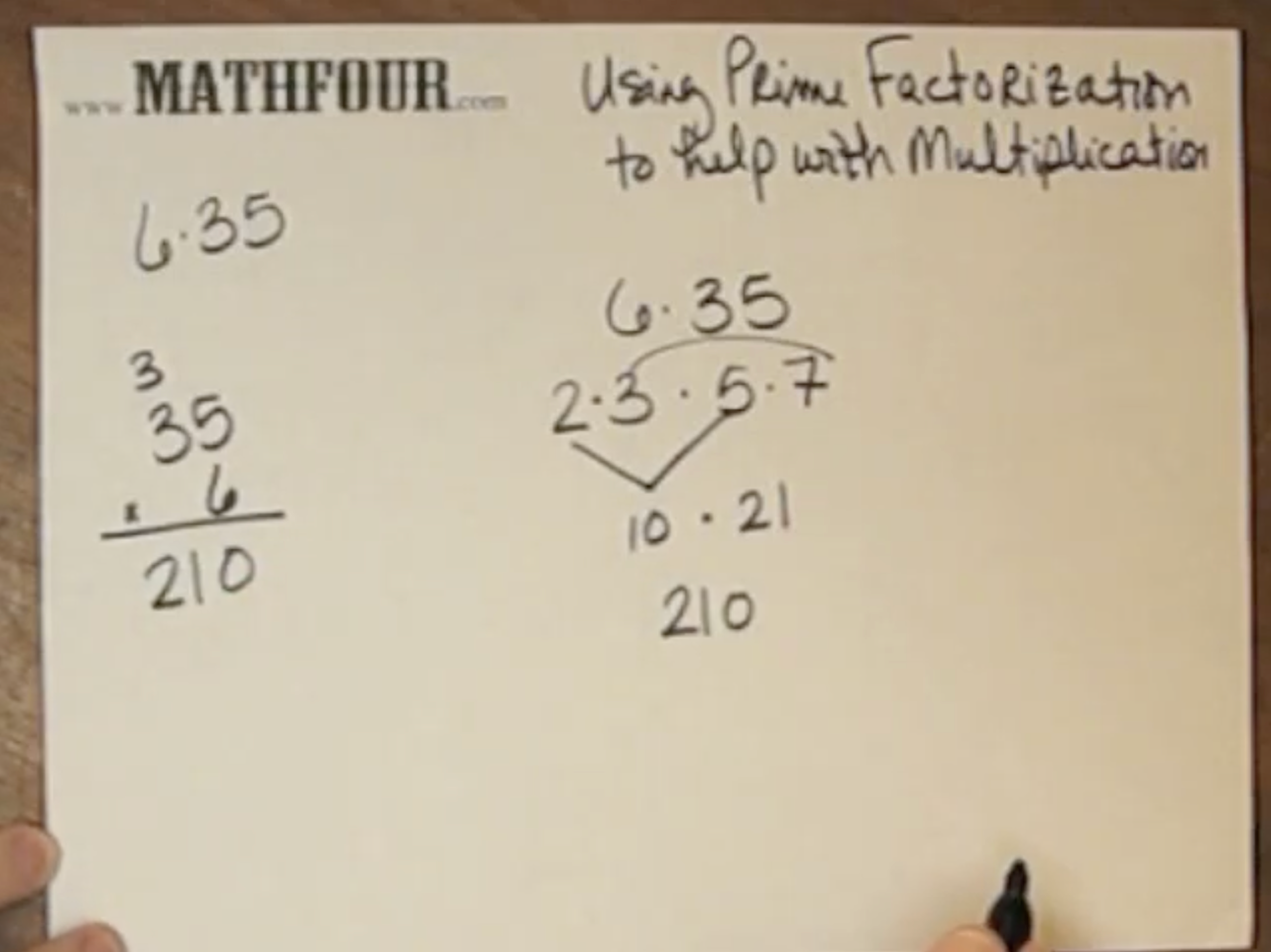
Alright, you might not win friends with this, but the more you can do arithmetic in your head… well… okay, you can’t influence people with it either. Regardless, it’s handy to know and helps with multiplication.
Here’s one that’s a little more challenging. The key is that you can combine the bits to something you’re more comfortable doing. I don’t like multiplying nines, so I avoid those.
Can you use this? Why or why not? Ha ha, just kidding – no essay questions here! – but if you do find a use for this, or if this annoys you, let me know in the comments.
Factoring is traditionally considered an “f-word” for students of math. But it sometimes has its good sides (which I’ll show over the next couple of days).
In the meantime, I’ll show the two ways (that I know) to factor numbers.
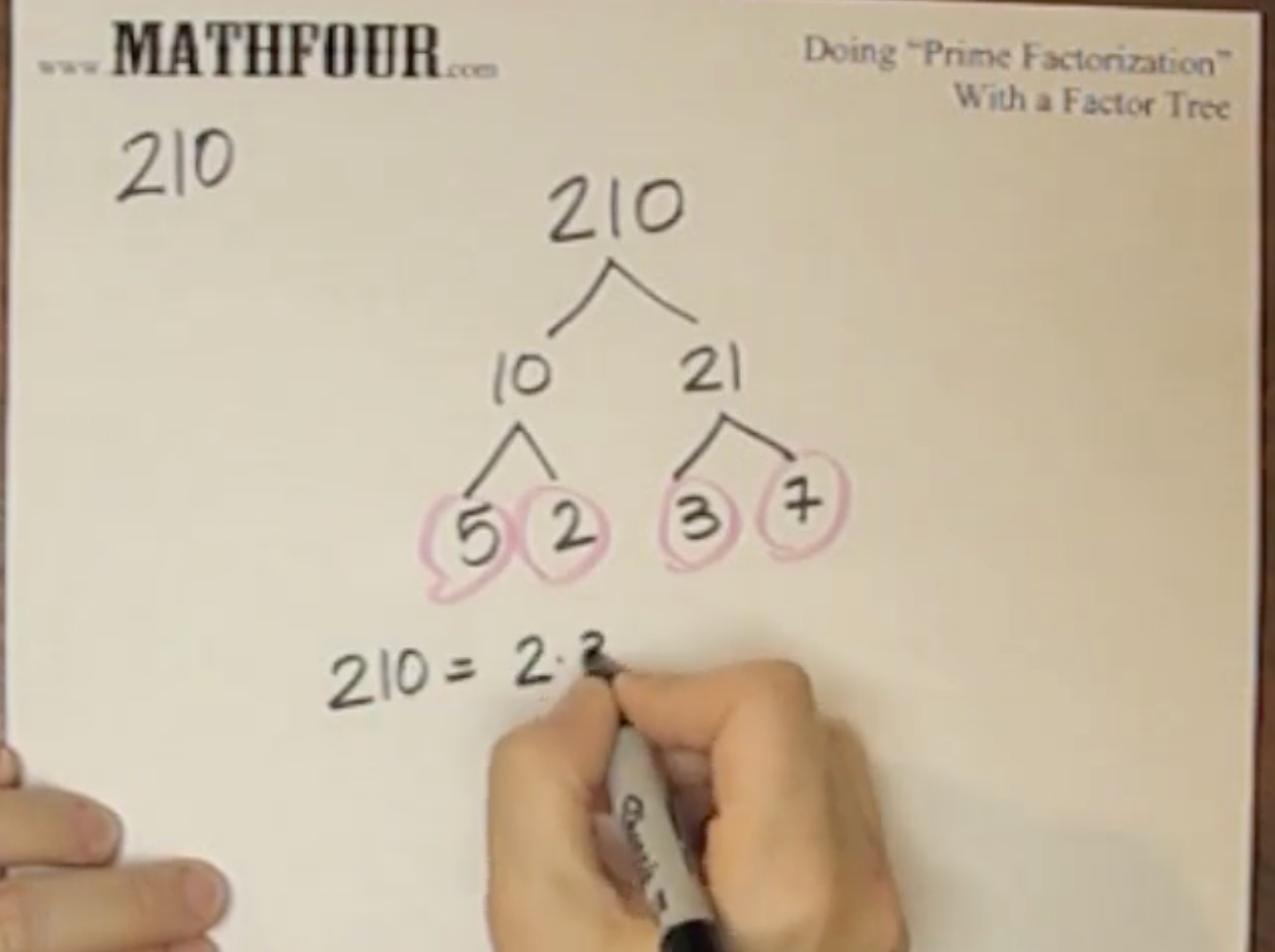
This method’s called a factor tree:
You don’t have to put the primes in order for it to be “right.” But it helps for later things.
Here’s another tree:
Here’s another way to factor using an upside division bar-type thing:
Remember, we don’t factor for the sake of factoring. This is only a tool to use when we do other stuff. You’ll see some of this in tomorrow’s post. Here’s one last example:
The way you factor is personal preference. Pick the one you like, or flip-flop. There’re no rules!
Share your preference (or a different way) in the comments!