A mom on the Living Math forum was asking for advice on how to teach adding numerators and not adding denominators in fractions. So this topic is again in the front of my mind.
First note, that you can add both numerators and denominators – this is called piecewise addition – but then you are getting into a whole new world of stuff. Actually, you’ll be experimenting with some goodies from Abstract Algebra (my field of study). We’ll talk about how and why this is good in a few paragraphs.
What is adding fractions, anyway?
For us in the “real world,” adding fractions is adding values that can’t be counted with fingers. It’s adding bits of things together – maybe whole things with bits, even.
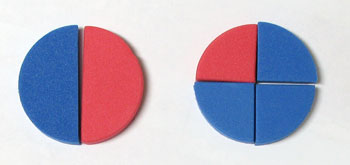
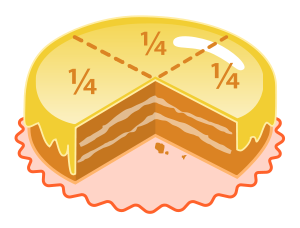
We have agreed to use things that look like
to represent fractional pieces of a whole.
When we add we have said that our total is
Total: 3/4 of a “pizza” is blue.
Quantity over value is important to young children.
I remember taking money from Little Brother when we were kids. You might think I was stealing, but it was more of conning the innocent. He would have 3 dollar-bills. I would have 20 pennies.
He would quite willingly trade his 3 monies for my 20 monies. For him, this was a matter of quantity. I knew the value, though. (Bad girl – sorry, LB I owe you. xo)
This measuring of quantity, rather than value was important in LB’s development. Instead of someone teaching him how to measure value, he learned it through experience.
This is why we should allow kids to add the denominators.
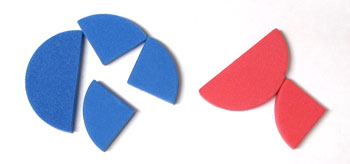
Let’s use the example above and add the numerators and the denominators to see what that means.
Adding means that our total is
Notice here you can’t “reduce” the fraction – because this isn’t the value as we know it.
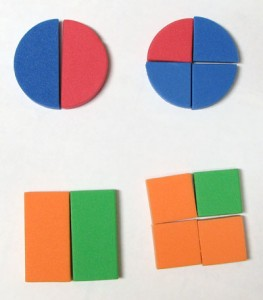
If you teach adding fractions using manipulatives or toys and allow adding denominators, soon your children will see that your (on the top in the picture below) is very different than having their, on the bottom.
We have six total pieces.
This will inspire them to work toward equality – and invent fractional addition (correctly) on their own!
Thanks to Will Summer who inspired this post with a retweet to me.
Seems researchers have previously studied the differences in math skills among children vs. adolescents and grownups. Dr. Vinod Menon with has done new research on early math training that focused on kiddos who where merely one year apart.
Turns out that in one year of math, the brain changes quite significantly!
You can integrate early math learning into just about anything.
Daughter is heavy into Brown Bear, Brown Bear by Bill Martin, Jr. and Eric Carle. This is not a math book. Nor does it pretend to be. But I’ve found a way to use it to develop math skills.
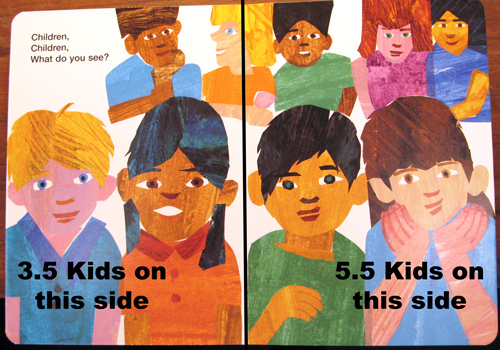
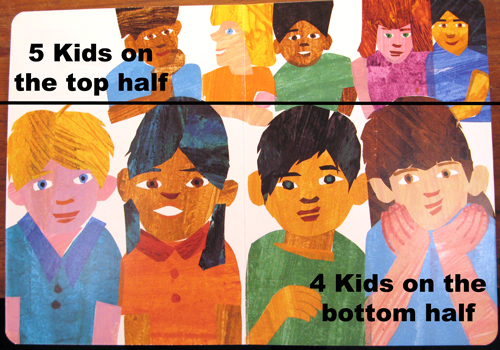
When we arrive at the page with the children, we practice counting the kids. First in one direction, then in the other – as direction matters to kids. It isn’t inherent that if you count one way you’ll get the same number as if you count the other way.
Sometimes we’ll count the top row of children and add it to the number of the bottom row. We can practice the commutative property by adding 5 + 4 = 9 and the adding 4 + 5 = 9.
As an alternative twist, we’ll count and add the kids on the left page to the kids on the right page. This one gets fun, because that little blond girl is half and half!
So we can now add fractions and practice the commutative property at the same time!
What else?
With Dr. Menon’s research, we now know how important it is to get started early with math learning. What other things can you do to start teaching math skills early?
Do you struggle explaining to your students what “simplify” means? Do you wonder why they won’t reduce fractions to their lowest terms?
Here’s how to explain and teach some of the top confusing terms in mathematics – without throwing you or your students into a tizzy!
Where
Really! “Where.”
As in “Where do the lines intersect?” or “Where is the highest point of the graph?”
“Where” in math almost always means “at what x-value?” Every now and then “where” can mean “at what point?” In the first case, “Where do the lines intersect?” can be just as easily satisfied by a point (x, y) as the x-value only.
When you get into calculus, the word “where” is used everywhere (pardon the pun). “Where is the slope of the tangent line equal to zero?” and “Where are there discontinuities?” among others.
Keep your eyes peeled in the textbooks for this tricky term.
Reduce
Typically this means to reduce to lowest terms. Which isn’t really helpful, since you still need the definition of “terms.”
Numerators and denominators (tops and bottoms of fractions) that have one or more common factors are not officially “reduced.” Once they have no common factors at all (except 1), they are said to be reduced or reduced to lowest terms.
A reduced fraction helps in many ways. You can “feel” the value more easily: 2/5 is a lot easier to picture than 14/35. Also, when you add fractions, starting out with all the numbers in their reduced form will often help to find common denominators.
Zeros, Real Zeros and Roots
Zeros, real zeros and roots all mean the same thing. It is where a graph passes through the x-axis. We can write “where are the zeros” meaning at what x-value (“where” from above) does the graph pass through the x-axis? We also will write “what are the zeros” and mean the same thing.
To find the zeros or roots, we set a function (or any equation solved for y that involves x) equal to zero. Then we solve for x. This will give the result that we want – the x-values where the graph will go through the x-axis.
We call them zeros because they are where y = 0. We call them real zeros because there can be complex or imaginary zeros that don’t exist on the graph.
Finding the zeros or roots of a function help when graphing it. If you know all the places it goes through the x-axis, you can then determine where it’s above or below the x-axis. Then you can roughly sketch the graph.
Simplify
Of all the terms in mathematics, this one is the most slippery. This meaning of this term is always in context to the book or situation. What it means is “manipulate the expression.” The end result may or may not be “simpler” than the starting expression.
Better textbooks use phrases that are clearer, like “multiply the polynomials” and “combine like terms.”
If “simplify” is the instruction to a problem set in a textbook, consult the examples to see what type of manipulation to do.
In later courses, students have to recognize when a situation requires a different form of the expression. Practicing various forms of manipulation (or “simplifying”) gives them tools to manipulate the expression to satisfy their needs.
Do you run into other terms in mathematics that are hard to explain to students? Hard to understand yourself? Share them in the comments!
Do you keep struggling to teach common denominators? Do your kids just not “get it”?
Well, it’s time to quit.
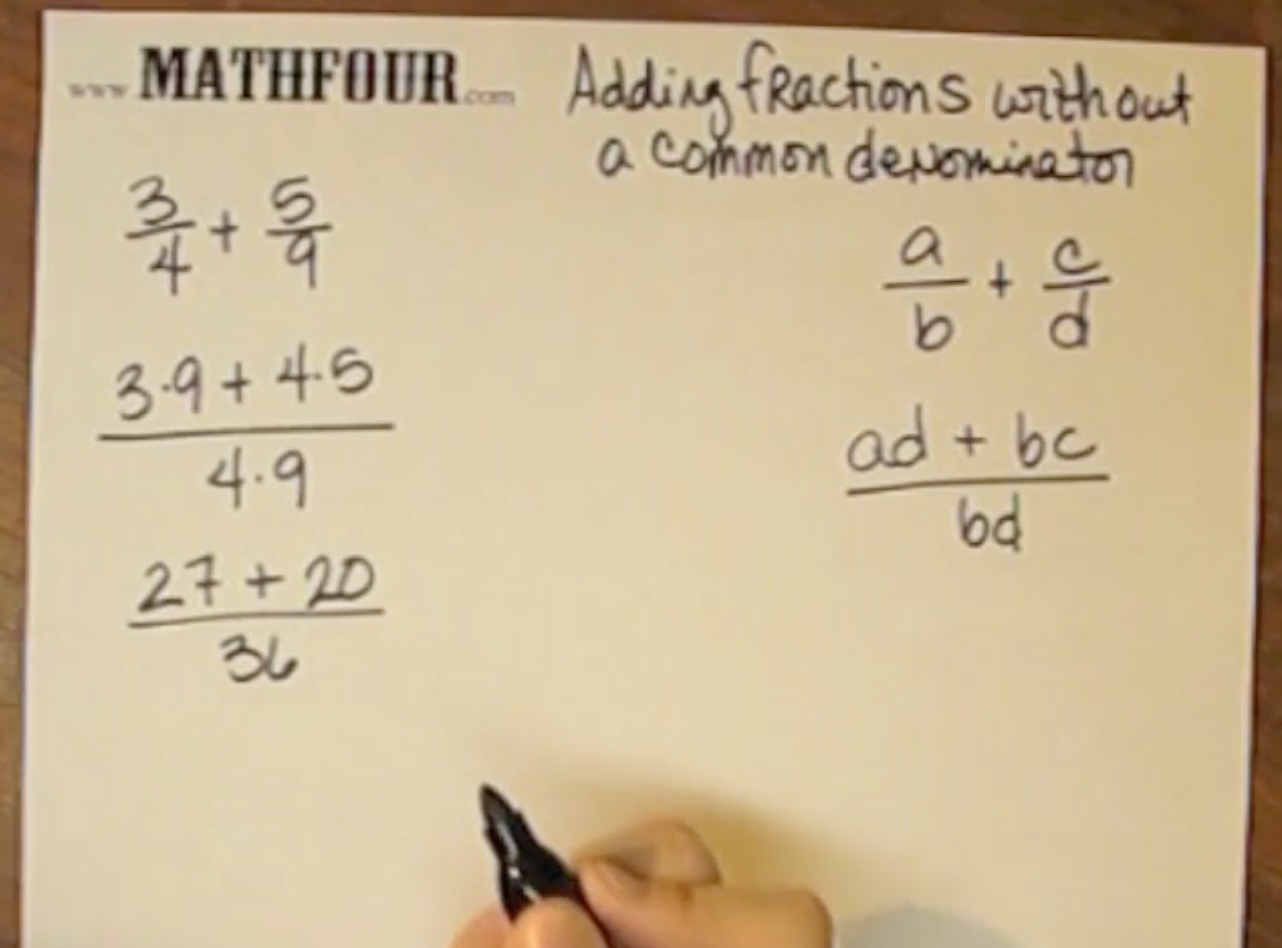
Yep! You can teach (and do) fractions without ever finding a common denominator.
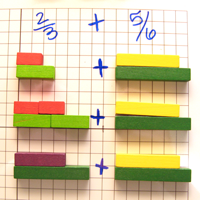
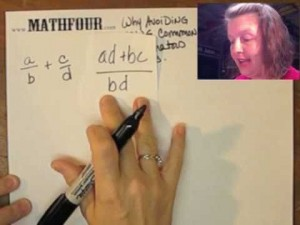
The key is in the definition of addition for rational numbers. If you have two numbers and the sum of them is .
Granted there is the technical issue of reducing, but using a little prime factorization will get you there without an issue. (And you don’t really HAVE to reduce, which I will discuss in a later post.)
Here is an example:
Here’s one with an obviously easy common denominator that works just fine with this method. In it I explain a little about why you would want to do it this way:
You might argue that finding a common denominator is an important learning experience. And you’re right. In the same way that learning about death through the loss of a pet is an important learning experience. But if you can avoid all that pain, why wouldn’t you?
If you teach this method first, kids will get annoyed with having to do so much reducing and discover the common denominator method for themselves. And that’s really what learning math is all about.
What do you think? Can you teach fractions this way? Share your thoughts and experiences in the comments.
Thanks to @padgets for our conversation about teaching fraction on #mathchat a few weeks ago. You inspired this post!