Have you seen the kid that isn’t getting the attention he needs at home? Wonder what’s going to become of him?
Well, the “it takes a village” concept isn’t far off. You might not be able to change his world, but sharing a little about math might help with one corner of it.
Share math in small bites.
Every time you see the child, pose a fun puzzle. It doesn’t have to be blatantly mathematical. Anything to get his logic working helps. I love the Childcraft Mathemagic book for puzzle ideas.
Ask her random math facts. Tell her you’ll give her something for each one she gets right – or each 10 she gets right in a row. Find out what’s important to her that you can’t get in trouble sharing. Like money, chocolate, baubles, etc.
Tell him that when you were growing up you wanted to be a mathematician. Ask him to find his favorite mathematician online. Find one yourself that you can discuss – I’m partial to Abel and Galois.
Be positive about math.
There might be many things wrong in a child’s life. Let math be the one that isn’t. Be positive. Help make math the thing a kid can hold on to.
Be the village because it takes a village. Share your stories in the comments!
This post is an answer to a question Michelle, a high school math teacher, sent. She writes:
I explain a new concept then give an example and finally do an example with the class directing me on how to solve. What I have noticed is that the bulk of the questions occur during or after the chapter assessment. Most of the students’ questions are great questions. It’s just that the questions they are asking are ones they should have asked much earlier.
Think of knowledge as a bag of shapes – all of which have different colors and textures. Once you get the bag, you have to sort through them. Some people want to count them, some people want to sort them by color, some by shape. Some people need to sort by texture. Some people need to sort by all three or just lay all of them out in rows to get a good look at them.
Everyone sorts the bag of shapes differently. Likewise, everyone sorts information differently.
Turns out, the bag of shapes isn’t the knowledge. It’s merely the information. And it takes each person “sorting” it in their own way to turn the information into knowledge.
In teaching and learning math, I’ve noticed a cycle. I’ll use the bag of shapes to illustrate it:
1. Exposure
Exposure is usually in the form of lecture and examples done by the instructor. It can be the first time the student has seen it or the first time in a long while.
This is where the student receives the closed bag of shapes.
2. Activity
Any activity following the exposure. This typically is in the form of homework or classwork practicing the concept and problems.
This is the “peeking into” the bag of shapes. The student gets to remove a few of them and start looking at them.
3. Settling
Allowing the subconscious to work. The brain does this all on its own.
Often mathematicians will go for long walks, go to the movies, hang out with their kids, talk to non-math people or do any number of non-math things to force the settling phase.
Children don’t know how to force the settling phase, nor do they need to. It just happens between when they do the homework and when they start to study for the exam.
In the bag-o-shapes analogy, this is where the students dumps all the shapes onto the floor and sorts them in various ways. It takes a while to get through all the shapes and see what kinds of sorting can be done.
4. Re-engagement
This is typically in the form of studying for the test and taking the test. It can be a heightened emotional situation where the learner is under stress.
This is a revisit of the concepts. It becomes easier because the settling has occurred and the information (the bag of shapes) is already organized.
The learner at this point will attempt to modify some of the conscious thinking to best fit with what the subconscious has done. The added stress will allow them to connect with what they’ve done better – as the “feeling” state induces a different type of learning.
5. Application
This is using the concepts for something else. This will often be the next class or next term of the math curriculum. If you learned graphing functions, you will likely use graphing functions in the future.
To wrap up the analogy, this might be a student realizing that the bag of shapes is needed for something – not just a random bag of shapes. Therefore he can re-organize them to be of use in the new situation.
Let the learning flow.
This flow of learning is natural. It will happen and has to happen. The only thing you can do to artificially speed it up is cycle it more often.
The students ask the good questions, as Michelle said, “during or after the chapter assessment.” This is in phase 4 – Re-engagement.
Instead of going through a single cycle, do it two or three times. Like this:
Monday: Lecture, chapter 1 (exposure)
Monday: Classwork and homework, chapter 1 (activity)
Friday: Test, chapter 1 (re-engagement)
Monday: Lecture, chapter 2 (initial exposure to chapter 2 and application of chapter 1)
Monday: Classwork and homework, chapter 2 (activity)
Monday: Lecture, chapter 3 (initial exposure to chapter 3 and application of chapters 1 and 2)
Monday: Classwork and homework, chapter 3 (activity)
Wednesday: Test, chapters 1 and 2 (re-engagement again)
Friday: Test, chapter 3 (re-engagement)
Monday: Lecture, chapter 4 (initial exposure to chapter 3 and application of chapters 1, 2 and 3)
Monday: Classwork and homework, chapter 2 (activity)
Wednesday: Test, chapters 1, 2 and 3 (re-engagement again)
Friday: Test, chapter 4 (re-engagement)
What do you think? Share your experiences with the cycle below in the comments.
Thanks to Michelle for requesting this tip. Michelle is one of only two math teachers in a rural private school. She teaches Algebra I, II, Geometry and Calculus.
Do you have a question? Ask it in the comments section.
I’ve learned of a thing called “What can you do with this?” from dy/dan. This teacher sets up a situation so that students can ask questions.
I’ve been pondering the effectiveness of this for a while.
The thought is that if you allow students to observe something interesting and ask them “What can you do with this?” then they’ll create their own word problems.
This is in response to the fake or “made up” word problems from a textbook which mostly don’t work for teaching thinking skills.
But the issue remains the same. If someone presents a student with a video of Coke vs. Sprite and the student lacks curiosity about that subject, then it’s still a contrived problem. Or a contrived situation.
The only reason to do a word problem is if you’re emotionally attached to it.
Husband and I were talking about word problems the other night. After my demonstration about using to teach math, he said he wished he learned math that way. He needed something to hold on to. A reason for doing it.
He’s a set dresser in Hollywood for part of each year. Which means that he has to hang pictures on movie sets. And they have to be 55″ above the ground – at the center of the picture.
Not hard to measure, but there’s also the wire on the back to consider. Is the wire dead center? No. It’s probably above the center of the picture.
It becomes one giant word problem. But it isn’t written in a book. And it isn’t videoed by a teacher. It isn’t fake. There’s a real reason for him to do it.
Which made me realize that there’s only one reason to do word problems: if you’re emotionally attached to it.
If you need an answer to a question, you attach to it emotionally.
Parent: You’ve got 45 minutes to clean the kitchen before we leave for softball practice.
Kid: If I finish the kitchen before we leave, can I watch TV?
Parent: Sure, but the kitchen better be spotless.
Most likely the kid has a plan for TV – like watching his favorite cartoon on DVR that takes about 30 minutes. So he works out how fast he needs to clean the kitchen so he can get in his cartoon before leaving.
This is a real problem. His problem.
Watch your kids intently. See where they are doing word problems in their heads. Ask them to explain them. Give credit for work done – especially when self-created.
If someone else needs an answer, you attach to it.
Being helpful is a powerful motivator. Try this: with a pencil and paper sit in a public place. Act like you’re writing something important. Then ask out loud, “What’s 87 minus 13?” $5 says that at least four people will chime in to be helpful.
Let your kid help with balancing the checkbook or creating the budget. If you’re a classroom teacher, let the kids help figure out what teacher supplies to buy. Give them a limit on what to spend and the catalog and some guidelines.
If someone you like wants an answer, you attach to it.
I couldn’t have given a feathery duck’s tail about biology, but the teacher was crazy cute. So I wanted to please him. So I worked. Hard. And had a 100 average.
I suspect this is why the teacher at dy/dan is so successful. He’s cute, compelling and cool. Who wouldn’t want to engage with him?
If you have carisma and charm, use it. This might not work as a parent but will definitely work as a classroom teacher – at least for some students.
Give it a try. Tap into the emotion. And share your success below!
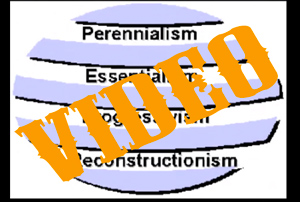
I discovered this video about the philosophies of teaching math from the blog Learning to Teach, The Empty Set of Education. Having degrees in math and not teaching I found it very interesting from a theoretical point of view.
And I totally love his conclusion – the 5th philosophy!
What is your philosophy for teaching math? Share your thoughts in the comments.
If you’ve ever taught or tutored math you’ve encountered the question, “When am I ever going to use this?” Maybe even hundreds of times.
And no doubt you’ve tried the answers that you’ve heard your math teachers give:
You’ll need it in a future job.
You’ll want to balance your check book someday.
Blah, blah, blah.
I was on the Teachers.net chatboard last night and there’s a discussion in the math teachers section about how to answer this question.
I was horrified to read that some teachers actually respond with, “How about as homework, you find the answer to that question.”
Egad!
We all know it’s a discrationary tactic. We know that there are lots of good uses of math. And we’ve experienced our answers shot down with, “I’m not planning on doing a math job for a living, so I won’t need it,” or “I’ll hire a CPA to do my checkbook.”
There’s only one right answer to this question.
“You’ll never use the math I teach you. Ever.”
I offer $10 to anyone who can come back to me in 10 years and tell me that graphing functions (or whatever we are learning that day) has actually had an applicable use in their life.
Of course they’re horrified at this answer. They give me looks like, “What? Are you an alien here to invade our classroom. Did you eat the real Bon?” No teacher has ever been that honest.
Graphing functions is virtually useless as a real tool. As is most of what we teach.
I used to get phone numbers from men at bars with my amazing use of the quadratic formula, but that’s only something you can tell college students. And they don’t buy it anyway.
Teaching math is teaching brain exercises.
The reason we teach and learn graphing functions (or other math) is to exercise a part of the brain that we rarely get to use. A part that will get used sometime later in a weird way.
We’re building new paths in the brain. We’re carving a way to alternative problem solving that might one day be useful in solving interpersonal, business, automotive, or other type of problems we have.
I tell them that math class is a game. A fun time to escape once a day. This is a play time to stretch their brains and do something completely different.
And I certainly don’t pile pissiness upon pissiness with the attitude of “If you’re going to challenge me, small menial student, then I’m going to give you extra homework.” That really motivates students… to hate math.
How about you? How do you answer the question? Are you supporting future math happiness? Share your thoughts in the comments.
I’ll bet the first answer you have is, “in school.”
In my recent research of different types of math teaching, including dancing, literature and gaming, it’s occurred to me that I didn’t learn math in school. I learned arithmetic, I learned algorithms, but math?
My dad is an engineer, and by nature not a teacher. But we did puzzles. Cryptograms from GAMES magazine, computer-based role-playing games and TV-based video games. He wasn’t one for shoot-em-up or beat-em-up games (although swords were essential). Everything we did had logical thinking.
My mother was an English major. She encouraged memorization of both prepositions and multiplication facts. And she played word games with me.
Puns have a special kind of logic to them. As she was punning around with me, I was learning a unique set of skills.
Of both of them, I was allowed to ask questions. Any questions. And I did. And they answered them.
Everyone learns math at home.
As a parent, your daily actions impact your child mathematically. It’s not your skills with pencil and paper that help you teach math, but who you are.
You connect with your children and understand them because of your similarities to them. Remember how you learned math. Not how you learned arithmetic and algorithms, but math. The art of math.
That’s your key to helping your kid learn math.
How did you learn math? Can you use this to help your children? Teachers – how can you help parents tap into this side? Share your thoughts in the comments.
I found an EdReach article through The Republic of Math‘s site and was so relieved. I’ve been hearing so much about the Khan Academy. Every time I look at it, I can’t help but think, “Same stuff, different medium.”
Math teaching is about connecting math with people in a way that works for them. If the Khan Academy helps a kid get it, then great. But if that’s the case, then it’s likely that they’ll get it regardless of the medium.
It’s time to step it up.
I’ve been hearing about experience selling for a while. You don’t sell a product, you sell an experience. I’m not typing on a Mac right now because it’s a better computer than a PC. I’m typing on a Mac right now because if I have a problem, the cute purple-haired kid at the Apple store 3.2 miles from here will help me fix it.
The same holds with math. We need the experience. Kids need the experience. It no longer works to sell “you’ll need this in life.” You have to sell the emotion behind it. The “what’s in it for me?”
And that’s easy – if we just step it up a bit.
This ain’t your daddy’s math class.
Nope – not anymore. Once kids are old enough to get it, they need to be allowed to get it. Until then, we can sell them the algorithms and the memorization. But once they hit that threshold (which is different for every kid), they have to be allowed to do it their way.
Which means no more rules. Math teaching is now about facilitation of learning. No more, “You must do it this way.” We’re losing them with forcing them to rationalize the denominator, simplify the fractions and write polynomials in descending order “because they’re supposed to.”
They should rationalize the denominator because it compares better when put next to another number. They should simplify fractions because it’s easier to wrap your brain around 1/4 instead of 13/52 (unless you play ). And polynomials add easier when you write them in some designated order.
Actually, you get only one chance when teaching anything.
I was in an internal adult training class for corporate websites. In the middle of a discussion one student said, “How about if we each take something about Sharepoint that interests us, research it and report back to the group?”
Great idea, right?
The instructor put her face in her hands, breathed deeply, ran her fingers back through her hair and said, “Well, I want to make sure you get the things you need, so hold off on that.”
CRUSH.
End of learning.
Game over.
What are your thoughts on this? Share them in the comments below.
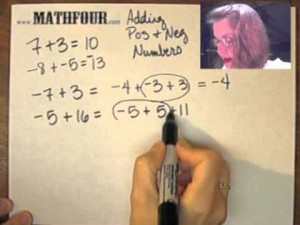
I’ve discovered many ways of teaching math through the years and the most interesting one was the addition of numbers with opposite signs. I learned this from a teacher who said that he never understood the rules – so he made up his own method.
He “breaks” the bigger number into two pieces so it can be cancelled. Here it is:
What do you think? Can you teach it this way? Share your thoughts in the comments.
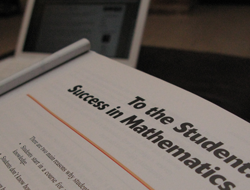
I bought a handful of math texts at Half Price Books this weekend. I opened up a Basic Mathematics text and the first thing that caught my eye was the intro titled “To the Student: Success in Mathematics.”
“Really?” thought I. As I read it, I grew more and more agitated.
Have these folks spent any time inside a math classroom? Did they pay attention to the students? If so, they should know that the likelihood of a student to do what they suggested is downright ridiculous. So why do we tell students to do it? Why can’t we give them tips that they can and will do? Like these:
If you feel comfortable asking questions in class, do it. If not, write your questions down to ask later. You don’t have to ask the instructor, especially if he or she is intimidating. Find a tutor or go to the school’s math lab instead. You don’t have to work with someone you’re uncomfortable with.
Read the stuff inside the gray boxes. We know it’s likely you’ll not read the text, but the things inside the gray boxes are really helpful.
Before you start on your homework assignment, do something physical or something you can do well. Run a mile, do a load of laundry or play tennis for a half hour. This will remind you of the things you are good at and get your endorphins flowing. It will help you be confident during your homework time.
Absorb the lectures, don’t copy them. If you can do it, try to just watch. See how the teacher thinks through a problem. You will gain more from this than from frantically trying to copy everything.
If you do take lecture notes, don’t dwell on notes that you can’t figure out. Many times you mis-copy or mis-write things the teacher wrote or said. If it doesn’t make sense, move on.
Tear out the back of this book (the part with all the answers) and burn it. It is important that you build your confidence. Checking your work with the magical back of the book just gives you a crutch. And don’t use a calculator to “check your work.” That’s just another crutch.
Do the first two problems in every section and subsection. If you can do those, do the last two. If you can do those too, continue to the next subsection. Math isn’t a spectator sport, but it isn’t an elliptical machine either. Do all the problems if you need the practice. And if you have it down, move on.
Give it a shot. Let the students know that what they want to do is okay to do. Let’s quit giving them the B.S. that’s been passed down to us over the last few decades. It’s time to go Math Book 2.0.
Whatcha think? What’d I miss? Let me know in the comments.