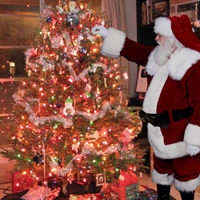
Every year people try to prove or disprove the existence of Santa. There are sites like iCaughtSanta.com for grownups to create “proof” and write-ups like Keith Devlin’s The Mathematics of Christmas that counter any proof that photos might provide.
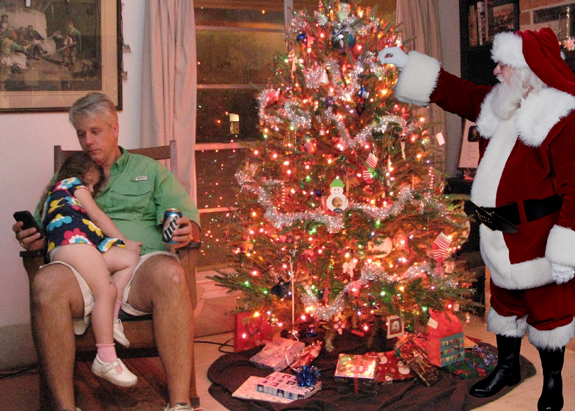
But to really prove anything about Mr. Jolly-Red-Boy, we must think about what it really means to prove something — mathematically.
Say what you want to prove.
The first thing you need for a nice mathematical proof is a “conjecture.”
A conjecture is a statement that you think can be proven. Or that you want to prove. According to the google dictionary a conjecture is
an opinion or conclusion formed on the basis of incomplete information
Our working conjecture here is: Santa exists.
It’s pretty straight up. But this isn’t quite enough. We need to know what “Santa” means.
Then define and refine.
Before we can work with the conjecture, it’s important to know the details. The details are usually definitions and assumptions.
So this is where it gets fun. I often tell people that mathematicians “make all this crap up.” This is because we start with definitions and assumptions — not reality.
So define Santa to be a human male who can enter the living room of every house with Christian children within a span of 24 hours.
We can refine our conjecture to be:
In the set of all human males, there exists x such that x can enter the living room of every house with Christian children within a span of 24 hours.
Now think about how to prove it.
There are many ways to prove something. Some of the common ones are:
- Direct proof
- Proof by contradiction
- Proof by blatant assertion
Here is a quick definition of each:
Direct proof — proving it without using any fancy logical methods. This is more difficult that you would think.
Proof by contradiction — proving it by saying if the conclusion weren’t true, then it would be really stupid. Or the earth would implode. Or 1 would be the same as 0. Etc.
Proof by blatant assertion — proving it by saying it is true. Usually in a really loud voice and with a shaking of the fist. It’s helpful in this method to use swear words, but not required. (Note: all mathematicians attempt this type of proof at least once in their lives. But they never accept this method from others.)
A myth is that mathematicians (and math teachers) know how to do something before they tackle it. In fact, they typically never know how to do something or what will happen when they try something.
So as good Christmas mathematicians, we’ll give these our best shots…
Play with the proofs and see what shakes out!
A direct proof would be to show that everything in our known world supports the existence of Santa. Without doing any calculations, we can easily see that no standard human would be able to visit every living room in a small country, much less the whole world.
So a direct proof won’t work for us.
A proof by contradiction would be “if Santa doesn’t exist, then the world doesn’t really exist either. Well, at least in the way we know it.”
This one doesn’t quite work either.
Of course if we adjust our conjecture to say the opposite of what it does, a proof by contradiction would work.
New Conjecture: In the set of all human males, there does not exist x such that x can enter the living room of every house with Christian children within a span of 24 hours.
Proof: Suppose Santa does exist. Using some calculations regarding physics (found in this article on the Math in Christmas), we can see that Santa must be able to time travel or break the general laws of physics.
Since breaking the laws of physics cannot be done, we have just shown (by contradiction) that Santa doesn’t exist.
Well that’s certainly not good for our original, and preferred, conjecture. But we have one more proof method left.
Say “Santa exists!” regardless of what the logic says.
Now we get to turn to proof by blatant assertion.
I believe in Santa in a way that can’t be shaken. But to be honest, my belief uses a different definition.
It doesn’t matter — if you want to believe you can. People all over believe in God, the spirit of the trees and some people even believe that the real line doesn’t exist. There are tons of ways to “prove” the opposite of all of these.
But these are things from the heart. Not from any logical or mathematical standpoint.
So go ahead, believe in Santa. Ignore the physics and go print out proof of Santa for your kids!
And don’t forget to talk about logic and proofs. At least on the surface.
Share your thoughts in the comments or on twitter/x.