Tag: preschool

  • Logic Skills — Ornery Kids Develop them Naturally!

    Logic Skills — Ornery Kids Develop them Naturally!

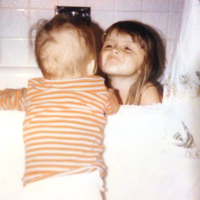
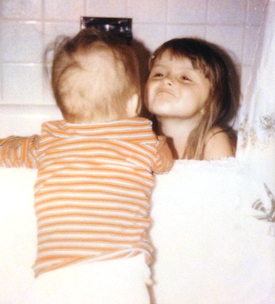
    I got to see a natural use of logic yesterday — but it was disguised as an ornery kid!

    Parenting experts (and magazines) suggest that giving options to kids is a great idea — but only if they’re real. You’re not supposed to ask your little one if he wants to take a bath when you intend to give him a bath anyway.

    Instead, ask him which bathtub he wants to use. Or which towel he prefers when he gets out of the tub. Or even if he wants to take a bath alone or with a sibling.

    It’s a clever way of saying, “It’s time for your bath, but you get some autonomy in the activity.”

    Kids like this.

    And it’s formal math!

    Yup — in formal logic terms it looks like this: p∪q, where p and q are the options. And that little ∪ means “or.”

    For instance, I give K8 the choice of taking a bath alone or with me. So it looks like this:

    p = Take a bath alone.

    q = Take a bath with me.

    So pq = Take a bath alone or take a bath with me.

    But she’s more clever than I thought!

    Yesterday I gave her this option. She responded:

    I don’t want to take a bath alone and I don’t want to take a bath with you.

    Ornery little thing she is!

    But in our formal math lingo, this is

    ¬p∩¬q

    (Those little thingies in front of p and q are the “not” part. And the ∩ is the “and.”)

    If you look it up (or know formal logic) you can find out that ¬p∩¬q is exactly the same as ¬(p∪q).

    She was clearly saying to us that she does not want to take a bath at all!

    Math is built in.

    I’ve claimed before that we all have a built in ability to do math. Now it looks like that’s not just with numbers — it’s also with logical processing.

    She doesn’t get that she’s doing formal logic, but she understands in her gut that saying, “I don’t want to take a bath alone and I don’t want to take a bath with you” is negating the “take a bath” statement.

    Encourage it!

    I know it seems like she’s being a snot. And as she gets older it’ll get worse. I’ve seen my niece do it with my sister — play these logical games that feel like back-talk.

    But logic is the foundation of learning math. So instead of admonishing children, discuss it with them. Talk about a way to phrase your statements or rules so that there’s no logical loopholes.

    Allow them to argue with you on these little things — they’re building skills that will make them into super math thinkers!

    Your turn…

    What do you think? Has your child shown natural logic skills? How do you handle it?

    And how do I get K8 into the bath now!?

    Share your thoughts in the comments or on twitter/x.

    You might also like:
  • Math in the Toddler Reading Readiness List

    Math in the Toddler Reading Readiness List

    I previously wrote about preschool math readiness after I found a list for preschool studies. There are many more preschool math concepts inside all the other subjects, too.

    Here’s the list for reading readiness and how math is really a part of these!

    Reading Readiness

    Remembers objects from a given picture.

    If a student can remember things that happened in previous problems in their math homework, they will make the connections faster. This remembering thing is huge in math!

    Knows what a letter is.

    This helps them to understand the difference between symbols with value (numbers) and sybols with no value (letters). Later they’ll be able to see that both letters and numbers can “signpost” things – like in an outline or the answer options on a test.

    Has been read to frequently.

    And count as many things in those books that you can!

    Looks at books and magazines.
    Make sure to include magazines like Time that have graphs and statistics in them.

    Recognizes some nursery rhymes.

    Great silly math one: “A dillar a dollar a 10 o’clock scholar – why do you come so soon? You used to come at 10 o’clock and now you come at noon!”

    Identifies parts of the body.

    The body is full of the symmetry and pairings. Not to mention patterns – like 5 fingers, 5 fingers, 5 toes, 5 toes.

    Identifies objects that have a functional use.

    Scissors cut things in half, glue allows you to add things.

    Knows common farm and zoo animals.

    Notice the pattern in the number of feet animals have. Also, if you multiply the number of animals by 4, you get the number of feet!

    Pronounces own first name.

    Identifying self helps to “name” things – in particular name a numeral with a word (like 2 is “two).

    Pronounces own last name.

    If a child has the same last name as one or both parents, you can point out that as a pattern.

    Expresses self verbally.

    Toddlers have to be ready for everything!

    This includes desires – so it’s a great opportunity to teach them to desire “three more,” and then count down. When they say, “one more,” they think it means “another” – unless they see they can go from three to two to one, etc.

    Identifies other children by name.

    Again – this is a forerunner to identifying the names of numerals.

    Tells the meaning of simple words.

    Number words are words too. Knowing the meaning of number words is important.

    Repeats a sentence of 6-8 words.

    When kids can repeat a sentence, they are ready to start repeating math facts. The sentence, “Four times eight is thirty-two” is pretty much a sentence of six words.

    Completes incomplete sentence with proper word.

    Can you say more math facts? Sweet!

    Has own books.

    And if some of these are counting books, how wonderful!

    Understands that print carries a message.

    This is the basis of equations too. An equation is a “printed” thing that means something, that has a message.

    Pretends to read.

    If your books also have basic math concepts, they can pretend to read those too.

    Uses left-to-right progression.

    Math is also read left to right.

    Answers questions about a short story.

    Include fun math stories and they can practice answering questions about those too.

    Tells the meaning of words heard in story.

    Use stories that have more than one of the same thing like two children – Hansel & Gretel – and Three Little Pigs. Discuss what it would change in the story if there were three children, or four little pigs.

    Looks at pictures and tells a story.

    If the pictures have multiples, they can use some counting and subitzing to explain what’s happening with those many objects.

    Identifies own first name in manuscript.

    Identifying manuscript letters is like identifying written numbers. It takes some time to see the differences between a 4 in print and a 4 in writing.

    Prints own first name.

    When they can do this, they also can print their phone number, zip code and street number.

    What you can do

    Notice that there’s math in so much – even toddler reading readiness. When you get your children ready for school – whether it’s homeschool or classroom school – you remind them that they are also doing math.

    The more they hear that they’re doing math, the better they’ll be when the get into an “official” math class.

    Got any tips? Share them in the comments. And you can also tweet this!

    Related articles
  • Preschool Math Success

    Preschool Math Success

    Through the Living Math Yahoo Group, I got a list for the typical courses of study for various grade levels. In each grade level link, there’s a list of math concepts.

    Since daughter is two, I immediately clicked on the preschool link. I was a little offended to find such a long reading list and no list titled, “Math.”

    And then I read the list. In almost every line I found math concepts!

    If you teach your little one these things on this list, check out the advanced math they will also be getting!

    (Note: my comments are italicized.)

    Size

    • Understands big and little.This preschool math concept sets them up for volume comparisons.
    • Understands long and short. This one gets them ready for length comparisons.
    • Matches shapes or objects based on size. Forerunner to inscribing shapes in other shapes, dissecting shapes to understand area formulas, etc. Also getting them ready for pattern recognition.

    Colors and Shapes

    • Recognizes and names primary colors. This preschool math concept is the beginning of pattern recognition.
    • Recognizes circles. Getting ready for the idea of a shape with no sides and a shape with infinite sides.(whoa!)
    • Recognizes rectangles. Setting up for all sorts of area formulas – since just about every regular shape can be made into a rectangle with scissors and glue.
    • Matches shapes or objects based on shape. The math concepts here get them ready for the geometric concept of similar and even more pattern recognition.
    • Copies shapes. Kinesthetically understanding concepts of geometry. This one also helps them get ready for pattern recognition – or making their own patterns!

    Numbers

    • Counts orally through 10. This is less of a preschool math concept and more of a “you just really gotta know this” concept – kinda like the alphabet.
    • Counts objects in one-to-one correspondence. One-to-one correspondence is a huge and important concept in algebra.
    • Understands empty and full. Volume comparisons as well as the grouping of objects to fill a volume.
    • Understands more and less. The foundation of ordering numbers and understanding relations.

    Position and Direction

    • Understands up and down. Forerunner of the number line.
    • Understands in and out. This preschool math concept gets them into early set theory.
    • Understands front and back. More number line stuff.
    • Understands over (on) and under. The math concepts here get them ready for setting up fractions.
    • Understands top, bottom, middle. Standard preschool readiness and also the basics of ordering.
    • Understands beside and next to. Gets them ready to multiply a number by a variable by just standing the number next to the variable: 3x means 3 times x.
    • Understands hot and cold. Getting ready to measure temperature.
    • Understands fast and slow. Getting ready to measure speed as well as rates.

    Time

    • Understands day and night. This preschool math concept gets them ready to expand into bigger and bigger time units – which will allow them to eventually understand the ideas of infinity and infinitely small. Curiously, this is also pattern recognition – every day you get day and every day you get night!
    • Knows age and birthday. This seems to be another “good to know” thing. However, it is another forerunner to big time units.

    More…

    There are many more preschool math concepts that can be spun off from the other lists, like Reading and Social-Emotional Development. I’ll be writing up how to integrate math in those in a few days!

    Am I missing anything? Let me know in the comments.