Tag: PEMDAS

  • The Order of Operations Explained: Exponents, Multiplication and Addition

    The Order of Operations Explained: Exponents, Multiplication and Addition

    This is the 4th in the series The Order of Operations Explained. For the other articles in this series, click here to visit the introduction.

    The Order of Operations can be boiled down into three “real” operations.

    Parenthesis are merely a way to group things – they aren’t a real operation. So they doesn’t count as a real operation.

    Since division is really just multiplication turned upside down, we don’t need to include it separately, either. Likewise, subtraction is addition on its ear. So we throw him out, too.

    Now we have only three: exponents, multiplication and addition.

    Exponents are the shortcut for multiplication.

    In a previous article about remembering exponent rules, I recorded this video about exponents:

    You see that 3 x 3 x 3 x 3 is 34. The exponent is the shortcut for multiplication.

    Multiplication is the shortcut for addition.

    Likewise, when we get overwhelmed with adding up the same numbers over and over, like in the video, 4 + 4 + 4 + 4 + 4, we can use multiplication to shortcut it: 5 x 4.

    Follow the shortcut evolution.

    The shortcut evolution is like this

    1. Addition came first.
    2. Then we created multiplication to make addition easier.
    3. Then we created exponents to make multiplication easier.

    So when you do arithmetic, we should do the “recent” shortcuts first (exponents) and then the “older” shortcuts (multiplication) and then the “regular” arithmetic (addition). Remember that subtraction is addition and division is multiplication.

    And keep in mind that we need to watch the grouping or anything isolated with parenthesis, absolute value bars or in a fraction. The grouping/isolation tools always trump the other operation rules.

    What if your answer isn’t the same as the back of the book?

    Some textbooks actually have multiplication done before division. This means that the problem 9 ÷ 3 x 2 will show a different answer (3/2) in that textbook’s solution pages than what you would get following the OoO I’m describing here (6). These texts are rare, but I’ve seen them. So keep your eyes peeled.

    The Order of Operations is a set of rules that we’ve agreed on. Which means that as long as a textbook clearly defines their order that they will follow, they can do things like this.

    If you get confused as to which to do first, demand parenthesis. (Yes, you can do that.) Or put parenthesis into your child’s textbook to help them out.

    The problem sets should be there to enforce, not confuse.

    What do you think? Does this help or hinder the way you’ve always viewed the Order of Operations? Share your thoughts in the comments.

    Related articles

  • The Order of Operations Explained: Exponents

    The Order of Operations Explained: Exponents

    This is the 3rd in the series The Order of Operations Explained. For the other articles in this series, click here to visit the introduction.

    Exponents are the second in the list for the Order of Operations (OoO).

    When we want to find the result of 32 x (2 + 7), we have no problem. We know to do parenthesis and then exponents, then multiplication.

    When you teach algebra, you’ll have to teach some distributing of exponents. But that’s still okay. And the rules of exponents are pretty straight up.

    So why a whole article on exponents?

    In the order of operations, the “Exponents” rule represents a bunch more than just superscripts or tiny numbers flying up and to the right of things.

    Roots are exponents, too!

    Tree Roots by Linda Allardice

    Not the ones from trees, but things like square roots and cube roots. Consider 9+2\sqrt9 + 2. You do the square root first because it qualified as an “exponent.”

    But if you had 9+2\sqrt{9+2}, the 9 + 2 is under the radical sign (the square root sign) so it’s bound together in the “Parenthesis” rule.

    This one isn’t that hard with arithmetic, but when you come to algebra and start “undoing” these things – it’s important to remember that roots fall into this category.

    Fractional exponents are exponents.

    This one seems pretty “duh” so it’s easy to see how they fall into the “E” of the order of operations. But what are fractional exponents really?

    912 means 99^\frac{1}{2} \text{ means }\sqrt9

    So fractional exponents are the same as roots.

    Note that some fractional exponents are roots and “plain” exponents all mixed up. Like this one:

    2723 means 2723 as well as (273)2.27^\frac{2}{3} \text{ means } \sqrt[3]{27^2} \text{ as well as } (\sqrt[3]{27})^2.

    This is a big fat full concept that needs a little more explaining. I’ll write more on these in another article.

    Logs fall under the E.

    Axe In Stump by caroline steinhauer

    As my algebra and computer math teacher in high school, Mrs. Kelley, used to tell us – logarithms are exponents. It took me a long time to figure out what the heck she meant. But when I did, I thought it was brilliant.

    This is a true statement: log39=2\log_3 9 = 2. Let’s analyze it.

    Based on the definition of logarithms, this means that 32 = 9. Which we know is true.

    Notice who the exponent is in this: 32 = 9: 2 is the exponent. And 2 is the same as log39\log_3 9 because the equals sign in log39=2\log_3 9 = 2 means “is the same as.” So the logarithm log39\log_3 9 is the exponent 2.

    Still with me? Either way, it’s okay. It’s a weird concept that I can go into detail in a video soon.

    The thing to remember here is that logarithms fall into the “Exponents” rule of the order of operations.

    So if you have log39+7\log_3 9 + 7, you have to do the log39\log_3 9 first and then add the 7 after.

    Want more on exponents?

    In the meantime, you can check out more than everything you always wanted to know about exponents on the Wikipedia Exponents page. Rebecca Zook created a great video on logarithms. And check out this explanation and problems to work on fractional exponents.

    And let me know what you think. Did I miss something?

    Related articles
  • The Order of Operations Explained: Parenthesis

    The Order of Operations Explained: Parenthesis

    This is the 2nd in the series The Order of Operations Explained. For the other articles in this series, click here to visit the introduction.

    I mentioned in the introductory article for this series that “the order of operations isn’t best practice for expressions involving variables.”

    When you involve a variable, you can’t just “do” the arithmetic. Like in the case of 2(3x + 4)=11. You can’t add 3x and 4 to get a result before moving on. You have to use the distributive property.

    And even the distributive property won’t work sometimes – as in the case of absolute values shown below.

    Parenthesis mean isolation.

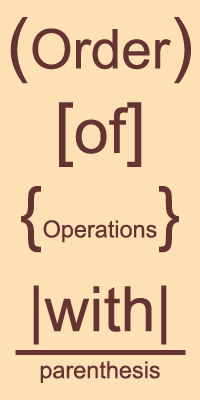
    When we say “parenthesis” in the Order of Operations (OoO for short), we mean anything that’s grouped together and isolated. This could mean with actual parenthesis. This could mean [square brackets] or {curly brackets}.

    Although grownups seem to know that square and curly brackets are the equivalent of parenthesis, children don’t. This has to be said out loud.

    “Parenthesis” in the OoO can also mean |absolute value bars|. This one’s not so clear.

    When you try to solve the equation 4|2x+3|=20, you have to start with dividing by 4 to isolate the absolute value chunk. There’s not a “rule” for distributing the 4.

    (Although, it would be worth it, and fun, to see if your children can come up with some rules for distributing within absolute value bars. This would be some real mathematics at work for them – experimenting and discovering.)

    Tops and bottoms of fractions are implied parenthesis.

    It’s also the case that the numerator (top) and denominator (bottom) of a fraction are isolated places. These fall under the OoO as parenthesis.

    Check out this older video I did. It shows how this works with fractions:

    Parenthesis are for deviation from the other rules.

    David Chandler of Math without Borders commented this in the previous article of this series:

    The rule is to do higher level operations first. Use parentheses whenever your intention is to deviate from this rule.

    If you can focus on this instead of a mnemonic device, you can get students to internalize what’s going on with the OoO. It’s important, however, to make sure they remember about other bracket shapes as well as isolation.

    Let us know your tips and thoughts on the P in PEMDAS!

    Related articles

  • The Order of Operations Explained: Intro and Mnemonics

    The Order of Operations Explained: Intro and Mnemonics

    The Order of Operations (OoO for short) is used everywhere in mathematics because it encompasses many of the foundational rules that we’ve agreed to follow.

    Alas, students have been given the cheap and dirty version of it for years. “Here, memorize this thing about your Dear Aunt Sally!” What the heck?!

    There are subtleties in the Order of Operations that every person over the age of seven should know.

    The series begins today.

    The order of operations is a set of rules – like the drivers’ handbook for math. If everyone follows the rules, we’ll all be safe. But if someone makes a bad turn, we could be looking at a crash.

    But the Order of Operations is only a set of rules for arithmetic! It isn’t even the best practice when it comes to expressions involving a variable like x. I’ll cover what I mean in this weekly series.

    Here are the proposed articles:

    1. Intro and mnemonics
    2. Parenthesis
    3. Exponents
    4. Exponents, Multiplication and Addition
    5. Multiplication and Division
    6. Addition, Subtraction and Conclusions
    7. Exponents of Negative Numbers
    8. Another Reason to Ban PEMDAS (aka parenthesis aren’t an operation)

    Mnemonics for PEMDAS

    Well, there’s one: PEMDAS (pronounced just like it looks). That’s what the cool kids in high school always said. It was the same kids who said “soh-cah-toa” – which I thought sounded really goofy.

    And then there’s “Please Excuse My Dear Aunt Sally.” And of course “Piranhas Eat Mostly Decayed Antelope Skin.”

    What’s your way to remember it?