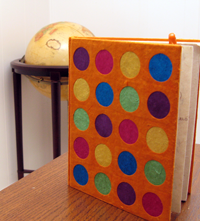
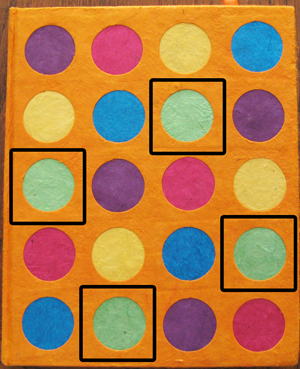
For my 40th birthday, I bought myself this beautiful Lokta paper book from a fabulous little store in the Houston Heights called Write Now!
It has circles on it – one of my “things.” I love circles. But then I saw how the colors were laid out.
“Holy cow! This is a teaching opportunity!” I thought.
And it got even better at the Texas Home School Coalition’s convention this last week. I shared it with former math teacher and now-homeschooler Sharon Brantley and she saw even more goodies in it!
You can use it to teach math!
Anything that has more than one aspect/characteristic/color (pretty much everything) can be checked for patterns. Patterns are an essential, perhaps even the most important, building block for mathematical thinking and development.
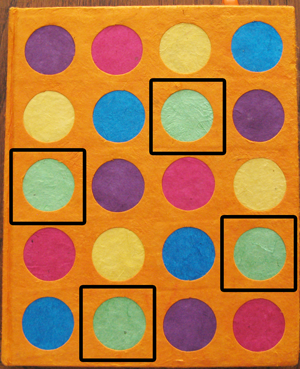
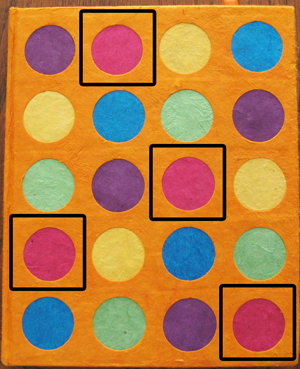
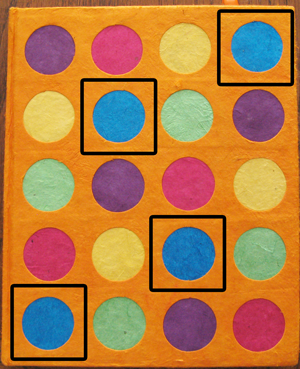
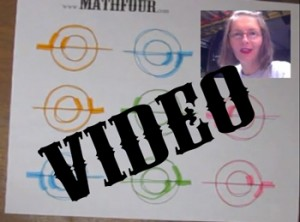
Here’s what you can see in this book cover:
Connect the green dots and you get a square. (Also the yellow dots.)The pink dots form a line and then the one dot off to the side can make a perpendicular line to the other line. (Purple dots, too.)
These blue dots make a funny little shape.
But wait! There’s more!
What Sharon pointed out to me was that you can draw an L from any dot to another dot of the same color!
Optional: This “L” thing links directly to the slope, by the way. Between any two points of the same color, the slope is either 1/2 or -2. Cool, huh?
Where do you see patterns in your world? Share it (and a link to the picture) in the comments!
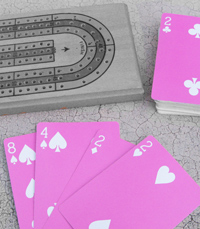
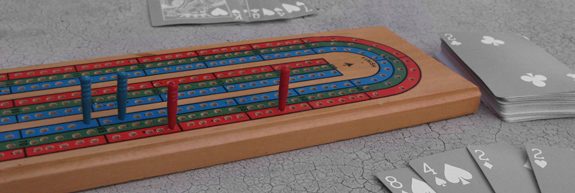
I was playing cribbage with Husband when I found my hand to be 8, 4, 2, 2 and the cut card was also a 2. I focused hard to see if I could come up with 15. (If any group of cards add to 15, you get two points.)
My resolve was strong. Then I remembered that for any group of numbers to add up to an odd number, one of them must be odd.
While shuffling for the next hand, I started thinking about adding evens and odds:
Even + Even = Even
Odd + Odd = Even
Odd + Even = Odd
This looked familiar. Then I remembered the rules of multiplying positives and negatives:
Pos x Pos = Pos
Neg x Neg = Pos
Neg x Pos = Neg
I was so excited to notice this. Alas, I’m pretty sure I’ve noticed it before. I love rediscovering patterns as much as discovering them!
Look for patterns everywhere.
Always keep your eyes peeled for similarities. When you see them, if your children are old enough, use leading questions to get them to observe the same thing. If they aren’t old enough, keep a journal to share things with them later. Encourage your kids to look for patterns in everything. Use toys and manipulatives to improve this, but also use nature and everyday activities. What patterns or nifty things in math have you noticed recently?
I was at a seminar yesterday with world famous (and awful fun) Thiagi. He keeps his participants on their toes with small activities called jolts. Jolts are defined at interactive experiential activities and:
…force participants to re-examine their assumptions and revise their habitual practices.
One jolt we did yesterday got me to thinking about math. Okay, many of them had me thinking about math. But this one was about the multiplication principal of counting and sets.
The multiplication principal says that if you have 7 ways to do the first thing and 3 ways to do the 2nd thing, then you’ll have 3 * 7 = 21 ways to do them together. Assuming you pick one of each.
So if I want a sandwich (tuna, ham or turkey) and a side (chips, onion rings, fruit or fries) for lunch, I will have the option of 3 * 4 = 12 different lunches.
The Thiagi Circles Jolt
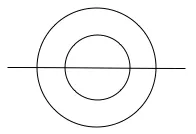
Here is the Circles Jolt that Thiagi offered: Draw this figure without ever lifting your pencil or retracing over any lines (or curves):
It isn’t hard, as you probably see. It takes anywhere from 10 to 45 seconds to figure it out. The question is, “Is there another way to do it than the one I thought of?”
So here are the ways I immediately thought of in the Thiagi Workshop:
The fancy pants teacher’s pet, Mark, was asked to demonstrate the answer. And he did it in an even different way! So I saw that there were 8 more ways to do it:
Trying to trump Mark and be the new teacher’s pet, I announced that there were indeed 16 ways to accomplish Thiagi’s goal.
There are 16 ways because of the Multiplication Principal of Counting.
Notice there are four questions to answer when solving this:
Do you start from left or right side of the drawing?
Do you start by drawing the outer circle or go through and start at the inner circle?
Do you go up or down on the first circle you draw?
Do you go up or down on the second circle?
Each question has two different options. So there are
2 sides to start from * 2 circles * 2 directions to go in the 1st circle * 2 direction in the 2nd circle
2 * 2 * 2 * 2 = 16 different ways to draw the diagram!
Teach this with experiments.
Although you now know how many there are, don’t teach it this way. Instead, just give the jolt to the kids. Once they solve it, show them “your way,” which should be any way that is different than theirs.
Then tell them that for ever unique solution, you’ll give them $1. (Thiagi gave out $1 bills yesterday, too!)
Once they come up with all 16, offer the extra $4 for some way they can show the number 16 with numbers (logically based on their solutions). They might come up with 2 * 8 or 4 * 4, as long as they can group their drawings in logical bundles.
Differentiation is the foundation of learning. Curiosity comes in the form of “Why is that different?” And right behind it is “Why is that the same?”
So patterns – and the lack of patterns – are essential in the development of a child.
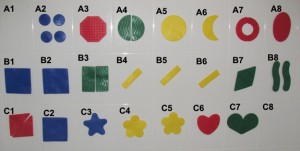
The picture below is a collection of Discovery Toys (not all of them because they live in a house with a 19mo child).
While in the tub, I encourage Daughter to see which ones are the same color. You can label the bathtub tiles with soap crayons so you can discuss the patterns more easily. Use the Cartesian Coordinate plane or Excel cell names like I did in Photoshop.
Here are some things to talk about to encourage pattern discovery and learning. Or click here to download this as a printable MSWord Document.
Which shapes are kind of the same (similar, but not in the official math sense of “similar”)
Put shapes together that “go together” – these could be same shape, color, “feel” (like B6 and B7 are both angled).
Compare shape A5 to the shapes A3, A4, A6, A7 and A8.
What do cells B3 and B8 have in common?
How are C3 and C4 different?
What’s in common in cells A2 and B2?
How are shapes C1 and C2 different?
How are C2 and B3 similar?
And then look at the world!
When you’re out of the tub, make sure to encourage observations – of everything. For something like the gate trim in the picture you can ask questions like:
What is similar?
What pieces are different?
Do you see spots that are kind of the same but mirror imaged?
If you were to make this symmetric, what other parts would you have to add to it?
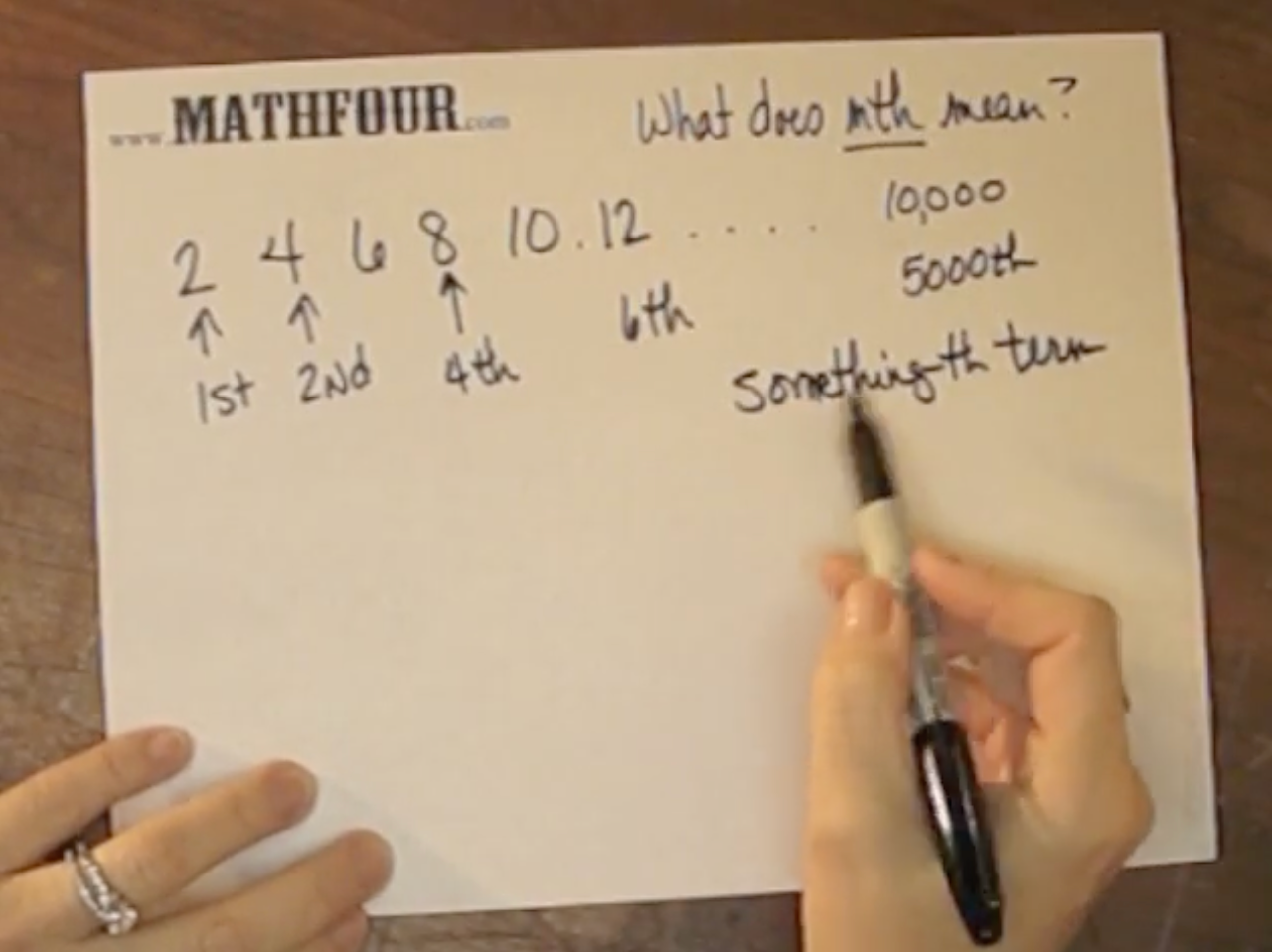
Kellie writes: “I am told to find the nth number in a pattern. What the heck does nth mean?”
So I’ll first answer the question directly. Then we can talk about what it means to the rest of the problems.
One more piece of the puzzle before we’re on to solve problems. I’ll bet you saw something in there about n-1 or n+1. Here’s a bit about that…
Now let’s get into writing the nth term of a sequence using the one before it. Remember the nth term is the number in the list if you count up to whatever you’ve labeled n.
In the previous video, we would have written it in fancy terms like this:
Once more, just to get the hang of it:
Again, this one would have been written:
Aha! But what if you don’t know the number right before the one you want? Watch this: