
Tag: algebra

  • How Calculators Inhibit Learning the Distributive Property in Algebra

    How Calculators Inhibit Learning the Distributive Property in Algebra

    Do you wonder if your children should be using a calculator “at their age”? Are you a fan of calculators, but have friends who aren’t? Are your friends “into” calculators while you oppose them?

    I often hear people say that children 50 years ago understood math concepts more quickly. Although our parents weren’t taking classes called algebra in the 7th grade, they were doing algebra in the 7th grade.

    Algebra is arithmetic.

    There are two fundamental and rarely understood facts about algebra:

    1. Algebra is arithmetic with one or more numbers in disguise.
    2. Algebra has exactly the same  rules as arithmetic.

    Which means if you can do arithmetic you already know how to do algebra!

    Our parents or grandparents, 50 or even 30 years ago, weren’t using calculators. They had to apply all the rules of arithmetic to get the job done. Which means that they had to apply all the rules of algebra.

    Teaching them a class called “Algebra” was much easier because of this.

    What are the rules?

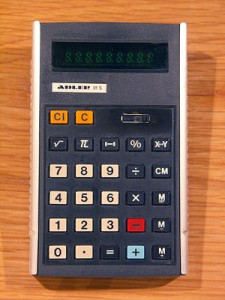
    The basic rules that non-calculator users must apply are the distributive property and the order of operations. The distributive property is the thing that calculator use eliminates.

    Children could get practice mentally multiplying things like 3 x 86 and do 3(80+6) = 240+18=268. With this practice, they are ready for 4x(3y+2z) = 12xy+8xz.

    If they never have to multiply 3 x 86 in their head, they never get the experience of the distributive property. Which means teaching them 4x(3y+2z) = 12xy+8xz will cause anxiety and frustration. They see it as “magic” or “something you made up just to confuse me.”

    Give them the tools they need.

    Refuse to let students have the calculator. Let them have the tool of the distributive property for algebra before you teach them “Algebra”. Give them the benefit our parents and grandparents had!

    Related articles
  • What’s the Domain, Why You Need It and How You Get It

    What’s the Domain, Why You Need It and How You Get It

    As you teach domain and range, do you get the question, “Why are we doing this?”

    No doubt the question, “When am I ever going to use this?” comes up too, right?

    I’ve asked myself that question my whole teaching and tutoring life. And now’s the time for an answer.

    A function is really a question.

    As I wrote in a previous post, a function is a question with only one answer to a valid question.

    When I write:

    y = 3x + 2 where x = 4

    I mean: “What is three times a number (that number is four), plus two?”

    The domain is all the possible questions:

    • What is three times a number (that number is five,) plus two?
    • What is three times a number (that number is six,) plus two?
    • What is three times a number (that number is seven,) plus two?
    • What is three times a number (that number is eight,) plus two?
    • <how long will I have to do this – Egad!>

    Not only do the questions go on forever, but they also have all the fractions and decimals in between. And all the negative versions of those numbers (and zero).

    So, what’s the point, you might ask. Looks like the questions go on forever and you can just pick any number.

    The domain might not include all the numbers.

    The two sticky points for the definition of “function” are bolded:

    A function is a question with only one answer to a valid question.

    The “valid question” part is where the domain comes in.

    The numbers that make  “valid” – meaning we actually can get some answer – are the numbers that aren’t negative.

    Many functions have “all real numbers” as a domain. There are no limits on the things you can put in, other than numbers that aren’t imaginary or alligators.

    For the most part, there are only two places where you have to be careful of limited domains. Those are

    • Numbers that cause a zero to turn up in the denominator
    • Numbers that cause negatives to turn up in square roots.

    Here are two videos tackling each:

    What do you think? Is this easier to teach when you consider “analyzing” the function rather than “solving” it? Share your thoughts and tips in the comments!

  • What’s a Function?

    What’s a Function?

    Other than being the most feared f-word in math teaching, a “function” is a question with only one answer.

    Take the question: “How tall are you?”

    We can change this to: “What’s the height of you?”

    And if we wanted to compare your height to other people’s heights we can ask: “What’s the height of <insert person’s name here>?” This is the question template – the formula.

    You can answer this question in inches, feet or cm, but the value of the answer remains unique, based on the person.

    And that last little piece of the sentence is what makes the difference, based on the person.

    The question changes with this little change. <cue music> This is the variable in the equation.

    And we say, “Height is a function of the person.”

    So where’s the fear come in?

    As always, the notation is the kicker when it comes to teaching math.

    Let’s change the question a little.

    What’s the height of Enrique tomorrow if he grows three inches tonight?

    Rather contrived, but work with me…

    The question template is

    What’s the height of <insert person’s name here> if he/she grows three inches tonight?

    Which becomes

    <height> = <height now> + 3

    Or

    H = N + 3

    Egad!

    And we haven’t even started with the f(x) stuff!

    What’s this “domain” thing about?

    I wrote the first sentence of this post a little too hastily. A function has only one answer if there’s a valid question.

    If you ask, “How tall is love?” someone will laugh at you. Or think you’re from California.

    Our question template included some specifics that you don’t normally get:

    What’s the height of <insert person’s name here>?

    If we instead ask, “What’s the height of x?” we would then have to ask: what kinds of things can we put in for x? Can we put concepts, like love? Or just objects? The kinds of things that you can put in for x is called the domain.

    For our question, we would need to specify that x is a person.

    What do you think? How does this feel when explaining it to your kids?