
I discussed empty sets in a previous article. I hadn’t yet listened to the recent podcast of The Math Dude, Jason Marshall, in which he introduced sets and subsets. Such a curious coincidence; I thought I would continue down our united path.
This week, the sweet Math Dude talked about union and intersection of sets. So I’m heading there too – and incorporating the empty set.
Union and intersection have symbols.
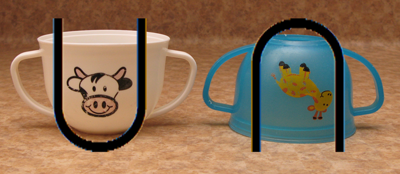
These symbols represent “operations” (like addition or multiplication) that you do to a pair of sets. They are called the cup and cap and look like, well, a cup and a cap. Or a U and an upside down U. The Union is the U and the intersection is the other one – that’s how I remember it and teach it.
For the sake of illustration, I’ll use Daughter’s handy SnackTraps like in the picture above.
The union is everything.
The sets I’m using are
L ={green cube, blue half circle thingie}
R = {green cube, red triangular prism, orange rectangular prism}
I’m using the letters L and R for left and right in the picture.
The union of the two sets results in all the pieces from each set, all crammed together. (And if there is a repeated item, you only take it once.)

Let’s take the set of all states that border Texas and the set of all states that border Oklahoma, like this:
T = {Louisiana, Arkansas, Oklahoma, New Mexico}
O = {Arkansas, Colorado, Kansas, Missouri, New Mexico, Texas}
Then the union of the two would be “The set of all states that border both Texas or Oklahoma or both” and would be T U O = {Louisiana, Arkansas, Oklahoma, New Mexico, Colorado, Kansas, Missouri, Texas}
Notice we don’t keep duplicates.
The intersection is only the common stuff.
Using the same L and R sets from above, I can take the intersection.
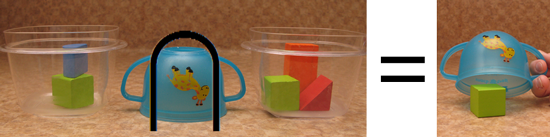
Let’s go back to our set of all states that border Texas and Oklahoma:
T = {Louisiana, Arkansas, Oklahoma, New Mexico}
O = {Arkansas, Colorado, Kansas, Missouri, New Mexico, Texas}
Then the intersection of the two would be “The set of all states that border both Texas and Oklahoma, at the same time” and would be T ∩ O = {Arkansas, New Mexico}.
What happens with the empty set?
When you start throwing the empty set into the mix, you follow the same rules.
For the union, you throw everything in both sets into one bag. Well, since there’s nothing in the empty set, “everything” is the original other set!

For the intersection, you take only the stuff that’s in common between the two. Since the empty set has nothing – there’s nothing in common.

Think about it…
Does this remind you of anything? What similarities do you see between this and addition or multiplication (or subtraction or division)? Ask your children these questions too.
Get out some snack traps and blocks (or a map) and go for it! Let me know how it goes in the comments.

Leave a Reply