Tag: slope

  • Why is the y-intercept called b?

    Why is the y-intercept called b?

    I’ve been teaching and tutoring the slope intercept form of the equation of a line for 25 years. That whole time I’ve wondered, “Why is the y-intercept called b?”

    Just today I discovered the answer!

    We teach it backwards.

    As is typical, we teach things in reverse of how we create them. The standard (or general) form of a linear function is

    f(x) = ax + b

    But this crazy f(x) notation isn’t really needed when you first learn to graph. We use y instead. So we have

    y = ax + b

    The nifty thing about this equation is that the number next to the x (in this case a) is the slope — or the measurement of how much the line tilts.

    The fancy letter for the slope is m. So we change the basic equation to include the slope notation…

    y = mx + b

    Turns out that the b here is also exactly where the line smacks into the y-axis — AKA the y-intercept. But there’s no fancy letter for that, so we just leave it as b.

    And we present that first!

    We tell early students of algebra that the slope intercept form of the equation of a line is

    y = mx + b

    where m = slope and b = y-intercept. But we don’t bother to tell them why we’re using such crazy letters!

    But now you have it. That’s the answer to the question, “Why is the y-intercept called b?”

    (If only we could figure out why they called the slope m!)

    Share your thoughts in the comments or on twitter/x.

    You might also like:
  • Finding Patterns in a Lokta Paper Blank Book

    Finding Patterns in a Lokta Paper Blank Book

    Written as part of the Count 10, Read 10 series.

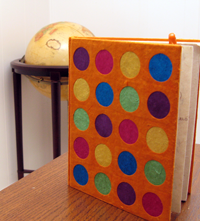
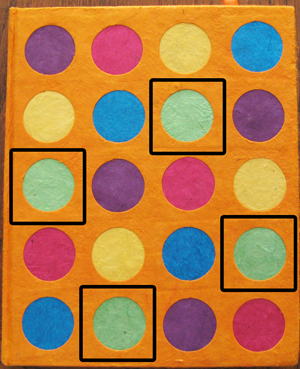
    For my 40th birthday, I bought myself this beautiful Lokta paper book from a fabulous little store in the Houston Heights called Write Now!

    It has circles on it – one of my “things.” I love circles. But then I saw how the colors were laid out.

    “Holy cow! This is a teaching opportunity!” I thought.

    And it got even better at the Texas Home School Coalition’s convention this last week. I shared it with former math teacher and now-homeschooler Sharon Brantley and she saw even more goodies in it!

    You can use it to teach math!

    Anything that has more than one aspect/characteristic/color (pretty much everything) can be checked for patterns. Patterns are an essential, perhaps even the most important, building block for mathematical thinking and development.

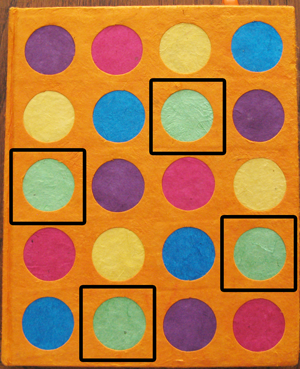
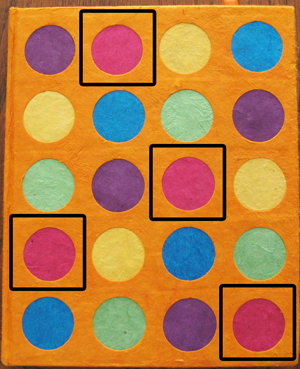
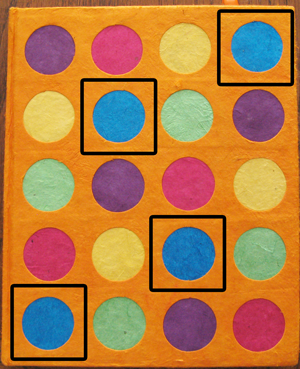
    Here’s what you can see in this book cover:

    Connect the green dots and you get a square. (Also the yellow dots.)
    The pink dots form a line and then the one dot off to the side can make a perpendicular line to the other line. (Purple dots, too.)

    These blue dots make a funny little shape.

    But wait! There’s more!

    What Sharon pointed out to me was that you can draw an L from any dot to another dot of the same color!

    Optional: This “L” thing links directly to the slope, by the way. Between any two points of the same color, the slope is either 1/2 or -2. Cool, huh?

    Where do you see patterns in your world? Share it (and a link to the picture) in the comments!

    Related articles