In Chapter 1 of What’s Your Math Problem?, Linda Gojak gives some initial thoughts on learning and teaching problem solving.
She introduces the concepts of routine problems and non-routine problems.
Routine problems are what you typically see at the end of a problem set in a traditional textbook. “In solving routine problems, the learner reproduces and applies a new procedure,” Gojak writes.
Non-routine problems, or rich problems, are the way of the world. They are the things grown-ups solve everyday effortlessly, and often don’t think of them as math problems.
Is solving non-routine problems teachable?
There is a divergence between the way traditional word problems are taught to kids and how grown-ups handle the rich problems in their lives. What’s Your Math Problem? attempts to distill and label each strategy of what grown-ups naturally do, so that we can teach these strategies to our children.
To make this work, knowledge of the various strategies is important. So Gojak labels, defines and gives examples of each strategy throughout the book.
This method of teaching problem solving to children will work if an instructor is careful not to force the use of a particular strategy.
Offer a strategy, but don’t force it.
The idea is to label and clarify each problem solving strategy so it can be one of the options in the toolbox of problem-solving for each child.
As students learn a strategy, teachers shouldn’t require it be used “so they can practice it.” Instead it should be offered and encouraged, but allowed to be tossed aside if the student prefers another method.
And caution should be used to ensure problem solving using these various strategies NOT turn into another algorithm.
Read more about it…
Don’t forget to check out Math Coach’s Corner for some other thoughts on Chapter 1 of What’s Your Math Problem? Make sure to scroll to the bottom, because others are linking up their thoughts and opinions!
I love how Linda Gojak calls juicy, meaty problems “rich problems.” A good, fun thinkable is indeed a math word problem rich with problem solving challenges.
But getting started on a rich problem can leave you feeling rather poor. So Chapter 3 gives, and is called, “Getting Started Strategies.”
What’s that problem about anyway?
The first question you (or your child) should ask when given a problem is, “What’s it all about, anyway?” This is the strategy of “Restate the Problem in Your Own Words.”
Ask
What’s happening — what does it look like?
What bits of this problem are useless to me?
If a normal person were to ask the question, how would it be written?
Now what the heck does it really say?
Restating the question in your own words means understanding what’s being asked and what’s happening.
Is this a trick question?
Sometimes textbooks (and even life) give you problems without giving you all the required information. This is grownup-talk for what kids call a trick question.
If there’s missing information, call that bluff! What info do you need to calculate the final answer?
Is that information contained in the problem?
Can you find that information online or in a library?
Can you figure out that information using other stuff in the problem?
Is it just a flat-out trick question — there can’t be an answer because there’s no way to get the information needed?
Calculate the information, if you can.
Now it’s time to do a little pre-work. Gojak calls it “identifying a subgoal.”
If you’re missing some numbers in the problem but you can get these from others, then start calculating.
I walked 30 feet and then walked another 24 inches. How many feet did I walk?
The subgoal here — figure out how many feet I walked the second time.
Figure out how to show your work — or not?
One of the strategies in chapter 3 is “Select Appropriate Notation” — which means determine how you’ll show your work.
But first ask the question, “Do you want to show your work?”
Here’s the big place where classroom schoolers and homeschoolers will diverge. It isn’t really necessary to show your work. Ever. And in homeschool, children don’t have to.
If you want to show your work that’s great. If you want to share your work, you have to show your work. If you want to be a famous mathematician or even a run-of-the-mill engineer, you have to show your work.
It doesn’t hurt to learn to show your work. But it’s not required to be a great problem solver.
In fact, if your child struggles with notation, and you push this too hard, their developing problem-solving strategies could be stunted.
But should you show your work for other reasons?
Gojak writes:
“…you use notation to help you reach a solution.”
This is not necessarily true. Some people do. I don’t. The problem-solving strategy that works for me is doodling pictures and trial and error, strategies covered later in the book.
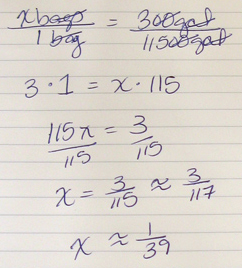
I rarely solve a problem using x and y — or even crude representations of x and y like question marks or blanks.
If you feel the need to verify that your child is thinking properly, ask them to explain it out loud. Or give them another rich problem. Don’t force them to show their work because you want to see it.
Read more about it…
Don’t forget to check out Math Coach’s Corner for some other thoughts on Chapter 3 of What’s Your Math Problem? Make sure to scroll to the bottom, because others are linking up their thoughts and opinions!