Tag: manipulatives

  • Teaching Patterns with Playful Bath Shapes

    Teaching Patterns with Playful Bath Shapes

    Do you get “why” questions often from kids?

    Differentiation is the foundation of learning. Curiosity comes in the form of “Why is that different?” And right behind it is “Why is that the same?”

    So patterns – and the lack of patterns – are essential in the development of a child.

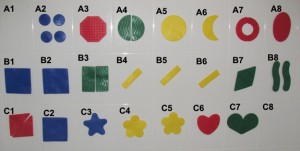
    The picture below is a collection of Discovery Toys (not all of them because they live in a house with a 19mo child).

    While in the tub, I encourage Daughter to see which ones are the same color. You can label the bathtub tiles with soap crayons so you can discuss the patterns more easily. Use the Cartesian Coordinate plane or Excel cell names like I did in Photoshop.

    Here are some things to talk about to encourage pattern discovery and learning. Or click here to download this as a printable MSWord Document.

    • Which shapes are similar? Which are congruent?
    • Which shapes are kind of the same (similar, but not in the official math sense of “similar”)
    • Put shapes together that “go together” – these could be same shape, color, “feel” (like B6 and B7 are both angled).
    • Compare shape A5 to the shapes A3, A4, A6, A7 and A8.
    • What do cells B3 and B8 have in common?
    • How are C3 and C4 different?
    • What’s in common in cells A2 and B2?
    • How are shapes C1 and C2 different?
    • How are C2 and B3 similar?

    And then look at the world!

    When you’re out of the tub, make sure to encourage observations – of everything. For something like the gate trim in the picture you can ask questions like:

    • What is similar?
    • What pieces are different?
    • Do you see spots that are kind of the same but mirror imaged?
    • If you were to make this symmetric, what other parts would you have to add to it?

    Have fun. See patterns. Enjoy the discovery!

    Download the activity questions here.

  • How to Teach Similar Triangles and Have Fun Doing It

    How to Teach Similar Triangles and Have Fun Doing It

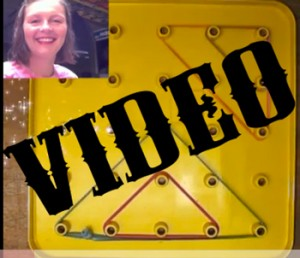
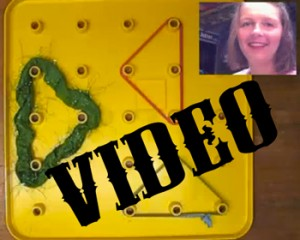
    How about some similar triangle work on the Discovery Toys Giant Pegboard?

    Not only is this video about triangles that are similar, but this video about triangles is similar to other videos! (Is that fun to say or just annoying?)

    Here it is:

    What do you think? What other triangle things can you do with a pegboard?

  • The Difference Between Similar and Congruent Triangles

    The Difference Between Similar and Congruent Triangles

    Do your kids get confused between congruent and similar triangles? Do you?

    In a previous post, I made this mistake when discussing right triangles on the Giant Pegboard. If a mathematician can make the error, then it is easy for a kid to, also.

    In the video I said “congruent” when I meant “similar.” Two triangles are congruent if they are the same size and shape. They are similar if they are the same shape (and maybe or maybe not the same size).

    One way to show that two triangles are congruent is to use the SSS Theorem or the “side side side” theorem. This says, essentially, that…

    If you can show all three sides of two triangles are the same, then the angles must also be the same.

    This ensures that your two triangles are congruent – or as a kid might say it “exactly the same.”

    Here’s how to use the Discovery Toys Giant Pegboard to play around with congruent triangles:

    What do you think? Can you use this? Give it a shot!

    Check out the next post for a video discussion on similar triangles.

  • Learning Right Triangles with Discovery Toys

    Learning Right Triangles with Discovery Toys

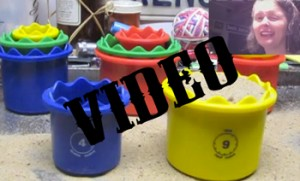
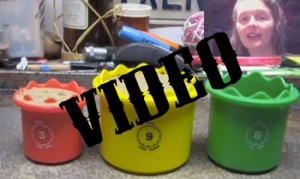
    I hosted a Discovery Toys party the other day and ended up explaining how to use many of the toys for teaching math.

    Alas, here I am now doing videos of the same. I can’t get over these toys. They are designed proportionally (the cups and weighing ones) and always with the thought “How can this be fun at the same time it’s teaching something.”

    Of course, all toys teach. But the designers of these toys put the extra oomph into the thinking process so that when a kid asks “why?” there’s an easy way for the parent to answer.

    Oh – and they are guaranteed for life!

    So from here out, I’ll be doing occasional videos on how to use them.

    The first is about right triangles on the Giant Pegboard. Notice in the video that when I say “congruent triangles” I really mean “similar triangles“.

    See what you think:

    Have you played with triangles and pegboards? What other ways can you use them to teach and learn?

    Disclaimer: I tried to become an affiliate of these toys to help pay for this blog. Alas, they don’t have an affiliate program. The only way was to become an official consultant. These toys are so cool and helpful, that I have done it.