Tag: exponent rules

  • Numbers Instead of Variables

    Numbers Instead of Variables

    Ever tried to teach someone how to remember this math rule:

    \(x^2 \times x^3 = x^5\)

    Or tried to remember it yourself? Do the letters trip you up? Or your students?

    How about this one:

    \((x^2)^3 = x^6\)

    I did a video on this some time ago. It has more Xs than an adult movie theatre. Here’s a still from the video:
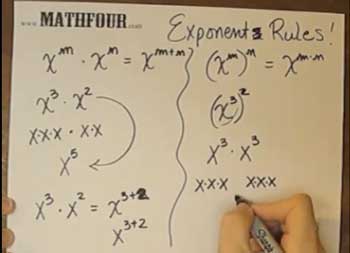
    In general, it’s a good way to remember the rule.

    But what if variables freak out your students?

    I’m the only person I know that teaches a kid to count, “1, 2, 3, x, 5, 6, …” (And I’m saving both for Daughter’s college fund and her psychiatrist.)

    Most people aren’t even told about letters in math until they’re well established in doing stuff with numbers.

    So why do we use letters to explain stuff?

    A tiny detour…

    I just geeked out and bought a course on google analytics through App Sumo. Andrew Warner with Mixergy, in the first video, was interviewing Justin Cutroni.

    In less than two minutes I had to pause, rewind and listen hard to what Justin said:

    Actual data makes a huge difference when you’re teaching.

    Wow.

    Rewind. Re-listen.

    What I heard was, “Hey! Knock it off with the letters already! Use some actual numbers when you’re teaching stuff!”

    Hey! Use some numbers!

    Theory is great. If you’re into that kind of thing.

    But when we’re learning, we need something to hold on to. That’s both “we” as grownups in Justin’s Web Analytics class, and “we” as kids in Miss Kelly’s Algebra class.

    We need data. Numbers.

    Something that feels good, makes sense and is easy to wrap our brains around.

    So what’s up with the letters?
    Math books and math courses are written by mathematicians. Folks who are as comfortable with letters as they are with numbers. People who can take theory to new heights of abstractness. And never need a beer doing it.

    Everyone else, well, they’re just unfortunate casualties.

    But you can change that!

    You don’t have to be a mathematician to teach math. In fact the less of a mathematician you are, the more likely you are to succeed in teaching math.

    Pull yourself out of “teach like a mathematician” mode and think about what a variable is.

    It’s a number. It’s data. Just an average ordinary thing that you can represent on your fingers.

    So now, what does this mean:

    \(x^2 \times x^3\)

    Maybe this:

    \(4^2 \times 4^3\)

    Or this:

    \(7^2 \times 7^3\)

    Or even this:

    \(9^2 \times 9^3\)

    And after you and your child play around with these and other examples using regular old numbers, your kid will say out loud:

    You just gotta add up those number that are flying in the air.

    And he’ll be right.

    Actual data.

    Period.

    Whatcha think? Share in the comments.

    Related articles
  • The Order of Operations Explained: Exponents

    The Order of Operations Explained: Exponents

    This is the 3rd in the series The Order of Operations Explained. For the other articles in this series, click here to visit the introduction.

    Exponents are the second in the list for the Order of Operations (OoO).

    When we want to find the result of 32 x (2 + 7), we have no problem. We know to do parenthesis and then exponents, then multiplication.

    When you teach algebra, you’ll have to teach some distributing of exponents. But that’s still okay. And the rules of exponents are pretty straight up.

    So why a whole article on exponents?

    In the order of operations, the “Exponents” rule represents a bunch more than just superscripts or tiny numbers flying up and to the right of things.

    Roots are exponents, too!

    Tree Roots by Linda Allardice

    Not the ones from trees, but things like square roots and cube roots. Consider 9+2\sqrt9 + 2. You do the square root first because it qualified as an “exponent.”

    But if you had 9+2\sqrt{9+2}, the 9 + 2 is under the radical sign (the square root sign) so it’s bound together in the “Parenthesis” rule.

    This one isn’t that hard with arithmetic, but when you come to algebra and start “undoing” these things – it’s important to remember that roots fall into this category.

    Fractional exponents are exponents.

    This one seems pretty “duh” so it’s easy to see how they fall into the “E” of the order of operations. But what are fractional exponents really?

    912 means 99^\frac{1}{2} \text{ means }\sqrt9

    So fractional exponents are the same as roots.

    Note that some fractional exponents are roots and “plain” exponents all mixed up. Like this one:

    2723 means 2723 as well as (273)2.27^\frac{2}{3} \text{ means } \sqrt[3]{27^2} \text{ as well as } (\sqrt[3]{27})^2.

    This is a big fat full concept that needs a little more explaining. I’ll write more on these in another article.

    Logs fall under the E.

    Axe In Stump by caroline steinhauer

    As my algebra and computer math teacher in high school, Mrs. Kelley, used to tell us – logarithms are exponents. It took me a long time to figure out what the heck she meant. But when I did, I thought it was brilliant.

    This is a true statement: log39=2\log_3 9 = 2. Let’s analyze it.

    Based on the definition of logarithms, this means that 32 = 9. Which we know is true.

    Notice who the exponent is in this: 32 = 9: 2 is the exponent. And 2 is the same as log39\log_3 9 because the equals sign in log39=2\log_3 9 = 2 means “is the same as.” So the logarithm log39\log_3 9 is the exponent 2.

    Still with me? Either way, it’s okay. It’s a weird concept that I can go into detail in a video soon.

    The thing to remember here is that logarithms fall into the “Exponents” rule of the order of operations.

    So if you have log39+7\log_3 9 + 7, you have to do the log39\log_3 9 first and then add the 7 after.

    Want more on exponents?

    In the meantime, you can check out more than everything you always wanted to know about exponents on the Wikipedia Exponents page. Rebecca Zook created a great video on logarithms. And check out this explanation and problems to work on fractional exponents.

    And let me know what you think. Did I miss something?

    Related articles
  • How to Remember Exponent Rules without Brain Ooze

    How to Remember Exponent Rules without Brain Ooze

    This post is by request from @corrincross on Twitter.

    Exponent rules are hard. Well, they are hard to remember, anyhow. But there’s an easy way that won’t make your brain ooze – and that’s doing a mini-experiment each time you have to deal with them.

    First remember what an exponent really is. It’s a shortcut for multiplication. Check it out:

    Notice that there are really only two rules that get you screwed up: when to multiply the tiny buggers and when to add them. Here’s how I teach this (and how I remember it myself!):

    So the new rules are x3x2=x3+2x^3 \cdot x^2 = x^{3+2} and (x3)2=x32(x^3)^2 = x^{3 \cdot 2}.

    And then what about those negative exponents? Again, you can’t remember a rule unless you remember what they heck is really going on. We go back to adding in this video to explain the similarity between the two shortcuts of multiplication and exponents:

    Can you use this in your classrooms? Share your thoughts in the comments.

    Thanks to Corrin Cross (@corrincross on Twitter) for requesting this post. Corrin is a Secondary Ed student with a math major and music minor at the University of Regina in Saskatchewan, Canada.