

Tag: creativity

  • Dumb Questions? Aren't They All?

    Dumb Questions? Aren't They All?

    I was labeled an “airhead” in high school. Until today, I’ve avoided telling people that. The moniker had a real negative effect on me.

    I was known as the kid who asks dumb questions. If my peers wanted to waste the last five minutes of class and not have to start another topic, they’d whisper at me, “Ask one of your dumb questions.”

    “There are no dumb questions.”

    If you’ve never said these words, email me now and I’ll send you $10.

    You’ve said them, haven’t you?

    Yup — we all have.

    The fact is that every question is a dumb question. Because someone else knows the answer.

    And the more people who know the answer, the dumber the question is. And the more valuable it is to ask it.

    Just because everyone knows the answer to a question, doesn’t mean it’s the right answer. It’s just the safe answer.

    I asked a question with an obvious answer.

    The story of how I earned my “airhead” nickname is a rather curious one. It happened like this:

    We had a guest speaker, a grownup, in our debate class. He was explaining details of the debate topic, which involved transporting water across some distance.

    He drew a series of pumps and downward sloping pipes on the chalk board. He explained that water had to be pumped up every so many feet so it could continue traveling the decline.

    I watched and listened. I wondered why they didn’t just pump the water straight through a horizontal pipe.

    I asked, “So why do the pipes have to be tilted?”

    The grownup responded with a snicker, “Because water runs downhill.”

    In retrospect, it is clear to me that I was dealing with an idiot. He lacked the novel thought, as well as nurturing behavior, to wonder what a 14 year old might be thinking when she asked the question.

    My classmates joined in on the grownup’s joke. “Wow, you don’t know that water runs downhill,” they jeered, “What an airhead!”

    Who knows what would have happened…

    Suppose that grownup would have encouraged my line of questioning.

    “The pipes have to be tilted because we let gravity do most of the work.”

    “But why can’t we just pump it straight through horizontal pipes?”

    “It’s not efficient to do it that way.”

    “What does it mean to be efficient? Do we have numbers on that?”

    “I’m not sure. Maybe that bears some investigation.”

    Perhaps I would have proposed that we create a pumping system so powerful, and efficient, that we didn’t need thousands of pumping stations? That might have led to other innovations.

    There’s no telling.

    And yet his snide remark, which gave the other students encouragement to be mean, shut down all routes of novel thinking for me.

    At least in that class.

    The airhead learns best.

    Novel thought — creative thought — is the foundation of innovation. It’s the foundation of learning.

    In math, thinking outside the proverbial box is an efficient way for a student to learn. Asking crazy, airheaded, dumb questions gets a student thinking about all sorts of things.

    The effort put into this novel thinking to solve a math problem will seem high. But the depth and breadth of a student’s understanding when they do this is incredible.

    And that understanding will carry to other things — decreasing the effort to learn even more!

    So why not be an airhead?

    Kids start out being airheads — thinking novelly and creatively. And grownups (like the guest speaker in the debate class) have an uncanny knack for destroying it.

    When your kids ask a dumb question, refrain from being a grownup. Ignore the fact that everyone knows the answer to that. See what happens.

    Encourage your kids to ask dumb questions. Give prizes for the most dumb question of the day — the one that sparks the most novel and innovative thinking.

    Epi-blog

    By the way, my peers continued this nonsense for years. It might be easy for me to say that I stopped wasting my dumb questions on those idiots. But in fact, they were just as squashed as I was.

    They were covertly given permission to do it by our teachers (except for Mr. Berkebile), therefore they continued.

    Share your thoughts in the comments or on twitter/x.

    You might also like:
  • Curiosity Based Learning with 100 Floors iPhone App

    Curiosity Based Learning with 100 Floors iPhone App

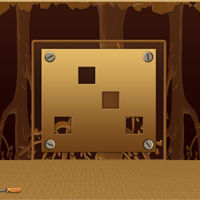
    From Floor 1, you can tell what you have to do.

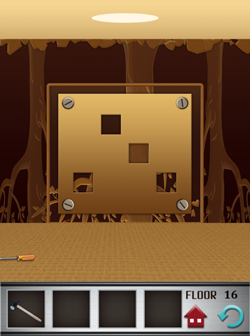
    I’ve become slightly addicted to this free iPhone game called 100 Floors. It has strange and interesting parallels to leraning math.

    It has no instructions and no hints. And upon first entry to the app, you feel lost, confused and annoyed. (Already starting to sound like a math problem, right?)

    Based on the name of the game and the view of “Floor 1,” it’s clear that the idea is to open each set of elevator doors.

    But with just a bit of patience and curiosity, you find yourself challenged just enough on each subsequent floor to keep going.

    And you have no idea what to do next.

    With each floor you’re not sure what to do.

    So you start doing seemingly random things. You notice yourself bumping the phone. Tilting the phone. Shaking it. Blowing on it (I know, that isn’t a feature yet, but I tried anyway).

    You tap and drag everything on the screen – including the ads.

    (I even yelled into it – just in case that was the key to getting the doors open.)

    And sometimes you just stare at it. Curious.

    Remember – there’s no punishment for failure.

    This one is my favorite!

    If you can’t get the doors open immediately, no big deal. If you look, shake, yell, bump, tap and tilt with no results… okay.

    So what? Who gives a fuzzy red rat’s tail?

    You might turn off the phone and go mow the yard.

    But those closed elevator doors stay in your mind. So you’ll come back at some point. You’ll open the app and check it out.

    Just one more time.

    Just to see…

    And when the doors open – yippee!

    There’s no prize. There’s no grade. There’s no money.

    But the excitement you have from getting those crazy doors open and seeing the green arrow is unimaginable!

    “Cheating” is allowed.

    Sharing a tip is something you do only if you want. Giving or getting a solution isn’t prohibited, but it’s fun to try to get the solution yourself.

    So you choose what to share and what to ask for. Based on your own desires and curiosity.

    And it’s the same as learning math.

    This one almost killed me. Had to go do something else for a while and come back later.

    So far I haven’t found an official math problem in the game. But the tactics, patience and curiosity that you use are exactly what learning math is all about.

    In each new math problem, students may wonder, “What the heck do I do with this one?” Just like you do with those elevator doors.

    And if there’s no punishment for trying nutty things, their curiosity will take them places.

    Tapping, dragging, shaking and yelling into the phone might have made me look goofy. But Husband was nestled in his chair doing equally insane things to get his elevators to open.

    But there IS punishment in learning math.

    That’s where things diverge.

    Performance based teaching is the basis of the typical math lesson. Math problems are given to the student. And the student is expected to give back the right answer.

    If the right answer isn’t given, there are repercussions. Points are deducted or the failure is publicly noted. Or both.

    And if you don’t have the right answer, you’re just not learning math.

    Period.

    (BTW – that’s a horrible myth!)

    And “cheating” is all or none.

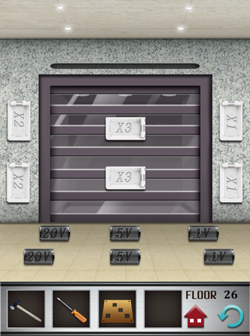
    This one sort of turns out to be a math problem.

    Either the teacher coaches step-by-step, or there is no tutor or teacher at all.

    Think about the last time you did a math problem from a textbook with a teacher watching.

    If you took the wrong path, you were quickly guided back on track. This was either with words, “Are you sure that’s what you need to do?” or with facial expressions.

    Math students aren’t allowed to take or leave tips at will. And they sure aren’t allowed to give them when they want.

    That’s cheating.

    But isn’t that what grownups do when they “guide” students?

    How do we change this?

    How can we make learning math more like playing 100 Floors? How can we get students into the adventurous mode – tapping, shaking and doing anything they can to a math problem?

    How do we get them to cheat on their own terms? And how do we get grownups to stop over cheating?

    Share your thoughts in the comments. And share this article on twitter!

    Related Articles:
  • Creativity Destroyed

    Creativity Destroyed

    I am attending the Offshore Technology Conference this week, meeting old friends and looking for great math to talk about. Yesterday, while relaxing at the Oil States booth, I explained my goal of finding math at a trade show.

    Amber, a subsea and pipeline engineer (i.e. super math girl) started throwing out ideas.

    She saw the ratio of bolts in a flange connection to the size. She mentioned gear ratios and the number of turns it takes to open and close valves.

    And then things took a strange turn.

    Amber jumped outside the box with both feet: “How many CEOs does it take to change a light bulb?” I wrote down the joke.

    Feeling comfortable with getting a little math-crazy, she unleashed her creativity.

    She suggested that thread size, shape and spacing on bolts was like the binding on spiral notebooks – both good places where math is used. She pondered the statistics of letter frequency in the names of different nationalities of people.

    And she noticed that the distance between the signs hanging from the rafters, and the tops of the booths must have been calculated or they would be smacking into each other.

    “I love thinking outside the box,” she gleefully exclaimed.

    And then she told a story of creativity destroyed.

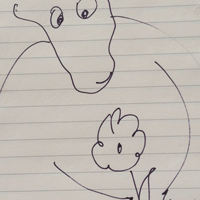
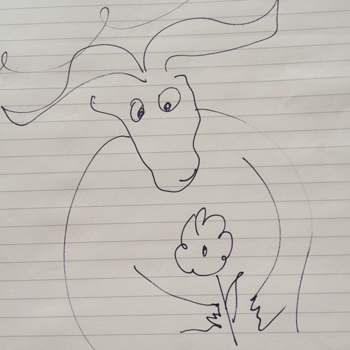
    As a child, she had drawn the famous Ferdinand the Bull under his favorite tree, smelling the flowers.

    And her teacher told her it sucked.

    “I never did art again,” she confessed to me.

    Heartbreaking – especially since I’ve heard a version of this story hundreds of times. I never thought that I would ever hear it told with drawing, though.

    A few words can destroy creativity.

    It’s normal and healthy to know our strengths and weaknesses. But we each have a right to discover our own weaknesses. Having someone declare our weaknesses is a violation.

    Amber does very well as an engineer. But how different would her life look like now if she had continued to draw?

    Maybe none. Maybe she would have drawn for years, enjoying it. Perhaps she would have eventually discovered that she was much better suited to engineering.

    But maybe she would have become a Picasso.

    Be careful what you say.

    If a child is giving it their best shot and you meet them with criticism, you might shut down their creativity for life. And it’s easy to do this with math – there are so many ways for a kid to do things “wrong.”

    But try to treat math learning like learning to create art. Regardless of how much the drawing sucks, be encouraging.

    If a child is adding denominators instead of finding a common one, discuss what the answer looks like. Give them the right, and the power, to see where they went wrong.

    Foster each child like they’re a budding Picasso and Pythagoras, regardless of how little talent you may see in them. Let them do things their way.

    You just might be surprised at what they end up doing.

    Do you have a story of creativity destroyed? Share it in the comments. And don’t forget to share Amber’s story on twitter.

    Related Articles: