

Category: Logic

  • HELP – Logic Puzzle Announcing The Homeschool Blog Awards

    HELP – Logic Puzzle Announcing The Homeschool Blog Awards

    Okay, y’all, I’m in over my head. I’m trying to create a logic puzzle as a nifty way to announce The Homeschool Blog Awards. Having never created a logic puzzle before, I thought, “How hard can it be?”

    Well, pretty darn hard.

    So I thought I’d put my start out there, as well as the solution, and see if I can get some help from y’all.

    Read the puzzle, try to figure out the solution, then suggest in the comments one or more clues that I should add (or get rid of).

    The Puzzle

    The Homeschool Post is the sponsor of The Homeschool Blog Awards every year. Writers of The Homeschool Post aren’t allowed to win, nor be nominated. So some of the writers of thought it might be fun to do a “within the family” blog award for themselves.

    After all was said and done, they decided to pass all information over to me, the math mom in the team, and let me figure out the winner. Alas, the information wasn’t well organized. So I had to figure out which blog went with which person, who voted for whom and who was the winner.

    The Clues

    Six of the writers decided to participate. They were

    • Lana (like Banana)
    • The writer of OK Homeschool Mom
    • Heather
    • The writer of Knit 1 Kids 4
    • Gidget
    • Rachel
    1. Heather said, “I love everyone. I’m just voting for them all!”
    2. Someone suggested that nobody should vote for themselves. So they agreed on that.
    3. The writer of Finding Joy voted for three people, including Heather and Kristal.
    4. Everyone who voted for Rachel also voted for the blog I Love My 5 Kids.
    5. Everyone but Gidget voted for the author of the blog SprittiBee.
    6. The author of  Homeschooling Unscripted only got two votes.
    7. Donnetta and Gidget got the same number of votes. As did the authors of SprittiBee and Knit 1 Kids 4. Also, Rachel and the author of I Love My 5 Kids had the same number.
    8. The author of Finding Joy is very popular – everyone voted for her.

    The Solution

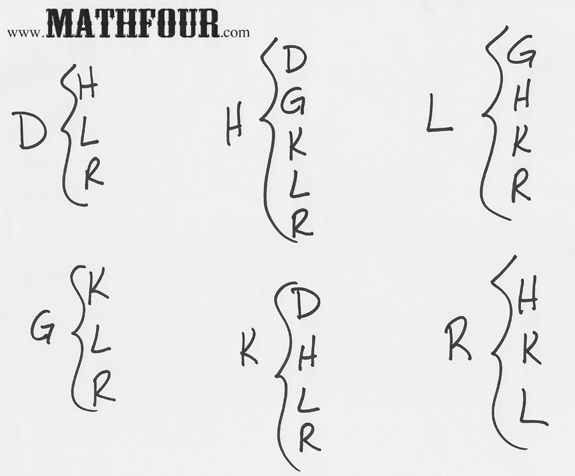
    Here is the solution of who voted for whom. The initial of the person is on the left and the initial of the people for whom they voted is in the curly brackets. Click on the picture to enlarge.

    Owners/writers of the blogs are here:

    • Donetta publishes OK Homeschool Mom
    • Gidget publishes Homeschooling Unscripted
    • Heather publishes SprittiBee
    • Kristal publishes Knit 1 Kids 4
    • Lana publishes I Love My 5 Kids
    • Rachel publishes Finding Joy

    Don’t forget…

    Suggest a clue in the comments!

    Related articles
  • Some Fun Ways to Teach Counterexamples

    Some Fun Ways to Teach Counterexamples

    This post is inspired by a discussion with Betty Ann on the www.Teachers.net math chatboard. She writes:

    I’ve got a high school student doing a very basic geometry course. She’s having trouble with the concept of a counterexample. I’m writing a worksheet on counterexamples and would love to have some more simple conjectures for her to work with.

    A counterexample is a special kind of example that disproves a statement. We start using these in Geometry because that’s the first course that really teaches proving things.

    Counterexamples are an essential part of logic.

    They don’t really need to be associated with math (or even philosophy) to be applicable. Which is the cool thing about them.

    Suppose someone says, “I always get to school on time.” It only takes one day when he isn’t on time at school to negate this statement. That one day would be considered the counterexample.

    We do this all the time and never use the fancy math term “counterexample.” So when we teach it, it’s helpful to tap into these everyday uses.

    Counterexamples are everywhere.

    Here are some statements for which students can come up with easy counterexamples.

    In the house:

    • Any four legged piece of furniture is a table.
    • If something has a knob on it, it’s a faucet.
    • Everything in the house with hands is a clock.
    • If a living being has eyes, it’s a human.

    In the grocery store:

    • Everything that costs $2.99 is a gallon of milk.
    • Everything that’s hot is fried chicken.
    • If something is white, then it is mayonaise.

    In the classroom:

    • If it’s a book, it has words. (Make sure there are blank journal books around.)
    • All books teach arithmetic.
    • Anything on the wall is a whiteboard.
    • If it’s full of pencils, then it’s a coffee mug.

    You can make your own statements for counterexamples.

    Choose a noun. Notice a feature about it. Then put it together using this MadLibs format:

    • Everything that has <feature> is a <noun>.
    • All <plural noun> have <feature>.
    • If it <has this feature>, then it’s a <noun>.

    You can also reverse them like this:

    • Every <noun> has <feature>.

    For instance:

    • Every cow is brown.
    • Every lightbulb is 60 watt.
    • Every hammer has a wooden handle.

    Which counterexamples or counterexample building method do you use?