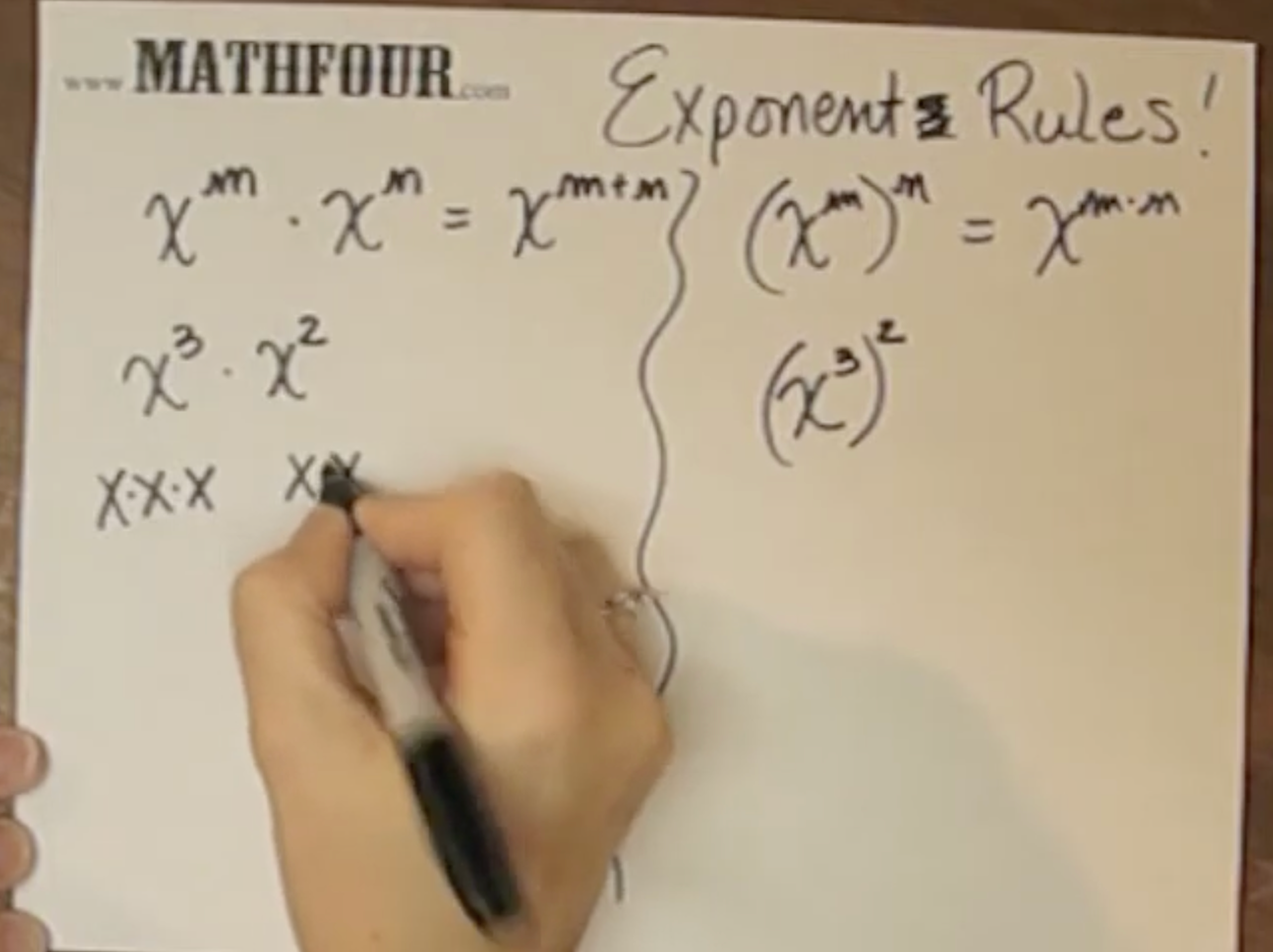

Remember that you can distribute multiplication over addition? You can also distribute exponents over multiplication.
Here’s how and why it works:
And here it is written out “long ways” for an algebra problem. Remember, you can use the short version. I do the videos with the long version to help you remember why it works.
This isn’t something you do everyday. Therefore it would be helpful to know how to remember it long term.
The mixed number really means .
Notice the PLUS sign? That’s the big key to doing this.
This video shows the long expanded way that most people won’t show you. You wouldn’t really convert this way, but it helps to see it in the long form. This way you know what your teacher is showing you isn’t some pixie dust magic:
Now that you can do that, you can probably go the other way too:
And how about checking your work? Nevermind the devil box (aka the calculator), the more you check your own work by hand, the more your confidence in your own math abilities will be. Try doing this:
What do you think? Will this help you remember? Do you have another way to remember? Share it in the comments.
We learn to factor polynomials so we can solve for x. Stuff like
3x2 + 2x – 1
can be easily factored into
(3x – 1)(x + 1)
But some things aren’t so easy. And some things are just down right a pain in the bottom. Like this one:
18x2 + 189x + 490
“Just shoot me,” you might be thinking. But cool your jets, cowboy. Here’s the first tool you need to never factor polynomials again:
I know – who wants to memorize that formula? But wait. If you use that one formula that you can memorize, you never have to factor polynomials again. Watch:
So the factoring isn’t bad on that one, right? How about this one:
And how about if you come across one of these. Wouldn’t it be nice to get rid of all guesswork:
This has some disadvantages, of course. You see that there’s a lot more arithmetic. And there’s some things to look out for. But if you hate trial and error (like I do), then you might be willing to take the bad with that good.
There’s an amazingly fancy tool that I began discussing in the last post. This D-word probably has been a close friend of yours for a while. It’s likely you’ve used it before and just didn’t realize it.
Well, now you can give it a name and give it some practice. It’s the Distributive Property.
Fancy name. Fabulous friend.
Check out what’s really going on with 87 x 48 here…
That one you can do quickly with pencil and paper. Here’s an easier one that you are more likely to do in your head (after practice with P&P of course)…
Have you done this before? Share your stories in the comments.
One of the common errors in algebra is canceling bits in fractions that can’t be canceled. To remember the rule, though, you don’t have to memorize anything. You only have to think of a plain arithmetic problem to compare it.
To help you remember what’s allowed with problem:
think about this simpler problem:
Like this:
And just to keep you straight, here are the requirements (and a couple of examples) for the fancy <cue music> “distributive property.”
What do you think of this explanation? Post your thoughts in the comments.
This was requested by Jake’s Mom. Since she was taught to borrow, she was dumfounded at what Jake brought home. Happily, Jake is young enough and unscathed enough to not balk at a “different” method than what his mom was taught. He got it right away.
But Jake’s mom, on the other hand, is struggling.
If your kiddo is being taught this, here’s a way to look at it that might help you understand what’s going on.
First, a brief review on the relationship of subtraction to addition:
Here’s what “reverse addition” looks like in relation to our old friend “borrowing,” using the same example:
And here’s an example:
Another example (along with a special tip for you):
And a final example, just to help you get the hang of it.
Kellie writes: “I am told to find the nth number in a pattern. What the heck does nth mean?”
So I’ll first answer the question directly. Then we can talk about what it means to the rest of the problems.
One more piece of the puzzle before we’re on to solve problems. I’ll bet you saw something in there about n-1 or n+1. Here’s a bit about that…
Now let’s get into writing the nth term of a sequence using the one before it. Remember the nth term is the number in the list if you count up to whatever you’ve labeled n.
In the previous video, we would have written it in fancy terms like this:
Once more, just to get the hang of it:
Again, this one would have been written:
Aha! But what if you don’t know the number right before the one you want? Watch this:
Complex numbers are made from one part real number and one part imaginary number. That’s one heck of a mixture.
Anytime you mix things, you take the complicated to, well, the complex. (Goodness I’m punny today!)
We use conjugates in the manipulation of these things. First it’s important to understand what a conjugate is…
It’s just a pixie-dust quick-switch sleight of hand thing, right? Pretty much. Can you legally do that? Well, no. Clearly 4+8 is not the same as 4-8. Anymore than 12 is the same as -4. Duh.
But you’ll see in this next video that you’re not really jumping up and trying to change the value of things…
What’s really happening is that you’re inventing something to use as a “clever form of one” – the big fat one.
And here’s one more example. Don’t forget to comment if you’re still confused.
Completing the square isn’t as hard as everyone thinks. And there’s no reason to memorize a bunch of strange pixie dust magic math rules. Here’s the way to see it for what it is.