Want to give your kiddos a jump start on multiplication and division? What to help the ones struggling with division to grasp it better?
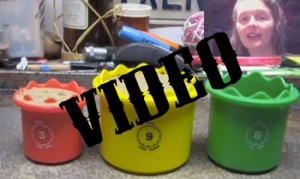
The Discovery Toys Measure Up Cups can do just that. They are built as a curriculum tool, in the proper ratios, so that the #6 cup holds exactly twice as much as the #3 cup. This allows for engaging and beneficial play that gives kids a grasp on how numbers relate to reality.
For example, in this video, kids can compare the numbers 3, 6 and 9 to see how they relate:
You don’t have to say out loud, “three plus 6 is 9” or, “9 divided by 6 is one with three left over.” But these concepts are ingrained into the child’s brain as they see this work.
I was at a seminar yesterday with world famous (and awful fun) Thiagi. He keeps his participants on their toes with small activities called jolts. Jolts are defined at interactive experiential activities and:
…force participants to re-examine their assumptions and revise their habitual practices.
One jolt we did yesterday got me to thinking about math. Okay, many of them had me thinking about math. But this one was about the multiplication principal of counting and sets.
The multiplication principal says that if you have 7 ways to do the first thing and 3 ways to do the 2nd thing, then you’ll have 3 * 7 = 21 ways to do them together. Assuming you pick one of each.
So if I want a sandwich (tuna, ham or turkey) and a side (chips, onion rings, fruit or fries) for lunch, I will have the option of 3 * 4 = 12 different lunches.
The Thiagi Circles Jolt
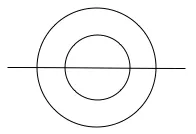
Here is the Circles Jolt that Thiagi offered: Draw this figure without ever lifting your pencil or retracing over any lines (or curves):
It isn’t hard, as you probably see. It takes anywhere from 10 to 45 seconds to figure it out. The question is, “Is there another way to do it than the one I thought of?”
So here are the ways I immediately thought of in the Thiagi Workshop:
The fancy pants teacher’s pet, Mark, was asked to demonstrate the answer. And he did it in an even different way! So I saw that there were 8 more ways to do it:
Trying to trump Mark and be the new teacher’s pet, I announced that there were indeed 16 ways to accomplish Thiagi’s goal.
There are 16 ways because of the Multiplication Principal of Counting.
Notice there are four questions to answer when solving this:
Do you start from left or right side of the drawing?
Do you start by drawing the outer circle or go through and start at the inner circle?
Do you go up or down on the first circle you draw?
Do you go up or down on the second circle?
Each question has two different options. So there are
2 sides to start from * 2 circles * 2 directions to go in the 1st circle * 2 direction in the 2nd circle
2 * 2 * 2 * 2 = 16 different ways to draw the diagram!
Teach this with experiments.
Although you now know how many there are, don’t teach it this way. Instead, just give the jolt to the kids. Once they solve it, show them “your way,” which should be any way that is different than theirs.
Then tell them that for ever unique solution, you’ll give them $1. (Thiagi gave out $1 bills yesterday, too!)
Once they come up with all 16, offer the extra $4 for some way they can show the number 16 with numbers (logically based on their solutions). They might come up with 2 * 8 or 4 * 4, as long as they can group their drawings in logical bundles.
Differentiation is the foundation of learning. Curiosity comes in the form of “Why is that different?” And right behind it is “Why is that the same?”
So patterns – and the lack of patterns – are essential in the development of a child.
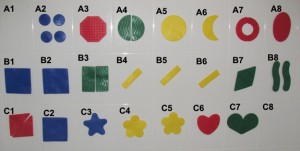
The picture below is a collection of Discovery Toys (not all of them because they live in a house with a 19mo child).
While in the tub, I encourage Daughter to see which ones are the same color. You can label the bathtub tiles with soap crayons so you can discuss the patterns more easily. Use the Cartesian Coordinate plane or Excel cell names like I did in Photoshop.
Here are some things to talk about to encourage pattern discovery and learning. Or click here to download this as a printable MSWord Document.
Which shapes are kind of the same (similar, but not in the official math sense of “similar”)
Put shapes together that “go together” – these could be same shape, color, “feel” (like B6 and B7 are both angled).
Compare shape A5 to the shapes A3, A4, A6, A7 and A8.
What do cells B3 and B8 have in common?
How are C3 and C4 different?
What’s in common in cells A2 and B2?
How are shapes C1 and C2 different?
How are C2 and B3 similar?
And then look at the world!
When you’re out of the tub, make sure to encourage observations – of everything. For something like the gate trim in the picture you can ask questions like:
What is similar?
What pieces are different?
Do you see spots that are kind of the same but mirror imaged?
If you were to make this symmetric, what other parts would you have to add to it?
I’ve learned of a thing called “What can you do with this?” from dy/dan. This teacher sets up a situation so that students can ask questions.
I’ve been pondering the effectiveness of this for a while.
The thought is that if you allow students to observe something interesting and ask them “What can you do with this?” then they’ll create their own word problems.
This is in response to the fake or “made up” word problems from a textbook which mostly don’t work for teaching thinking skills.
But the issue remains the same. If someone presents a student with a video of Coke vs. Sprite and the student lacks curiosity about that subject, then it’s still a contrived problem. Or a contrived situation.
The only reason to do a word problem is if you’re emotionally attached to it.
Husband and I were talking about word problems the other night. After my demonstration about using to teach math, he said he wished he learned math that way. He needed something to hold on to. A reason for doing it.
He’s a set dresser in Hollywood for part of each year. Which means that he has to hang pictures on movie sets. And they have to be 55″ above the ground – at the center of the picture.
Not hard to measure, but there’s also the wire on the back to consider. Is the wire dead center? No. It’s probably above the center of the picture.
It becomes one giant word problem. But it isn’t written in a book. And it isn’t videoed by a teacher. It isn’t fake. There’s a real reason for him to do it.
Which made me realize that there’s only one reason to do word problems: if you’re emotionally attached to it.
If you need an answer to a question, you attach to it emotionally.
Parent: You’ve got 45 minutes to clean the kitchen before we leave for softball practice.
Kid: If I finish the kitchen before we leave, can I watch TV?
Parent: Sure, but the kitchen better be spotless.
Most likely the kid has a plan for TV – like watching his favorite cartoon on DVR that takes about 30 minutes. So he works out how fast he needs to clean the kitchen so he can get in his cartoon before leaving.
This is a real problem. His problem.
Watch your kids intently. See where they are doing word problems in their heads. Ask them to explain them. Give credit for work done – especially when self-created.
If someone else needs an answer, you attach to it.
Being helpful is a powerful motivator. Try this: with a pencil and paper sit in a public place. Act like you’re writing something important. Then ask out loud, “What’s 87 minus 13?” $5 says that at least four people will chime in to be helpful.
Let your kid help with balancing the checkbook or creating the budget. If you’re a classroom teacher, let the kids help figure out what teacher supplies to buy. Give them a limit on what to spend and the catalog and some guidelines.
If someone you like wants an answer, you attach to it.
I couldn’t have given a feathery duck’s tail about biology, but the teacher was crazy cute. So I wanted to please him. So I worked. Hard. And had a 100 average.
I suspect this is why the teacher at dy/dan is so successful. He’s cute, compelling and cool. Who wouldn’t want to engage with him?
If you have carisma and charm, use it. This might not work as a parent but will definitely work as a classroom teacher – at least for some students.
Give it a try. Tap into the emotion. And share your success below!
Not only is this video about triangles that are similar, but this video about triangles is similar to other videos! (Is that fun to say or just annoying?)
Here it is:
What do you think? What other triangle things can you do with a pegboard?
Do your kids get confused between congruent and similar triangles? Do you?
In a previous post, I made this mistake when discussing right triangles on the Giant Pegboard. If a mathematician can make the error, then it is easy for a kid to, also.
In the video I said “congruent” when I meant “similar.” Two triangles are congruent if they are the same size and shape. They are similar if they are the same shape (and maybe or maybe not the same size).
One way to show that two triangles are congruent is to use the SSS Theorem or the “side side side” theorem. This says, essentially, that…
If you can show all three sides of two triangles are the same, then the angles must also be the same.
This ensures that your two triangles are congruent – or as a kid might say it “exactly the same.”
Here’s how to use the Discovery Toys Giant Pegboard to play around with congruent triangles:
What do you think? Can you use this? Give it a shot!
Check out the next post for a video discussion on similar triangles.
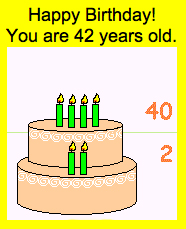
It’s Husband’s birthday today. He’s 42. But instead of just saying, “Husband’s 42,” I can say he’s 13.37pi years old. (At that site you can also find an “exact” pi birthdays in case you want to celebrate at some other time.)
He’s also 15,340 days old! This site calculates months, hours and seconds too.
He’s years old. His age is also the second sphenic number. What’s that? I’m not sure – but if you click on your child’s age on this Wikipedia page, you’ll get some fun sounding words for their number that they can use all day! Here are some for your kids:
He can go here to find out that he was born in MCMLXIX. This nifty birthday math trick will result in the number 4.22 (April 22 – his birthday!). Or this one which will result in 42269 (also his birthday).
For some fun birthday math, he (and you) can check out The Birthday Problem – also known as the birthday paradox.
How will you celebrate a family member’s next birthday? Will you use birthday math? Share your thoughts in the comments.
I discovered this video about the philosophies of teaching math from the blog Learning to Teach, The Empty Set of Education. Having degrees in math and not teaching I found it very interesting from a theoretical point of view.
And I totally love his conclusion – the 5th philosophy!
What is your philosophy for teaching math? Share your thoughts in the comments.
If you’ve ever taught or tutored math you’ve encountered the question, “When am I ever going to use this?” Maybe even hundreds of times.
And no doubt you’ve tried the answers that you’ve heard your math teachers give:
You’ll need it in a future job.
You’ll want to balance your check book someday.
Blah, blah, blah.
I was on the Teachers.net chatboard last night and there’s a discussion in the math teachers section about how to answer this question.
I was horrified to read that some teachers actually respond with, “How about as homework, you find the answer to that question.”
Egad!
We all know it’s a discrationary tactic. We know that there are lots of good uses of math. And we’ve experienced our answers shot down with, “I’m not planning on doing a math job for a living, so I won’t need it,” or “I’ll hire a CPA to do my checkbook.”
There’s only one right answer to this question.
“You’ll never use the math I teach you. Ever.”
I offer $10 to anyone who can come back to me in 10 years and tell me that graphing functions (or whatever we are learning that day) has actually had an applicable use in their life.
Of course they’re horrified at this answer. They give me looks like, “What? Are you an alien here to invade our classroom. Did you eat the real Bon?” No teacher has ever been that honest.
Graphing functions is virtually useless as a real tool. As is most of what we teach.
I used to get phone numbers from men at bars with my amazing use of the quadratic formula, but that’s only something you can tell college students. And they don’t buy it anyway.
Teaching math is teaching brain exercises.
The reason we teach and learn graphing functions (or other math) is to exercise a part of the brain that we rarely get to use. A part that will get used sometime later in a weird way.
We’re building new paths in the brain. We’re carving a way to alternative problem solving that might one day be useful in solving interpersonal, business, automotive, or other type of problems we have.
I tell them that math class is a game. A fun time to escape once a day. This is a play time to stretch their brains and do something completely different.
And I certainly don’t pile pissiness upon pissiness with the attitude of “If you’re going to challenge me, small menial student, then I’m going to give you extra homework.” That really motivates students… to hate math.
How about you? How do you answer the question? Are you supporting future math happiness? Share your thoughts in the comments.
I hosted a Discovery Toys party the other day and ended up explaining how to use many of the toys for teaching math.
Alas, here I am now doing videos of the same. I can’t get over these toys. They are designed proportionally (the cups and weighing ones) and always with the thought “How can this be fun at the same time it’s teaching something.”
Of course, all toys teach. But the designers of these toys put the extra oomph into the thinking process so that when a kid asks “why?” there’s an easy way for the parent to answer.
Oh – and they are guaranteed for life!
So from here out, I’ll be doing occasional videos on how to use them.
The first is about right triangles on the Giant Pegboard. Notice in the video that when I say “congruent triangles” I really mean “similar triangles“.
See what you think:
Have you played with triangles and pegboards? What other ways can you use them to teach and learn?
Disclaimer: I tried to become an affiliate of these toys to help pay for this blog. Alas, they don’t have an affiliate program. The only way was to become an official consultant. These toys are so cool and helpful, that I have done it.