Tag: polynomial

  • Factoring Polynomials  — FREE Worksheet

    Factoring Polynomials — FREE Worksheet

    In factoring polynomials it’s sometimes handy to break up the work graphically. Lisa Nuss, a member of Sam Shah’s New Blogger Initiation, shared a handy graphic organizer last week.

    I struggle with factoring polynomials, myself, so I wanted to give it a try.

    It started out easy.

    I started factoring polynomials with 1 as the leading coefficient (i.e. x2 has no messy number in front of it).

    I factored:

    \(x^2 + 14x + 48\)

    First, I put the first and last terms in the boxes. (Note that this graphic organizer works the same way as a multiplication table.)
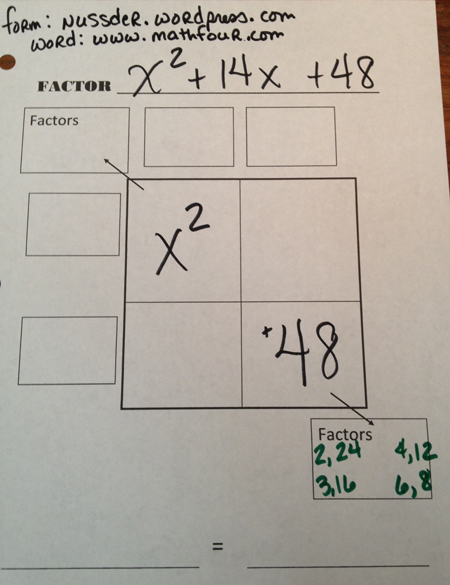
    Then I factored those two in the given “factors” boxes. I determined which factors of 48 would add up to 14, and filled in the chart appropriately.
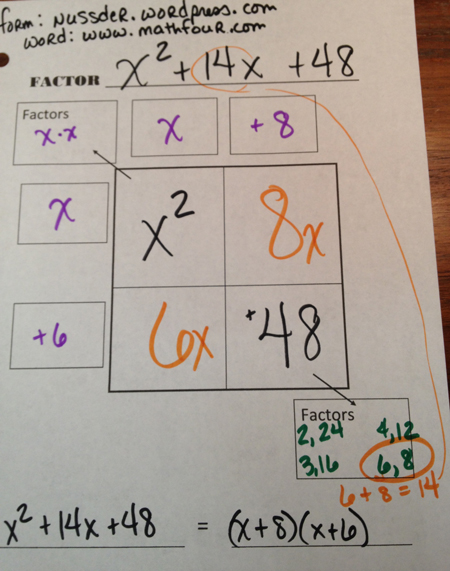
    I was done with that factorization.

    Yay me!

    Then I got into harder stuff.

    Lisa put in an extra “Factors” box to handle non-unit leading coefficients. So I went for a big dog:

    \(6x^2 + 65x + 50\)

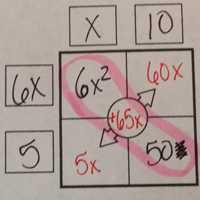
    Here’s how far I got before the breaks squealed:
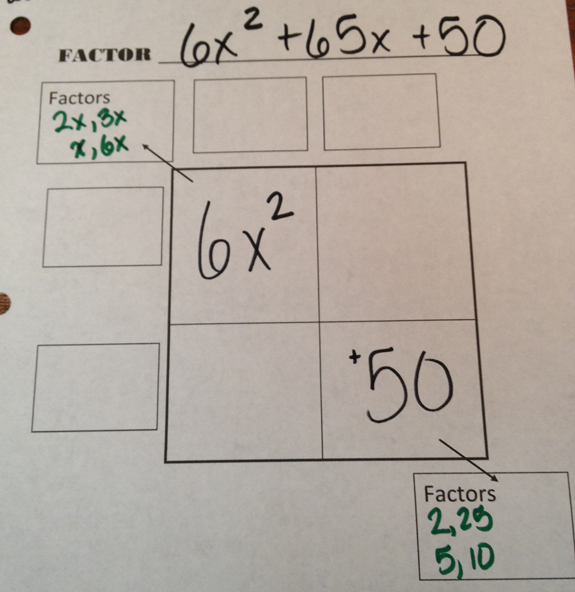
    Factoring polynomials like this one shouldn’t be too much of a problem. Especially if you use a page protector and a dry erase pen to do the trial and error work, as Lisa suggested.

    But I don’t have such fancy technology.

    And I don’t like to erase my work. I want to see everything I’ve tried. For me, it’s very likely that I make a mistake and have to go back. And it’s a real pain to have to re-create everything.

    So instead of playing trial and error with the one big sheet of paper, I created a Factor Trial & Error Boxes worksheet (or in Lisa’s terminology: a graphic organizer).

    Here’s what my work looked like:
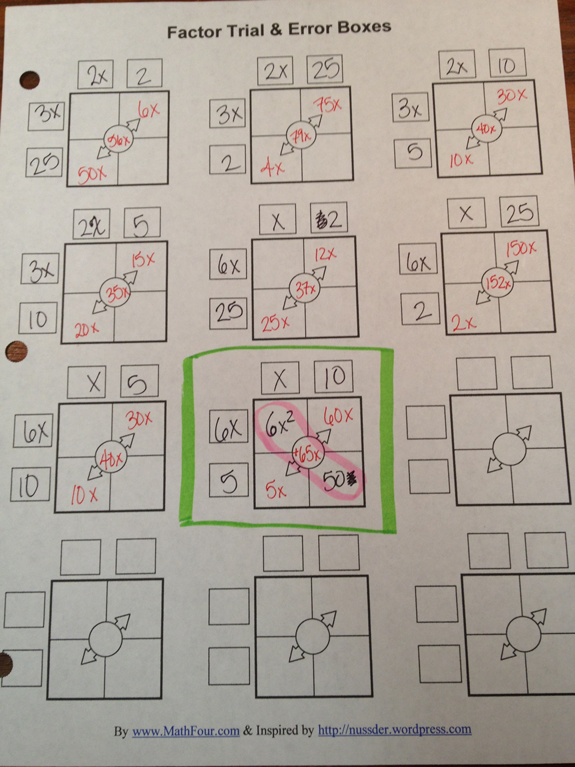
    (It was a coincidence that the right answer was last, by the way.)

    With that info, I could go back to my big graphic organizer and finish the problem.
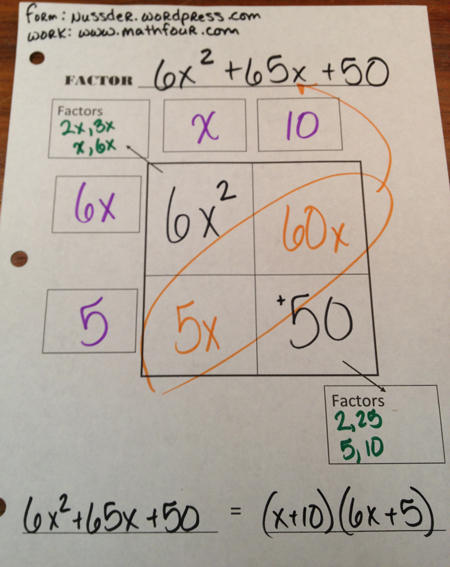
    This was very pleasing. I was able to use Lisa’s graphic organizer and mine to make sure I didn’t lose any options in my my trial & error.

    Will it work for you and your kids? Download the Factor Trial & Error Boxes worksheet now and give it a shot!

    Share your thoughts in the comments or on twitter/x.

    You might also like:
  • Polynomial Factoring Practice – with YouTube!

    Polynomial Factoring Practice – with YouTube!

    The #PowerMath classes and I were taken with the videos done by Westerville South High School in Westerville, Ohio. Especially the polynomial factoring one called “Teach Me How to Factor.”

    The students asked that I put together some optional homework for them on the videos. No sense in watching something that fun and not getting to practice it!

    Check out the video. Below it, there’s a free downloadable collection of “homework” problems that match each of the polynomial factoring examples in the video.

    And right below that, parents and teachers can get the teacher cheat sheet I created to get a whole bunch of fairly easy polynomial factoring examples.

    Get the free downloads here:

    What do you think about the video? Can you use the worksheet and cheat sheets for teaching polynomial factoring? Share your thoughts in the comments!

    Related articles
  • How to Use the Quadratic Formula to Never Factor Polynomials Again

    How to Use the Quadratic Formula to Never Factor Polynomials Again

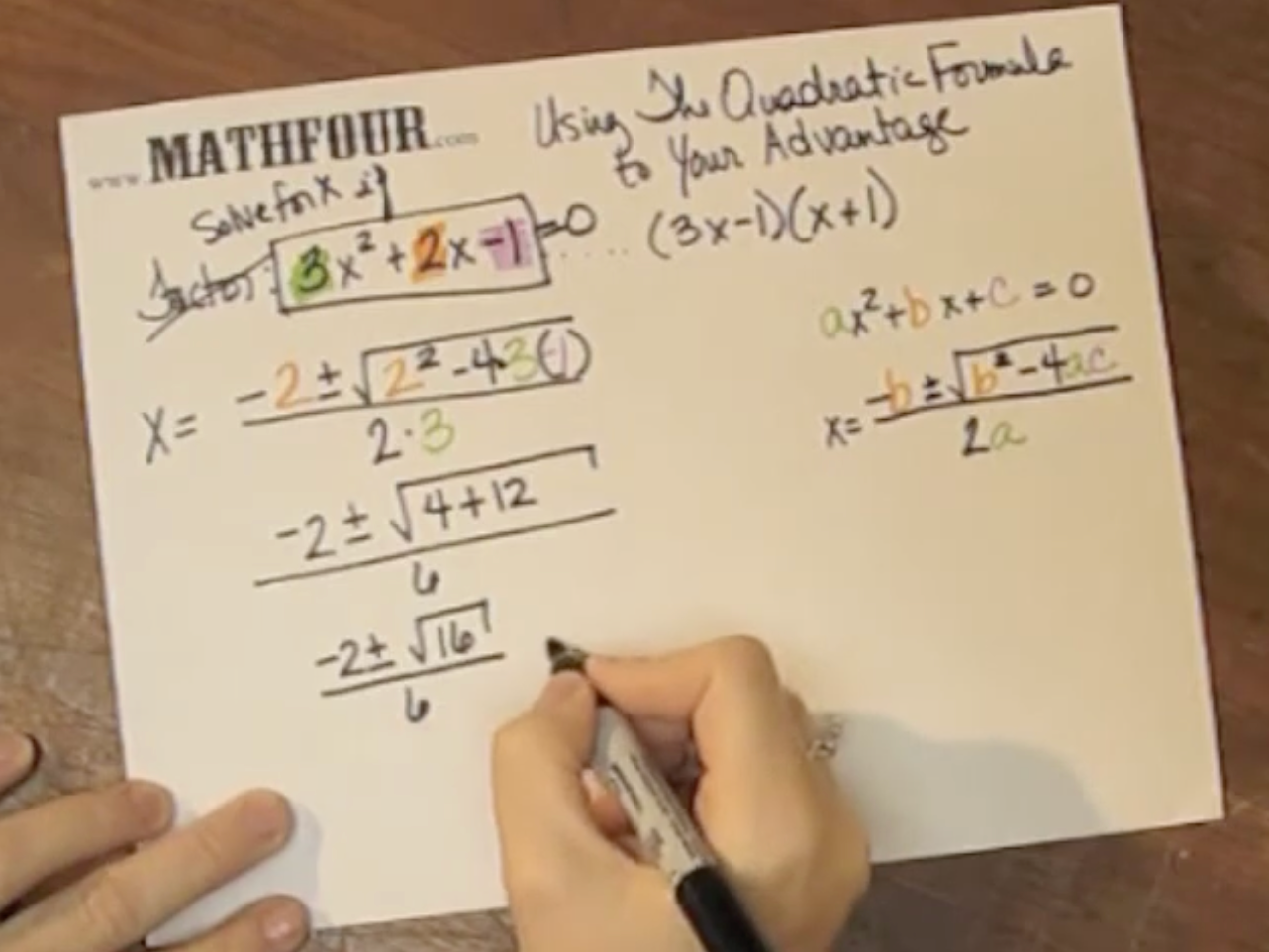
    We learn to factor polynomials so we can solve for x. Stuff like

    3x2 + 2x – 1

    can be easily factored into

    (3x – 1)(x + 1)

    But some things aren’t so easy. And some things are just down right a pain in the bottom. Like this one:

    18x2 + 189x + 490

    “Just shoot me,” you might be thinking. But cool your jets, cowboy. Here’s the first tool you need to never factor polynomials again:

    I know – who wants to memorize that formula? But wait. If you use that one formula that you can memorize, you never have to factor polynomials again. Watch:

    So the factoring isn’t bad on that one, right? How about this one:

    And how about if you come across one of these. Wouldn’t it be nice to get rid of all guesswork:

    This has some disadvantages, of course. You see that there’s a lot more arithmetic. And there’s some things to look out for. But if you hate trial and error (like I do), then you might be willing to take the bad with that good.

    Whatcha think?