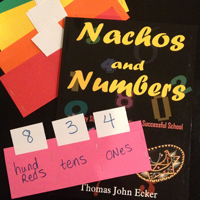
I attended the Statewide Parent Involvement Conference in San Antonio this weekend. There I saw Thomas Ecker, award winning classroom teacher and author of Nachos & Numbers.
Ecker developed the Nachos & Numbers Family Math Night (and the book) based on years of experience in classroom teaching and parent involvement.
But the book Nachos & Numbers is so much more than a guide for an annual parent involvement Math Night event at a school.
You can use the activities at home, in the car or anywhere the urge to learn strikes your child!
It has activities for all areas.
Chapter 8 of the book is full of activities perfect for a homeschool family, classroom or family game night. There are activities that promote basic numeracy all the way up to probability and statistics.
In the session, we created some place value pocket charts (found on page 24). This is a simple and fun activity you could do at your kitchen table!
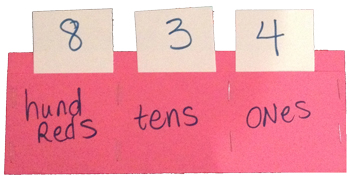
Place value pocket charts work great for practicing place value — and you can cram them in your purse for some on-the-go educational opportunities.
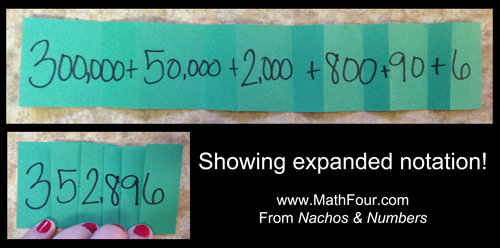
One of my favorite activities is “Expanded Notation in Expanded Form” on page 27. It’s an awesome way to show how a number can be written as the sum of its parts.
It has a step-by-step plan for a Family Math Night.
If you’re in charge of Family Math Night at your school or want to create a Math Night for your homeschool group — Nachos & Numbers is the best resource to make it happen.
At just $12.50, it will be the cheapest thing you buy for Family Math Night!
The other chapters cover getting support, publicizing your Math Night for optimum parent involvement, getting the right food and getting volunteers — everything you need!
Get it!
Whether you’re a parent wanting some ideas or a Parent Involvement Specialist tasked with putting on the annual Math Night, Nachos & Numbers is a must-have resource!
(By the way, I paid full price for it. They haven’t given me anything to recommend this — I just think it’s super awesome!)
Share your thoughts in the comments or on twitter/x.