As you wrap presents this holiday season, take a minute to notice the patterns in the wrapping paper. You might just find some math!
How does the paper come together in the back? Does it neatly match up, seamlessly? Or is it way off?
Are you able to scootch things a little so that you can get the paper to line up?
What happens when you use a different box?
Is this really math?
Absolutely!
Consider wallpaper: it has a pattern that repeats every so many inches. When you put wallpaper in your home it’s important to know how often it repeats so that you can match patterns in the corners and around windows, etc.
Patterned wrapping paper also repeats. Most people ignore it because they don’t think about matching the patterns in the back when wrapping gifts.
Unless they are particularly detail oriented, a perfectionist, or want to teach a little bit of math at home while wrapping presents…
Choose your wrapping paper to match your boxes!
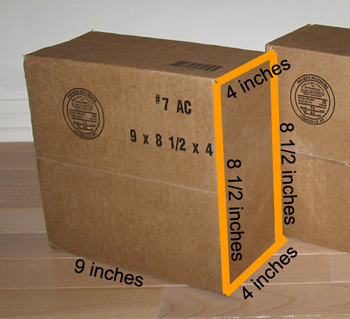
On this box your wrapping paper would go around 8 1/2 + 4 + 8 1/2 + 4 inches.
This means the wrapping paper would travel 25 inches before meeting back up with itself. So any wrapping paper that repeats after 5 inches or 25 inches will match back up in the back. Both 5 and 25 are factors of 25 – and that’s math!
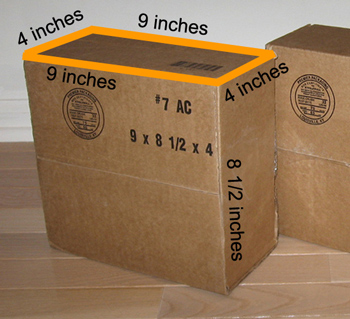
If you wrap the box the other way, instead, like this,
…the wrapping paper would travel 26 inches. Therefore any patterned wrapping paper that repeated after 2 inches, 13 inches or 26 inches would match in the back perfectly.
A box whose “wrap around” distance was 30 inches could use any wrapping paper that repeated after 2 inches, 3 inches, 5 inches, 6 inches, 10 inches, 15 inches or 30 inches. All those are factors of 30.
Choose your boxes to match your wrapping paper!
Or do it the other way – figure out how frequently your pattern repeats. Any box that has a girth of a multiple of this number can be wrapped perfectly. (Girth is the distance around the box – where you wrap the paper.)
For instance, if your wrapping paper repeated after 2 1/2 inches, you would look for boxes that have a girth of 2 1/2 inches (a tiny ring box), 5 inches, 7 1/2 inches, 10 inches. All the way up to giant boxes that have a girth of 314 1/2 inches.
Your turn!
How often does your favorite wrapping paper repeat? Have you found the perfect box/wrapping paper combination? Share your wrapping paper math discoveries in the comments!
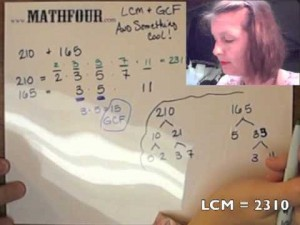
In a previous post, we learned that you don’t have to use a LCM (least common multiple) to find a common denominator to add fractions. In another post, we learned that you can use primes instead of the GCF (greatest common factor) to reduce fractions.
And now I’m going to demonstrate that finding the LCM and GCF of two numbers is still pretty cool.
Apologies for the glare on the video. I tried a different method and clearly it is inferior to the other method.