

Tag: following curiosity

  • The Learning Cycle

    The Learning Cycle

    Kids learn.

    People learn.

    If you aren’t a “lifelong learner,” well, bummer for you. Because you’re dead.

    But what exactly does it mean to learn?

    What does real learning look like?

    I’ve been watching people learn for over 20 years. Everyone goes through this learning cycle:
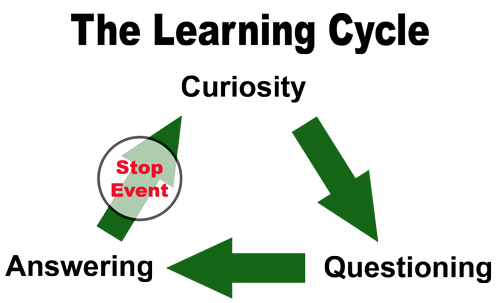
    Curiosity

    It all starts when you get curious.

    “Hmm… I wonder…”

    Questioning

    And then you form curiosity into words.

    “What is that?”

    “How does it work?”

    “Why?”

    Answering

    After the question is out there, someone answers it.

    “What is that?”

    “It’s a flower.”

    You might answer it yourself. Or someone else chimes in to offer an answer.

    And the answer could be all sorts of things.

    • The “right” answer (something that’s true)
    • The “wrong” answer #1 (something that’s false, but sounds good)
    • The “wrong” answer #2 (something that’s false, and obviously so)
    • The “I don’t know” answer (an open ended un-answer)

    The learning cycle can continue.

    After obtaining some sort of answer, you decide if you should go on or stop. Continued curiosity causes you to go through the learning cycle again. You start searching for deeper meaning.

    “Hmm… What is that?”

    “It’s a flower.”

    “Oh. It’s funny looking for a flower. Hmm… I wonder…”

    And the learning cycle can hit a stop event.

    If you have enough information to satisfy your curiosity, you’ll likely stop the learning cycle. (Even if the answerer is ready to give more information.)

    “Hmm… What’s that?”

    “It’s a flower.”

    “Oh. It’s pretty.”

    But sometimes the stop event is damaging.

    If you obtain an answer in a way that oppresses your natural curiosity, you’ll also stop.

    And here’s where trouble starts.

    “Hmm… What is that?”

    “Really? Are you blind? It’s a flower.”

    Or

    “Hmm… What’s that?”

    “We already went over this. It’s a flower.”

    And if you encounter a damaging stop event, you’re likely to internalize it. You’re also likely to avoid that curiosity again.

    What is your experience with your learning cycle? Share it in the comments or on twitter/x.

    You might also like:
  • Motivation or Inspiration – How do you teach?

    Motivation or Inspiration – How do you teach?

    In order to see what the difference is between motivation and inspiration when teaching math, I’m going to start with a quick story…

    You have a dog named Herman. Herman is cute, fuzzy, has a pink nose and loves you unconditionally. You think he’s great. So you want to share him.

    You put a bow around his neck, and hand him to your children, Abby and Dirk.

    “Here is Herman. He’s cute, lovable, and a perfect pet. Isn’t he fabulous?” you tell them.

    Abby looks at Herman and is so excited. She thinks he’s fabulous, wonderful and sees in him everything that you do. Inspiration hits her – she loves him like you do!

    Dirk, on the other hand, wants a cat. He’s not sure how to voice this. But since you’re so excited about Herman the dog, he rolls with it.

    He wants to please you, so he feigns interest in Herman.

    Herman’s not a dog.

    Herman is your curiosity. Herman is what you find interesting and inspirational.

    And just because Herman is wonderful for you, doesn’t mean Herman is perfect for everyone else.

    Abby loves Herman. And Dirk loves Herman, but only because loving Herman pleases you.

    We offer Herman, and they take him. Because they want to please us.

    Lots of educators these days are talking about helping children connect with math through real life experiences. They want to give children curiosity about math in the real world.

    But the real world means different things to different people. And it means different things to different kids.

    • Some children like to build things. Give them a stack of Legos and they’ll work for hours.
    • There are kids who are outdoor people, always running around and wanting to see what next thing they can find in nature.
    • Some kids want to be in the kitchen, helping their parents cook dinner.
    • Some kids are quite happy connecting math just to math.
    • Some children are gamers, enjoying puzzles, riddles and games just for the fun of it.
    • And the list goes on…

    Grownups take their connection to the real world, their own curiosity, and pass it on to children. We take everything that we find fascinating, our own personal Herman, and hand it to the child.

    And they take it. Some because they are excited about it, and some because they want to please us.

    Motivation is not inspiration.

    The growing thought among educators is that children need to be curious in order to learn math. So we’re creating ways to get children curious.

    But are we doing it right?

    The child will happily take Herman, your form of curiosity. This could mean they are truly inspired by what you give. And it could mean that they are merely motivated.

    Motivation isn’t a bad thing, for sure! But if we mistake motivation for inspiration we are doing the children a disservice.

    If they’re motivated, they’ll only do what’s next to get praise. It’s about you, the grown-up, and how much they can please you.

    If they’re inspired, they’ll want to take their learning to the next level – even when you’re not around. They’ll want to see and do things to enhance their understanding without needing your praise and attention. It’s about them.

    And when things are about them, they own it. They succeed because they can, not just because we want them to.

    What’s your Herman?

    And have you passed him along? Was he inspirational or motivational? Share your thoughts in the comments!

    Related articles