Tag: words

  • The Best Online Math Dictionary for Kids

    The Best Online Math Dictionary for Kids

    UPDATE June 2026: This tool is still available, however it’s no longer interactive Unless you use the version captured on the Wayback Machine. I’ve included links for both the current static version as well as the Wayback Machine’s interactive version in the post.
    My friend and fellow educator, Jeri, shared with me a super find — A Maths Dictionary for Kids by Jenny Eather (static, interactive).

    I have a lot of math dictionaries, and have seen many online. Generally they all do the same thing — give definitions.

    But the interactive version of A Maths Dictionary for Kids does something more than all the others — it gives kids a chance to experience the words.

    After playing around with it a bit, I’ve decided that it’s the best online math dictionary I’ve ever seen — even better than Wolfram’s MathWorld!

    It’s not just for kids!

    Yes, it’s colorful, interactive and easy to use. But that doesn’t mean you have to be a little one to appreciate it.

    As a grownup you’ll also enjoy the interactive version of A Maths Dictionary for Kids. Head over there now and pick some terms to play with. Here are some good ones to start with:

    • Absolute value
    • Attribute (shown in the video)
    • Centre of rotation
    • MPH
    • Terminating decimal
    • Three-dimentional
    • y-coordinate

    Print it out and use it!

    If you do something cool you can print it out and use it as a handout.
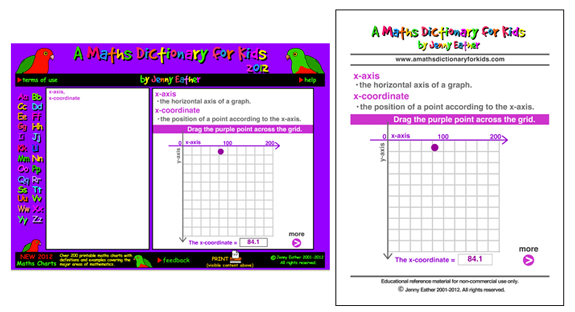
    On the left is what you see on the site, on the right is the printout!

    UPDATE June 2026: The print function doesn’t work in the interactive version from the Wayback Machine. However, you can still do a screenshot.

    What do you think? Can you use it?

    Share your thoughts in the comments or on twitter/x.

    You might also like:
  • Math Words — Start Using Them Early

    Math Words — Start Using Them Early

    Every parent is concerned that their children will not get what they need to be successful. Especially in math.

    Instead of worrying, you can take action. And it’s not hard.

    Use “big” math words.

    Don’t refrain from teaching your child math words just because they’re big or seem complicated to you.

    This sentence, “May I have milk, please,” has five simple words. To a grown-up.

    But to a child, a five word sentence is no different than a five syllable word. Like, “parallelogram.”

    In fact, if you teach your child to count to 10, it’s the same as teaching your child an eleven syllable word. (Seven has two syllables.)

    To put this in perspective, the word overintellectualization has only ten syllables!

    O – ver – in – tel – lec – tu – a – li – za – tion

    One – two – three – four – five – six – seven – eight – nine – ten

    In fact, overintellectualization is easier to say when you look at it like this.

    Try some words!

    Give these math words a shot with your little ones:

    Parallelogram (pear-uh-lell-uh-gram)

    A parallelogram is a shape. It has four sides. The sides that are across from each other are parallel to each other. Which means a square is a type of parallelogram. And so is a rectangle.

    So the next time you see a square or a rectangle, say to your child, “Hey, there’s a rectangle. It’s also a parallelogram. Can you say parallelogram?”

    Hypotenuse (hi-pot-uh-news)

    The hypotenuse is any diagonal that you take instead of walking first to the left and then to the right (or vice versa). So the next time you walk across the street at a diagonal, say to your child, “Were walking the hypotenuse. Can you say hypotenuse?”

    Coplanar (co-plane-er)

    Any two things that are on the same flat surface are coplanar. Like two people standing on the floor together.

    When you’re around stairs, stand on a different step than your child. Say, “Look, we are not coplanar.

    Then move to the same step as your child and say, “Now we are coplanar. We are on the same flat surface. Can you say coplanar?”

    Go do it. Have fun!

    You don’t have to know the formal definitions of your math words. Just know a place or two where you can demonstrate them in your own world.

    Remember, getting your child familiar with math words will make a big difference.

    So pull out some big words, and try them on for size. Your little ones can handle it!

    You might also like: