Tag: hypotenuse

  • Math Words — Start Using Them Early

    Math Words — Start Using Them Early

    Every parent is concerned that their children will not get what they need to be successful. Especially in math.

    Instead of worrying, you can take action. And it’s not hard.

    Use “big” math words.

    Don’t refrain from teaching your child math words just because they’re big or seem complicated to you.

    This sentence, “May I have milk, please,” has five simple words. To a grown-up.

    But to a child, a five word sentence is no different than a five syllable word. Like, “parallelogram.”

    In fact, if you teach your child to count to 10, it’s the same as teaching your child an eleven syllable word. (Seven has two syllables.)

    To put this in perspective, the word overintellectualization has only ten syllables!

    O – ver – in – tel – lec – tu – a – li – za – tion

    One – two – three – four – five – six – seven – eight – nine – ten

    In fact, overintellectualization is easier to say when you look at it like this.

    Try some words!

    Give these math words a shot with your little ones:

    Parallelogram (pear-uh-lell-uh-gram)

    A parallelogram is a shape. It has four sides. The sides that are across from each other are parallel to each other. Which means a square is a type of parallelogram. And so is a rectangle.

    So the next time you see a square or a rectangle, say to your child, “Hey, there’s a rectangle. It’s also a parallelogram. Can you say parallelogram?”

    Hypotenuse (hi-pot-uh-news)

    The hypotenuse is any diagonal that you take instead of walking first to the left and then to the right (or vice versa). So the next time you walk across the street at a diagonal, say to your child, “Were walking the hypotenuse. Can you say hypotenuse?”

    Coplanar (co-plane-er)

    Any two things that are on the same flat surface are coplanar. Like two people standing on the floor together.

    When you’re around stairs, stand on a different step than your child. Say, “Look, we are not coplanar.

    Then move to the same step as your child and say, “Now we are coplanar. We are on the same flat surface. Can you say coplanar?”

    Go do it. Have fun!

    You don’t have to know the formal definitions of your math words. Just know a place or two where you can demonstrate them in your own world.

    Remember, getting your child familiar with math words will make a big difference.

    So pull out some big words, and try them on for size. Your little ones can handle it!

    You might also like:
  • How to Teach Right Triangles when Crossing the Street

    How to Teach Right Triangles when Crossing the Street

    This morning Daughter and I went to the gym.

    When we crossed the street, I exposed her to undo risk by crossing at an angle.

    So on our way out, I explained to her that we were walking a little further to get to the car this time. And we would minimize the risk of getting hit by a car by taking the longer route.

    (Of course she’s not yet two, so she really didn’t care. But it was important for me to say.)

    Crossing at an angle is shorter than going straight across.

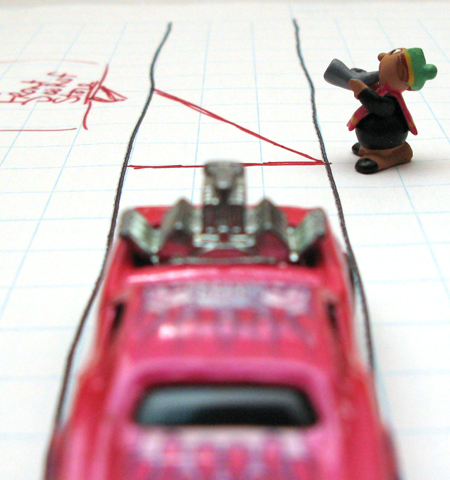
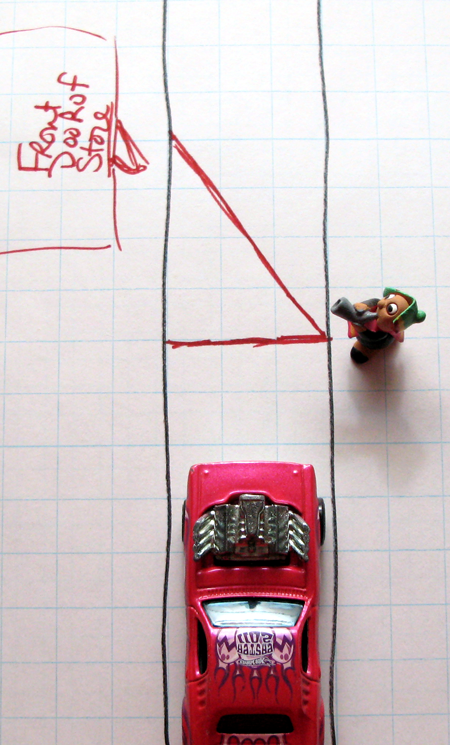
    People most often cross the street at an angle. Intuitively we know it’s shorter. Look at the tiny person in this picture. He needs to get to the front door of the store.

    It’s five yards to go at the angle, while if the little guy walked straight across then up, it would be seven yards.

    Suppose walking one yard takes 5 seconds. It will take the little guy 15 seconds to cross the street straight across. (And with a toddler, it does take 5 seconds to walk a yard.)

    Then he has to walk the four yards along the side to the door. Which means his total time is

    3 yards across at 5 seconds per yard = 15 seconds

    4 yards up at 5 seconds per yard = 20 seconds

    Total walking time = 35 seconds

    If he went at an angle, it’s 5 yards total (by the Pythagorean Theorem).

    5 yards diagonally at 5 seconds per yard = 25 seconds

    Total walking time = 25 seconds!

    Crossing at an angle puts you at risk for longer.

    For the pedestrian in a hurry (and wearing the shirt that reads “Safety Third”) the angled route is the way to go. But for a parent with toddler in tow, minimizing risk is a better option.

    If the little guy were to cross at the angle, he’d be in front of the oncoming cars for 25 seconds. If he were to take the route that is longer overall, he’d be in front of oncoming traffic for only 15 seconds.

    The car doesn’t care what angle you’re walking, it can squish you pretty easily either way.

    Not to mention he keeps the driver happy.

    Getting out of the driving area faster means keeping the driver happy. That might not be your goal, but adding some cosmic happy juice into the world of drivers never hurts.

    Plus, if someone were to “hypotenuse you” by taking the angled route when you were driving, wouldn’t you get a little annoyed?

    Next time you practice safety, practice math!

    So be safe. And tell your children why.

    It’s all about the math!

    Share your thoughts in the comments.

    Related articles

  • Learning Right Triangles with Discovery Toys

    Learning Right Triangles with Discovery Toys

    I hosted a Discovery Toys party the other day and ended up explaining how to use many of the toys for teaching math.

    Alas, here I am now doing videos of the same. I can’t get over these toys. They are designed proportionally (the cups and weighing ones) and always with the thought “How can this be fun at the same time it’s teaching something.”

    Of course, all toys teach. But the designers of these toys put the extra oomph into the thinking process so that when a kid asks “why?” there’s an easy way for the parent to answer.

    Oh – and they are guaranteed for life!

    So from here out, I’ll be doing occasional videos on how to use them.

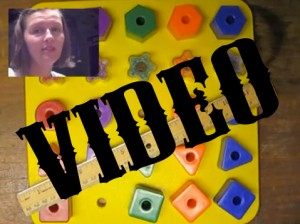
    The first is about right triangles on the Giant Pegboard. Notice in the video that when I say “congruent triangles” I really mean “similar triangles“.

    See what you think:

    Have you played with triangles and pegboards? What other ways can you use them to teach and learn?

    Disclaimer: I tried to become an affiliate of these toys to help pay for this blog. Alas, they don’t have an affiliate program. The only way was to become an official consultant. These toys are so cool and helpful, that I have done it.