I hear often that the “basics of math” are important. What people mean is that kids should memorize their math facts.
The basics of mathematics that are required for a student to learn and do mathematics aren’t math facts. They are these: Logic, Joy of Failure and Familiarity with Math.
1. Logic
Children start learning what an if/then statement is at an early age:
If you clean your room then you can go to the park and play.
The more parents have normal conversations with their children, the more children will understand the other subtleties of logic — like negation, contradiction and contrapositive. We all understand these, even if we don’t know the proper math words for them:
- Negation: “I am not going to listen to you whine!”
- Contradiction: “That dog is green.” (and K8 says, “Nu-uh! That dog is brown!”)
- Contrapositive: “Oh, I see you’re not at the park. I guess you didn’t get your room cleaned!”
Once the basics of logic are understood, a child is able to pick up a calculus book and work through it. At any age!
2. Joy of Failure
Teachers often well rehearse their lectures before they present them to the students. The struggle and failure that he or she goes through figuring out how to smoothly demonstrate the problem is kept from the children. Teachers know the job of failure, but they keep it hidden.
Thus children believe that failure is not an element of mathematical thinking. And nothing could be farther from the truth.
Parents can support their children in finding the joy of failure by allowing them every opportunity to attempt, reattempt, and fail at everything.
Promoting failure is tough, but important.
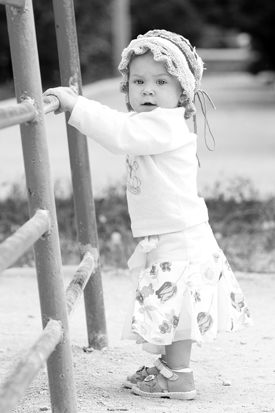
If your toddler is trying to climb a ladder, resist the urge to jump in and help. The more the child fails a climbing the ladder, the more insight he or she will gain into what else might work. (Like different hand positions, different footing, etc.)
You helping them climb the ladder might get them to the top faster, but resisting helping them (until they ask at least) will help them get used to learning from failure.
Mastery may seem a pleasant goal, but it merely means there is no more learning to be done and it’s time to move onto something else. Don’t give them a false sense of mastery — let them learn the joy of failure.
3. Familiarity with Math
Children are quite confident and very engaged in learning the craziest things. It may be how to skateboard, how to make funny noises or how to repair their bike. One of the reasons they are competent and engaged in these activities is because they are familiar with them. Everyone is doing it!
It’s difficult to be fearful of something that you see as a normal everyday part of life.
Parents can help children gain a familiarity with math by pointing out where they themselves use math every day.
This can be challenging to some parents, because they truly believe they don’t use math. But finding where the math is — and saying it out loud — will help your children a great deal.
How are you doing?
Do you talk to your children and let them read users’ manuals? (This promotes logic.)
Do you let your kids mess up? (Helping them find a joy of failure.)
Do you talk math to your kids? (Showing them how math is everywhere.)
Will you start?
Share your thoughts in the comments or on twitter/x.