My muse, Bartholomew, visited me this weekend with a question:
Can every number be written as a palindrome in some base?
What’s that mean!?
Okay — first thing’s first. A palindrome is something that can be written the same way forward as backward. Like mom or 1001. Typically we ignore punctuation, so things like, “Go hang a salami, I’m a lasagna hog,” also count as a palindrome.
And base means the number system — in our normal world we use base 10. Computers use base 2 (all ones and zeros) and hexadecimal (like the color codes you sometimes see on a computer — hex #ff9900 is the MathFour orange).
Notice in hexadecimal — using 16 digits — we have to use letters as numbers. I did a video on base 12 arithmetic here — base 12 also uses some letters as numbers.
So what’s the question again?
Take any number — say 85. Can you convert it to some other base (like base 2 or base 7 or base 61) so that it looks like a palindrome?
You can work hard converting numbers — or you can have a spreadsheet or Wolfram Alpha do it for you.
If you use Wolfram Alpha, put in the statement “convert NUMBER base 10 to base NEW_BASE” — change the blue things, but leave the black ones the same.
Notice if you convert 85 base 10 to base 84, the result is 1184 — which means every number can be written as a palindrome in the base that is one less than it.
So 27810 is 11277. And 11 is a palindrome!
So yes — every number can be written as a palindrome in some base.
That’s a lame answer!
You’re right. That’s what mathematicians call a “trivial” solution. It’s true, but it’s pretty lame.
So let’s rewrite the question to be more interesting.
Can every number be written as a palindrome in a base less than or equal to 10?
This lets us use our “normal” digits — and it makes it more natural.
I put together a spreadsheet to calculate some conversions. The yellow highlights are palindromes. The blue rows — those have no palindromes!
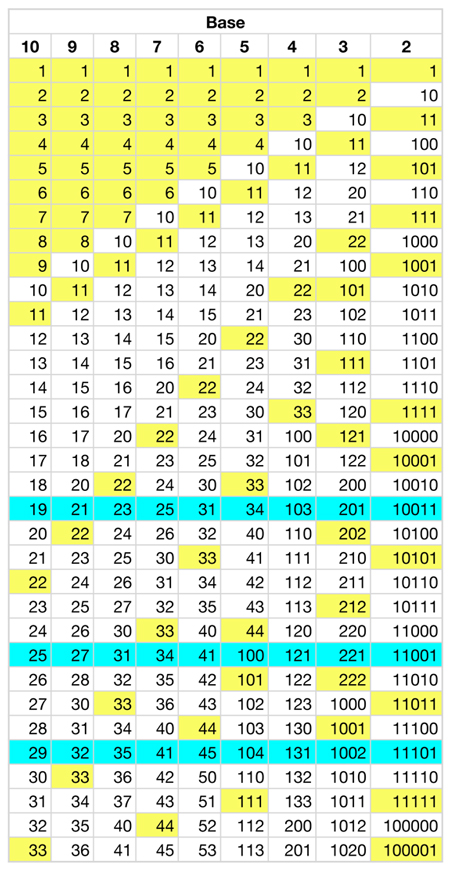
Not every number can be written as a palindrome!
That answers the question — but any good mathematician will ask the next question:
What’s up with the numbers that can’t be written as palindromes?
I did up to 100 and these numbers didn’t have palindrome conversions:
19
25, 29
39
47
53, 58, 59
69
75, 76, 79
84, 87
90, 94, 95, 96
Some are primes, some not. One’s even a perfect square!
I leave the question with you…
Any thoughts? What happens if you change the question again? Can you ask your children this question?
Share in the comments — and don’t forget to tweet it!