The comparison of numeracy to literacy is curious.
Learning math is the opposite of learning to read. When you read, usually simultaneous to learning a language, you sound out words and then put meaning to them. When you learn to count and do math, you know the meaning inherently and then put a language to it.
At some point we learn to recognize words without sounding them out. And at some point we learn to recognize quantities without counting them out. This is called subitizing.
The Your Baby Can Read program uses the concept of subitizing to teach reading – you show your baby the word alongside the object. So the shape of the word car is as recognizable as a car itself.
The children using Your Baby Can Read don’t learn to sound out words. They don’t understand the concept of letters any more than babies not using the program. But they instantly recognize the shapes of the words – giving them an (assumed) advantage.
Aside: We didn’t use the “Your Baby Can Read” program, not because it was gimmicky (I love anything that looks gimmicky), but because there is a huge DVD element to it. We decided not to put Daughter in front of the TV for her first 2 years. A decision we stuck with, but sometimes was a struggle!
This article contains a “your baby can count” type program. (And it’s a free download!)
How did we learn subitizing?
I don’t recall having been taught it directly. Although I could be wrong. The research on it has been happening since the early 1900s, so it might have been taught without being labeled “subitzing.”
I wonder how many of us do that. Are grownups so adept at subitizing that they forget that’s how we assess quantity? Maybe we’re taught to chant-count because that’s the way we think counting is.
But it isn’t!
How do you teach subitizing?
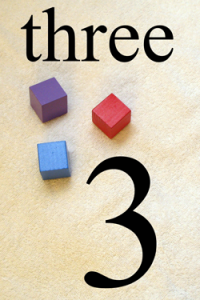
Images are accompanied by the written numeral as well as the number spoken aloud. The images would be printed on cards, done via video or “live” with 3D objects.
I’m still working on the numbers 5-10 and up, but for the numbers 1-4, the following 8 styles of image sets would be done twice. Once using the same objects for each image set, and once using different objects for each image set.
Organized in a row vertically.
Organized in a row horizontally.
Organized in a row diagonally.
Organized in a row other way diagonally.
Organized in a regular shape (triangle, square).
Organized in a differently oriented regular shape.
Organized in an irregular shape.
Organized in a different irregular shape. (There will be more of these for 4 than 3, etc.)
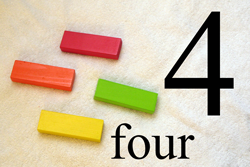
The objects could be blocks, cars, little dolls, just about anything. I created the set below from blocks I found left in Daughter’s block set.
Each zip file contains a few .jpg files with 4″ x 6″ pictures. You can print them at home or ship them to Walmart, Target, CVS, etc. for printing. I left off the MathFour.com logo so the kiddos wouldn’t get distracted. Please share them along with links back here.
Most parents aren’t professional mathematicians. But there are a few. This is the second in a series of interviews with mathematician parents with the goal of helping parents integrate math teaching into parenting.
I had the privilege of interviewing Caroline Mukisa, a math teacher and math blogger.
MathFour: Thanks for taking the time to chat, Caroline. First, what’s your degree and career? And how long have you been in math?
I’ve a Bachelors in Civil Engineering from Imperial College, University of London and a Post Graduate Certificate in Maths Education from Cambridge University. I taught maths to high school students in the UK, and I also ran a Kumon tuition centre before moving to the Middle East as an expat. I now run the Maths Insider website. My husband has a Bachelors in Maths also from Imperial and a Masters in Mathematical Modeling from Oxford University.
MathFour: Tell me about your family – how many kids do you have and how old are they? Are any of them more or less interested in math than the others?
Caroline: I’ve got four kids aged 11, 10, 4 and 2. My 10 year old son is very much the maths boffin, he’s memorized the first 300 digits of pi just for fun. His 11 year old sister is more of a problem solver. The younger two like counting and sorting but it’s too early to say if they’ve caught the maths bug yet!
MathFour: Do you have any worries about your children academically? In particular, do you think they will do better in math than in other subjects because of your influence?
Caroline: With maths, being a former maths teacher, I have a feel of how they’re each doing with that subject, whereas with the other subjects, it’s difficult to judge. For example, “Is that poem they wrote good for their age level?”
MathFour: How do you play with your kids? In particular, what kind of math play do you do compared with non-math play?
Caroline: We talk a lot about maths, we like showing them You Tube videos or Ted Talks related to maths or science, but we also try to expose them to different things like poetry, anthropology, and business.
MathFour: Do you think you speak with your children or behave differently than other parents because you have a math background?
Caroline: I’m not sure about that. I don’t talk about maths with my kids in front of other parents – I don’t want to appear to be “showing off” although my 10 yr old likes to “perform maths.”
MathFour: Have you ever had any of your children express negative thoughts about math and how did you handle it?
Caroline: Of course! There’s always days when maths homework is not appreciated, and although my 11 year old finds maths easy, I wouldn’t say she loves it – she likes that maths can help her do the things she likes, like Design and Technology and Science. It’s not a problem – kids shouldn’t be carbon copies of their parents.
MathFour: How is the interaction with your children’s math teachers?
Caroline: I usually let my kids teachers know early on about my and my husband’s maths background. We try to work with the kids teachers to help extend their maths but in the end we can supplement and support their maths ourselves at home.
MathFour: Now to change direction a little to a more worldview of math. What do you see as the biggest challenge in math education today?
Caroline: With the move away from rote learning towards practical maths, kids mental maths skills are declining. Parents need to make sure that they’re reinforcing those skills at home, since there’s not enough time allocated to fully learning them within the curriculum.
MathFour: What do you see great happening in the world of math education?
Caroline: I love that kids get to explore different practical applications of maths, with many teachers, using technology to present real-life math problems.
MathFour: What advice can you give to non-mathematician parents that might help them raise their kids to like and appreciate math.
Caroline: I think the key things are to stay positive about maths even if you hate it, try to spot something related to maths as often as you can. If your child is having problems with maths, act early and make sure their basic skills are solid. And of course, read MathFour and Maths Insider!
MathFour: Thanks so much for taking the time to answer our questions, Caroline!
How about you? Do you have any questions for a mathematician parent? Share them in the comments – I’ll bet Caroline will be around to answer them!
I started this series over a month ago. In that time, I’ve gotten pretty deep in thinking, learning and reading about the order of operations. I’ve seen a variety of ways people view, use and teach it.
Before I go too far into some conclusions, though, let’s look at addition and subtraction.
Consider the problem . Moving from left to right, and doing both subtraction and addition as we come to them, we get 4. If we found a book, or person, that meant the full-on PEMDAS and wanted addition done strictly before subtraction, then we would end up with 0. The latter is because we would do the addition of 3 and 2 before we did the subtraction.
Which is right?
It depends on what you really mean. If you don’t know if you should go left to right or strictly addition before subtraction, either look in the textbook you’re using or demand parenthesis.
The text will clearly outline the order of operations it’s following. Be careful, too because there isn’t always agreement among textbooks. I have seen some texts that instruct the learner to do multiplication first and then go back and do all the division signs. While others (and this is more common, today) have us do multiplication and division from left to right, simultaneously.
If you compare contemporary texts to each other, you’re likely to find them all the same. But grab a math text from the 80s at Half Priced Books. I’ll bet you’ll find at least 50% of the time they put division strictly after multiplication. (I’ll verify this the next time I’m there.)
The order of operations needs context.
I have $5 in my bank account. Then I bought a coffee for $3 and a bagel for $2. I might accidentally write down . I still mean, “I need to add up the stuff I spent and subtract it from my balance.” I wrote it in error, though. What’s “mathematically” correct is .
But you knew what I meant.
This was a typo that was helped along by using the context.
Until there’s a reason to do arithmetic, the order in which we do things is arbitrary. If we all agreed to do addition first, then multiplication, we would calculate and come up with 35 (instead of 23).
As long as we all come up with the same thing, we’re fine.
“We” have agreed to do multiplication things before we do addition things. So “we” would come up with 23 in the example.
Coach G noted it correctly: the order of operations is a convention. In other words, we’ve decided on it. We invented it.
How can you use this to teach your children?
The coolest thing is that you can let them play. Get dirty. Break it.
Remember opposite day? Have that. Let your little one make new rules. Let them see what happens if you all decide one day to do multiplication before addition. If your child is older and doing some algebra, this will mean reversing the order in which you UNDO the operations too!
This is a real brain stretcher. But it’s just math. You’re not building a bridge or balancing your checkbook. Let them break it. Let them see what happens if you make your own rules.
And then they’ll really learn!
Let me know how it goes – share your stories in the comments.
I had this grand idea when we got married and were hoping for kids – I would teach our children to count starting at 0.
When Daughter was 15 months old, I decided we should start teaching to count with negatives.
But I was wrong on both.
And so is everyone else.
Why do we teach toddlers to count?
We practice counting 1-10 with our kids. We know (somehow) that before they’re official school age, they should know how to count to 10. And how proud we are as parents if they can count to 20!
But these are just words.
I can teach Daughter to memorize the Fibonacci sequence, but she’d no more know what that means than what counting to 10 means.
In fact, I know this first hand because I used to count to 10 in Spanish. And I’d leave out ocho everytime!
I saw a guy made fun of in Germany because he told a waitress he had fünf people in his party and held up four fingers. (She did it behind his back to another waitress – she wasn’t so rude to say it to his face. (Thank goodness; I would’ve had to go Texan on her.))
We teach toddlers to count for the same reason that we teach them to say please, thank you, yes ma’am and no ma’am – because someday they’ll understand what it means. And in the meantime they can establish good habits.
So where do they start understanding?
Regardless if we teach a toddler to start counting with -5, 0 or 1, they start with 2.
-5 to a toddler makes no sense. Teaching -5 to a toddler can only be dreamed up by a math teacher with no kids (i.e. me three years ago).
0 is useless. Why would you even mention that you have zero? Maybe saying that there are zero cookies after she ate them all might work. But generally zero things can’t be seen and by the time you’re down to 0 cookies, there’s probably a meltdown in the works. And we all know there’s no learning during a meltdown.
1 is just as useless. Why count things that are only one? They started with one mom, one dad, one dog, one couch, one bed, one bear,… Almost everything in their world is a single. The number “one” is just as useless to them as the words “the” or “a.”
But 2 is interesting!
Daughter was so amazed at the discovery that she had two SnackTraps. Not just the ordinary situation of a bowl of snacks but “TWO BOWLS!”
As soon as multiple copies of things are in her world, she takes note. If you’re an identical twin, the first time your child sees you with your twin might be traumatic. My best friend is the daughter of a twin and she tells horrors stories of this discovery.
This is an extreme, but consider all the pairs of things that kids can notice – two shoes (vs. only one that you can find when you’re freaking out and you’re late), two forks (when you’re begging for yours back from her because you’ve not eaten since breakfast), two cars (when you need to get in one and she insists on going in the other).
And, toddlers really don’t start counting at 2. They don’t start their mathematical careers with counting at all! They start by recognizing multiples. And 2 is the first and fastest multiple.
So what can you do?
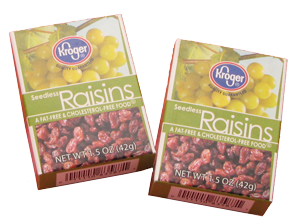
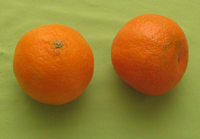
Keep teaching your kids to count – they still need this skill, just like they need to memorize math facts. But also teach them to subitize (recognize amounts without counting them out). Hold up two of the same items and exclaim “TWO ORANGES!” Then go to another two items and exclaim, “TWO RAISINS!” Stick with one number at a time.
Daughter is on “two,” so we’ll stick with that for a few months. We’ve got plenty of time.
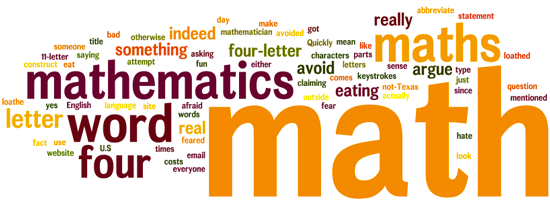
It’s been mentioned more than a few times that ‘math’ is indeed a four letter word. Quickly after that’s said comes a look of, “So why are you claiming otherwise in your website title?!”
I just got an email from someone asking the same question.
Math isn’t a four letter word.
When we type “math” we use four keystrokes. But we actually mean “mathematics” which has 11 letters. In some parts of not-Texas, outside the U.S., they abbreviate mathematics as maths. So really, math and maths are both 11-letter words!
Math isn’t a four-letter word, either.
The real statement of this site is that math isn’t a four-letter word. It isn’t a bad word. It isn’t something that should be feared, loathed or avoided. In fact, since everyone does it, it doesn’t make sense to fear, loathe or attempt to avoid it.
It’s like saying, “I’m afraid to eat,” “I hate eating,” or “I avoid eating at all costs!”
It’s something you do. You were born with it.
Math is a four letter word.
But indeed, yes. Math, the English language construct, has four characters:
Originally posted on MathsInsider.com as a guest post.
Are you thinking about tutoring your own children?
Are you hesitant?
The toughest thing about giving instruction to a family member is how close you are to the situation.
Hire a math tutor and you can watch him peacefully manage your sweet offspring.
Try it yourself and they turn into maniacs.
And why?
Because you’re still frustrated that they haven’t learned to pick their clothes up off the floor. And you’re annoyed that they don’t clean up the milk they spill. They want to go to the movies and you won’t let them. And they feel like you aren’t letting them be themselves. And…
But you can pull away from all that and still tutor!
Make yourself into a tutor
It’s time to be creative, parents. If you’ve tried to tutor as “the mom” and failed, well, try to tutor as “Mrs. Fibonacci.” Get a smock and a hator pair of fake glasses. Put on some earrings that you would never wear. Don’t get too goofy, but have fun with it.
Let your sweet dear know that you’ll be tutoring as Mrs. Fibonacci and set aside a specific amount of time. Depending on the needs of your child, you might try one hour on Tuesdays and Thursdays or a half hour each day. Go to a set place and close the door. Get the rest of the family on board with this, too, so they won’t interrupt.
Also pay for the math tutoring. Instead of paying an outside tutor, set up a reward system for both you and your child. Every hour that you successfully tutor, you get an hour of fun on the weekend doing something as a treat. Or you earn points toward a trip. Or you can use monetary rewards – depending on how effective they are with your family.
Prepare ahead of time
Many math tutors will ask what the subject and topic is a few days ahead of time. This gives them the opportunity to brush up.
Find out what the next few lessons are and get help before the next session. That way when you’re Mrs. Fibonacci and in session, you’ll have some of the answers on hand.
And allow yourself to be wrong – mathematicians do it all the time. If he asks a question that you don’t know the answer to, let Mrs. Fibonacci offer to do research and get back to him in the next session.
Let the tutoring session be professional.
As Mrs. Fibonacci, speak differently to your child. Forget the clothes he left all over the floor this morning and the milk he spilled that he didn’t clean up. Those are all out. He’s a new, fresh kiddo. Beautiful, smart and ready to learn.
And have him call you Mrs. Fibonacci. Keep that role alive through the whole session. You’ll feel the difference and be able to talk math in a professional way to him.
Make it happen!
Are you ready? You might start getting your “kit” together now – in the summer before the school year starts. Create your outfit and choose your name. “Mrs. Fibonacci” is okay, but you might want to find another mathematician’s name that speaks to you more.
Start getting the whole family on board. Let them choose the location and times. Get ready. Get set. So when the school year starts, you can GO!
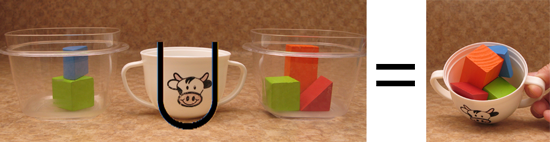
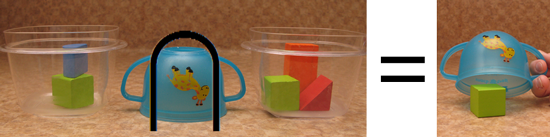
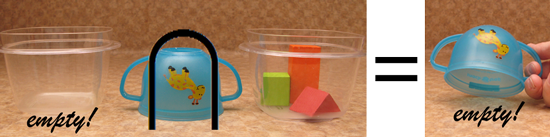
The union is on the left and the intersection is on the right.
I discussed empty sets in a previous article. I hadn’t yet listened to the recent podcast of The Math Dude, Jason Marshall, in which he introduced sets and subsets. Such a curious coincidence; I thought I would continue down our united path.
This week, the sweet Math Dude talked about union and intersection of sets. So I’m heading there too – and incorporating the empty set.
Union and intersection have symbols.
These symbols represent “operations” (like addition or multiplication) that you do to a pair of sets. They are called the cup and cap and look like, well, a cup and a cap. Or a U and an upside down U. The Union is the U and the intersection is the other one – that’s how I remember it and teach it.
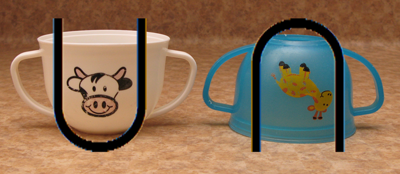
For the sake of illustration, I’ll use Daughter’s handy SnackTraps like in the picture above.
The union is everything.
The sets I’m using are
L ={green cube, blue half circle thingie}
R = {green cube, red triangular prism, orange rectangular prism}
I’m using the letters L and R for left and right in the picture.
The union of the two sets results in all the pieces from each set, all crammed together. (And if there is a repeated item, you only take it once.)
The union of the two sets is everything combined (without duplicates).
Let’s take the set of all states that border Texas and the set of all states that border Oklahoma, like this:
T = {Louisiana, Arkansas, Oklahoma, New Mexico}
O = {Arkansas, Colorado, Kansas, Missouri, New Mexico, Texas}
Then the union of the two would be “The set of all states that border both Texas or Oklahoma or both” and would be T U O = {Louisiana, Arkansas, Oklahoma, New Mexico, Colorado, Kansas, Missouri, Texas}
Notice we don’t keep duplicates.
The intersection is only the common stuff.
Using the same L and R sets from above, I can take the intersection.
The intersection is only the stuff they have in common (we get rid of the duplicates here, too).
Let’s go back to our set of all states that border Texas and Oklahoma:
T = {Louisiana, Arkansas, Oklahoma, New Mexico}
O = {Arkansas, Colorado, Kansas, Missouri, New Mexico, Texas}
Then the intersection of the two would be “The set of all states that border both Texas and Oklahoma, at the same time” and would be T ∩ O = {Arkansas, New Mexico}.
What happens with the empty set?
When you start throwing the empty set into the mix, you follow the same rules.
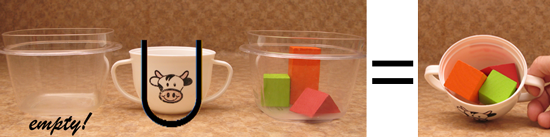
For the union, you throw everything in both sets into one bag. Well, since there’s nothing in the empty set, “everything” is the original other set!
The union of the empty set with anything… is that same set back!
For the intersection, you take only the stuff that’s in common between the two. Since the empty set has nothing – there’s nothing in common.
The intersection of the empty set with any other set it just the empty set – there’s nothing in common at all!
Think about it…
Does this remind you of anything? What similarities do you see between this and addition or multiplication (or subtraction or division)? Ask your children these questions too.
Get out some snack traps and blocks (or a map) and go for it! Let me know how it goes in the comments.
Most parents aren’t professional mathematicians. But there are a few. This is the first in a series of interviews with mathematician parents with the goal of helping parents integrate math teaching into parenting. See the list of interviews here.
I had the privilege of interviewing David Chandler, a physics and math teacher. He runs Math Without Borders, an ongoing project to supplement high school math textbooks with Home Study Companions, to make them useful for homeschoolers and adults for self-teaching.
Last week I published an article about mazes that was inspired by some of his work with homeschoolers. He does some really cool things!
MathFour: Thanks for taking the time to answer some questions, David. First, what’s your degree and career? And how long have you been in math?
David: I have a BS in physics (1970), an MA in education (1975), and an MS in mathematics (applied math) (1997). I have taught physics and math (high school, Jr. college, some K-12) since 1972 and done other math-related projects on the side (inventions, design projects, publishing, curriculum innovations).
MathFour: Tell me about your family – how many kids do you have and how old are they? Are any of them more or less interested in math than the others in the family?
David: Two daughters born in 1974 and 1979, making them currently 37 and 32. B1, my older daughter, went through Alg II. She had some excellent teachers and some rather poor teachers. She would freely come to me for help and discussion. My younger daughter, B2 didn’t want the discussion. She tended not to come to me because she just wanted to know how to do the immediate problem at hand and got irritated when I said any more. As an adult she went back for more math as a prerequisite to other course work (involving logs, trig, etc.) and got tutoring from me over the phone. She values the explanation thing more now. My wives have not been mathematicians.
MathFour: Did you have any worries about your daughters academically? In particular, did you think they would do better in math than in other subjects because of your influence?
David: I think they both got the point that math is about understanding and problem solving and creativity. Both are academically well rounded.
MathFour: How did you play with your girls? How do you play with your grandchildren? Did/do you view playtime as different in any way than other “non-mathematician” parents?
David: I engage in a lot of banter that is probably math-influenced. When they say to me “Happy Birthday” I say back to them, “Happy Birthday to you too,” in the sense that she can be happy on my birthday. This year B1 sent a Facebook message, “Happy Birthday to us all.” That’s not explicitly mathematical, but it is the kind of thing Sheldon might say. I came up with a song that eliminates the asymmetry of l-m-n-o-p so you could sing the alphabet both forward and backward and taught it to my grandkids. Every rainbow we see is a physics excursion into dozens of phenomena. Theme park rides are, of couses, a learning experience. We have lots of “shared learning experiences.” Whenever something triggers a new insight in me, they are definitely exposed to the excitement it generates. They know what it is like to experience the world through eyes informed by physics/math awareness.
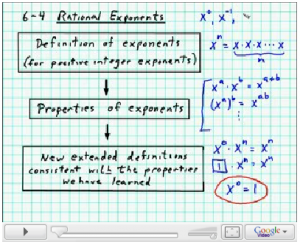
Screenshot from David’s Algebra II with Trigonometry Home Study Companion
MathFour: Do you think you speak with your daughters or behave differently than other parents because you have a math background?
David: I don’t talk down to them, but I don’t overwhelm them in jargon either. I wonder about a lot of things out loud. I critique the world with a quantitatively informed (and order of magnitude informed) crap detector in their presence. I model inquisitiveness and observation and show appreciation when it is a shared endeavor. I think that attitude has rubbed off on both of them, possibly genetically as well as environmentally.
MathFour: Have you ever had either of the girls express negative thoughts about math?
David: Not really, except for B2’s impatience for my explaining in too much detail, and a tendency to go on too long when her attention has already shifted.
MathFour: Have you ever disagreed with one of your daughter’s math teachers?
David: Yes. B1 took Alg II in India where I was teaching at an international school. Her teacher was a young, very traditional Indian woman who spent a week or so teaching them how to read log tables, including interpolation, funky work-arounds for logs of numbers less than 1, etc. It was a total turnoff to the class, all of whom had calculators by then, and seeing this drove me up the wall.
MathFour: What happened; how did you handle it?
David: I discussed with B1 how all of this was now outdated and how using logs to solve exponential equations, using log paper, modeling perceptual phenomena with log scales (dB’s, astronomical magnitude scale, octaves, etc.) was really where it was at. I approached the teacher about this issue, as tactfully as I knew how. She listened politely, and didn’t react in an overtly negative way, but she may have been overwhelmed by me. She didn’t change what went on in class. I taught B1 a lot of things not in the book, and better ways to do things, but this didn’t generally lead to direct interactions with the teachers.
MathFour: Now to change direction a little to a more worldview of math. What do you see as the biggest challenge in math education today?
David: Getting kids to quit memorizing things and start digging for understanding. Also seeing math not so much as a body of knowledge as a mindset.
MathFour: What do you see great happening in the world of math education?
David: Internet communication for discussions like these. New insight-generating computational tools (Geogebra, Geometer’s Sketchpad, Tracker, spreadsheets, etc.) and their use in the classroom. What goes on in my (and presumably a lot of other) classrooms despite regressive influences like high stakes testing, minimum standards which become maximum standards, etc.
MathFour: What advice can you give to non-mathematician parents that might help them raise their kids to like and appreciate math.
David: Learn some math, engage in problem solving, problem posing, observation of the world, cultivating a sense of wonder, taking curiosity a step further and digging a little, model these for your children, etc.
MathFour: Thank you for taking the time to answer our questions, David!
How about you – do you have any questions for a mathematician parent? Share them in the comments – we’ll see if we can get David in here to answer them!
Last week’s article on the order of operations included a quick mention that division is the same as multiplication – but different. Now’s the time to explain that a bit.
The only thing mathematicians like to do more than create, is destroy. That’s how we get imaginary numbers, dividing by zero and raising things to infinity.
Once we create with multiplication, we want to know what happens when we destroy with the opposite of multiplication.
Enter Division, stage right.
Multiplication is created from the need to quickly add a bunch of numbers that are all the same. They each must be equal to make this work:
6 + 6 + 6 + 6 + 6 is shortcutted to 5 X 6.
Division is the breaking up into pieces that are all equal.
Technically we can break 30 up into these 5 pieces: 4, 8, 7, 6 and 5. But “division” requires (or implies) that we are dividing equally. So 30 would have to be broken up into 5 equal pieces of 6 each.
Of course this is in a purely mathematical world. When you get into a toddler world, things will be different.
How division is the same as multiplication.
We represents multiplication with little x‘s or dots or stars. Like this:
3 X 5 or 3 • 5 or 3 * 5
We represent division with this cute little symbol:
But we can write it in many more ways. Notice the cute symbol looks like a fraction with dots on the top and bottom. That’s not a coincidence. A fraction means division.
is the same as .
Remember the poem:
When dividing fractions Don’t bat an eye Just flip the last And multiply!
Well, you can change this to:
When dividing numbers Don’t bat an eye Just flip the last And multiply!
And “flipping” the last just means taking the “assumed 1” that’s underneath it and putting it on the top.
Now go forth and divide…
So when you’re teaching the MD in PEMDAS, the order of operations, remember that D is the same as M. And if things get a little confusing, demand some parenthesis before doing the problem.






![[50 Word Friday] A Vicious Cycle](https://mathfour.com/wp-content/uploads/2026/01/image-124.png)