Tag: That’s Math

  • Math Words — Start Using Them Early

    Math Words — Start Using Them Early

    Every parent is concerned that their children will not get what they need to be successful. Especially in math.

    Instead of worrying, you can take action. And it’s not hard.

    Use “big” math words.

    Don’t refrain from teaching your child math words just because they’re big or seem complicated to you.

    This sentence, “May I have milk, please,” has five simple words. To a grown-up.

    But to a child, a five word sentence is no different than a five syllable word. Like, “parallelogram.”

    In fact, if you teach your child to count to 10, it’s the same as teaching your child an eleven syllable word. (Seven has two syllables.)

    To put this in perspective, the word overintellectualization has only ten syllables!

    O – ver – in – tel – lec – tu – a – li – za – tion

    One – two – three – four – five – six – seven – eight – nine – ten

    In fact, overintellectualization is easier to say when you look at it like this.

    Try some words!

    Give these math words a shot with your little ones:

    Parallelogram (pear-uh-lell-uh-gram)

    A parallelogram is a shape. It has four sides. The sides that are across from each other are parallel to each other. Which means a square is a type of parallelogram. And so is a rectangle.

    So the next time you see a square or a rectangle, say to your child, “Hey, there’s a rectangle. It’s also a parallelogram. Can you say parallelogram?”

    Hypotenuse (hi-pot-uh-news)

    The hypotenuse is any diagonal that you take instead of walking first to the left and then to the right (or vice versa). So the next time you walk across the street at a diagonal, say to your child, “Were walking the hypotenuse. Can you say hypotenuse?”

    Coplanar (co-plane-er)

    Any two things that are on the same flat surface are coplanar. Like two people standing on the floor together.

    When you’re around stairs, stand on a different step than your child. Say, “Look, we are not coplanar.

    Then move to the same step as your child and say, “Now we are coplanar. We are on the same flat surface. Can you say coplanar?”

    Go do it. Have fun!

    You don’t have to know the formal definitions of your math words. Just know a place or two where you can demonstrate them in your own world.

    Remember, getting your child familiar with math words will make a big difference.

    So pull out some big words, and try them on for size. Your little ones can handle it!

    You might also like:
  • Concrete Math — Like in Your Driveway

    Concrete Math — Like in Your Driveway

    They poured my new driveway yesterday. We ate breakfast and watched as they worked.

    And we witnessed an amazing feat of engineering.

    A tiny twist is all it takes!

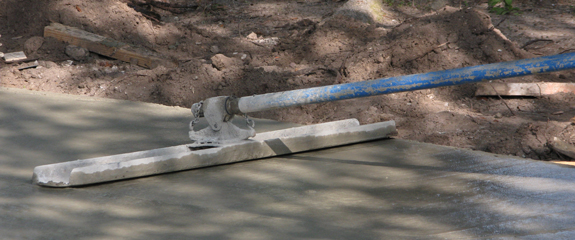
    I was watching one of the workers smooth the concrete. He was using a bull float:

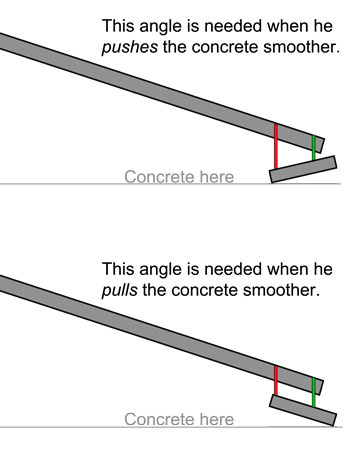
    I noticed he was twisting the handle as he worked. On closer inspection, I saw the engineering of the device:

    And here’s the other side:

    As the worker twisted the handle, it would change the angle of the surface of the bull float. This prevented him from having to change the angle of the handle. Like this:

    Watch it in action:

    Oh, yeah — those angles and changing the of length of the chain… That’s Math!

    Share your thoughts in the comments or on twitter/x.

    You might also like:
  • Math Problem Quickie: Prime Number Fun on Your Wedding Day

    Math Problem Quickie: Prime Number Fun on Your Wedding Day

    This is the first in the Math Problem Quickies series.

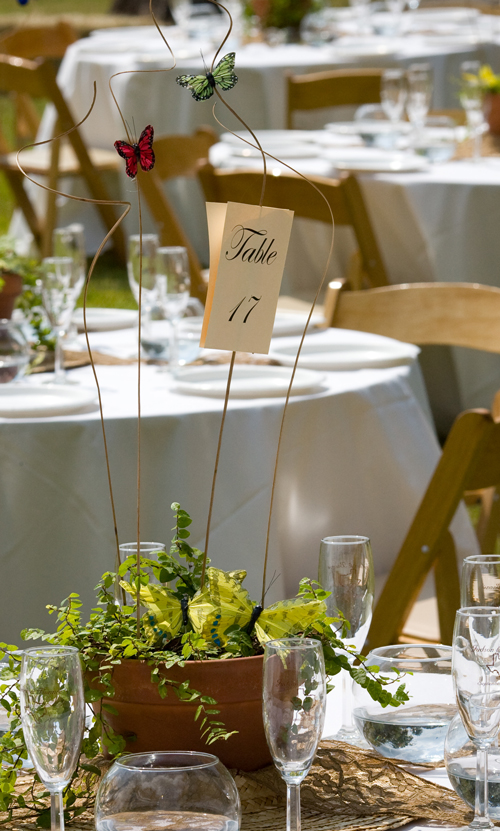
    The bride wanted to have all the tables labeled with prime numbers. She used all the primes through 43. Each table was set for 10 people. How many guests could come to the wedding?

    Share your thoughts in the comments or on twitter/x.

    You might also like:
  • Insight into the Development of That’s Math!

    Insight into the Development of That’s Math!

    Update: The That’s Math! membership site is no longer available. However, this post still has useful and entertaining information.

    While developing the That’s Math! membership site, that launches today, we’ve had some interesting discussions about wording. Because of our different backgrounds, we’ve had to have some lengthy clarifications. Bon, with her technical math info, and myself, with ethical/credible research wording.

    Below is a rough “transcript” sample compiled from a couple of discussions.

    Bon: Math anxiety makes it so that kids lock up – they’re paralyzed with fear and then can’t do math.

    Wil: Well, actually, the anxiety they experience doesn’t prevent them from doing math. It just makes it much more difficult.

    Bon: And That’s Math! will fix that.

    Wil: No. We aren’t trying to “fix” anything. Just help parents with positive math exposure.

    Bon: And the research proves that the parents talking about math in front of kids will take care of that. Got it.

    Wil: You have to be careful with that word “prove”. We have to say the research suggests that kids who have a supportive environment are more likely to engage in math exercises and homework. Part of that support is talking about math in a positive way.

    Bon: Great! So we support the parents by helping them discover math that happens in their environment.

    Wil: Right. And the exercises we’ve designed help parents to practice saying that math in front of their kids. When the kids hear Mom and Dad talk about math, the kids learn to be not so scared of it.

    Bon: We act just like we see our role models act. Mom says “hey, there’s math” instead of “I was never good at math, it’s so hard!”

    Wil: Right. It’s called social modeling. We pick up on what other people do, whatever it is. There’s all kinds of research to support that social modeling is how we learn how to act.

    Bon: So “social modeling” is doing stuff where kids see it. And if parents use that for math specifically…

    Wil: Exactly and…

    Bon: …and BAM! Their kids will love math and be geniuses!!!

    Wil: It doesn’t mean they’ll love math or be geniuses!

    Bon: But it will get them closer to being geniuses.

    Wil: Well, there’s research that supports that they are likely to engage more, so I guess you could say they’re getting closer to being geniuses.

    Bon: Virtually proving that using positive math talk like we teach in That’s Math! will improve your kids’ grades.

    Wil: Dude. You’re killin’ me. But I like the enthusiasm.

    Are you ready to positively influence your kids in math? Learn more about the That’s Math! membership website now!

    Share your thoughts in the comments.

  • There's Math in Planting Grass

    There's Math in Planting Grass

    Part of Wordless Wednesday

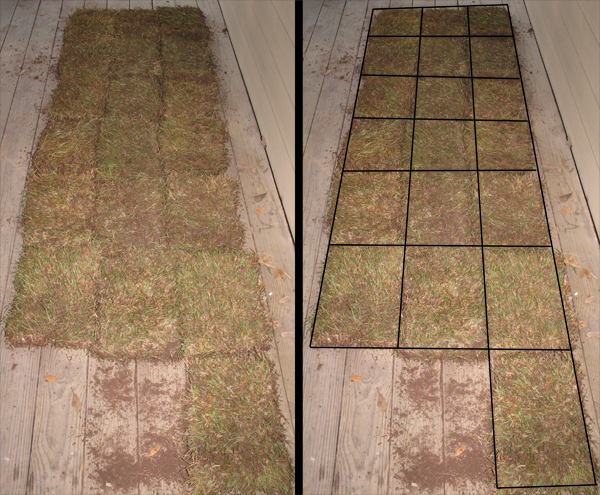
    I’ve planted all of this Amazoy grass from Zoysia Farms.

    All of it.

    Doesn’t sound bad, right?

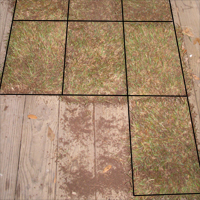
    Well, each of those rectangles are 15 inches x 10 inches. And we cut them into one-square-inch pieces before planting them.

    My new grass better be beautiful!

    So how many did I plant?

    You don’t have to be a mathematician to know the answer. It’s “HOLY COW MY BODY HURTS!”

    (Sometimes the right answer isn’t a number.)

    Share your thoughts in the comments or on twitter/x.

    You might also like:
  • I'm Throwing Out Fifty Things!

    I'm Throwing Out Fifty Things!

    I bought the book Throw Out Fifty Things a few weeks ago and it’s changed my life.

    My latest accomplishment – getting rid of 50 things from this (now neat) bookshelf!

    Of course, I haven’t read it – inspirational books like this only need me to purchase them to apply their basic principles.

    But I have thrown out multiples of 50 things in the past few weeks. All because of this book!

    “What’s that got to do with math?”

    Great question; I’m glad you asked.

    Well, for starters, “fifty” is a number. In particular a positive integer.

    And if you buy this book (adding one more thing to your pile of stuff, as Husband points out), then you probably have at least 50 things you can throw out.

    Which means you have way more than 50 things.

    How many things do you have?

    Take a quick inventory. No – not of everything. But just of what you see right in front of you at this very moment.

    Chances are you stopped counting and started estimating at around 50. Then you stopped altogether at around a few hundred.

    Even if you divide this by two (if you’re married or partnered) that’s still a ton of stuff.

    “Things” are more than what you see.

    Now take a quick peek at your email. How many things are clogging your inbox?

    If you’re online, I’ll bet you have a plethora of people you’re friends with and following.

    And if you write a blog… look at how many drafts you have.

    So throw out fifty things.

    Well, make sure to recycle them or donate them. But get them out of your world.

    If it helps, think of how many thousands of things you have. If you have 500 things in each room and you have ten rooms, that’s 5000 things.

    Throwing out 50 of those is 1% of your stuff. That’s practically nothing. And you’ll feel great!

    I’m throwing out 70 things in the next three weeks!

    I’ve pitched books, sold cloth diapers and donated socks – at least 50 pair of the cutest 1980’s socks you’ve ever seen!

    Shirts, pants and shoes… if I didn’t love them, I gave them to someone who would.

    And now it’s time for the e-throw-out.

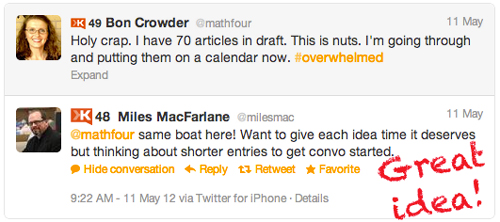
    I have 70 articles on this site – in draft mode! So for the next three weeks, every one of them is getting published or pitched.

    Many will be conversation starters, as my twitter friend Miles MacFarlane suggested. Some might turn into full articles.

    And some drafts will meet their fate with the “File 13” button of death.

    And I’ll be free!

    Okay, there’ll certainly still be things that haunt me. Things I need to do, want to do and have to do.

    But I won’t have a mountain of “should-haves” sitting on my shoulders.

    So how about you? Share in the comments what kinds of things you’ll throw out for your first 50 things. And let others join the fun – tweet this out!

    Related Articles: