

I was told about the Lands’ End f(x)™ Collection by a reader a few days ago. She was excited to see that Lands’ End had used the traditional function notation for a line of clothing that was very functional.
And indeed it is. If we didn’t live in Houston, this coat, and all it’s functional bits, would be a perfect coat for K8.

I wanted to know more.
I was excited to be able to write about this line of clothing — and be able to quote Lands’ End on how “functional” it was. I wanted to share how “up on math” this very popular clothing store was.
So I started searching.
During the search, Husband peeked over my shoulder. I told him about it and showed him the ad.
“They probably mean effects,” he said calmly.
I was horrified. “What do you mean?”
“You know,” he explained, “When you put F and X together, it is effects. That’s probably what they mean by it.”
So I dug deeper!
I found nothing written to support the naming of the Lands’ End f(x)™ Collection after anything math or even claiming functionality. But I wasn’t deterred.
After all, they are using the standard notation, right down to the italics.
So off to twitter I went.
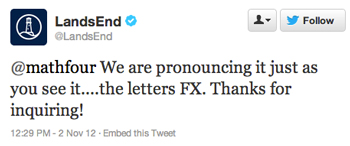
According to a tweet from @LandsEnd, the official pronunciation is FX (like effects) not “f of x” as the math world knows it. Husband was right!
What’s the message?
Does the presence of the italicized f(x) in popular print help us to be more familiar with the notation? Absolutely.
And since familiarity leads to comfort and then engagement, this advertisement is a definite cultural boost for math.
But what effect does the mispronunciation have? And since the branding has minimal (or no) association to math functions — what message does that send?
I look forward to hearing your thoughts. Please share them in the comments or on twitter/x.
P.S. I also find it strange that they trademarked it. Can you really trademark functional notation?