
Tag: iPhone App

  • Marble Math iPhone Apps

    Marble Math iPhone Apps

    Artgig studio recently released two iPhone apps for math learning support: Marble Math & Marble Math Junior.

    In the games, you roll or drag a marble around a maze collecting right answers (or the pieces of a right answer) to a math question.

    Husband likes to roll the marble. He says that’s more fun because dragging the marble isn’t a challenge.

    But I like to drag it.

    Marble Math is fun and educational!

    Both of the Marble Math games have the same features: it’s a maze with obstacles, vortexes, bonus items and point decreasers.

    The difference between the two apps is the level of math. So before you see the cool screenshots, check out some of the things covered in each version of the iPhone app:

    In Marble Math, I encountered

    • Addition (three digits)
    • Subtraction
    • Ordering Roman numerals (yipes!)
    • Addition of fractions
    • Algebra with addition, subtraction, multiplication, division
    • Ordering decimal numbers
    • Combining things to get a number using order of operations
    • Factors of a given number

    In Marble Math Junior, I encountered

    • Ordering things (including a mixture of dice, tallies, arabic numerals, etc.)
    • Finding items that are the same as a given number
    • Identifying shapes
    • Adding up to a number
    • Telling time
    • Finding numbers less than a number
    • Multiples of 2 and multiples of 10
    • Basic multiplication (by 10)
    • Some basic fractions
    • Basic algebra with addition (10+?=17)

    The pictures are worth 103 words!

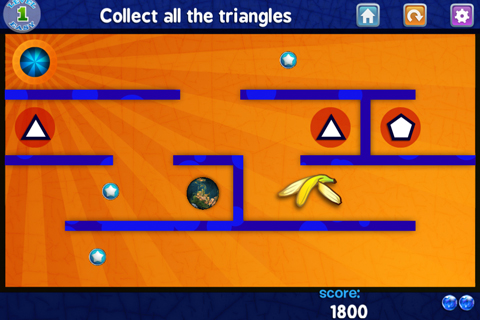
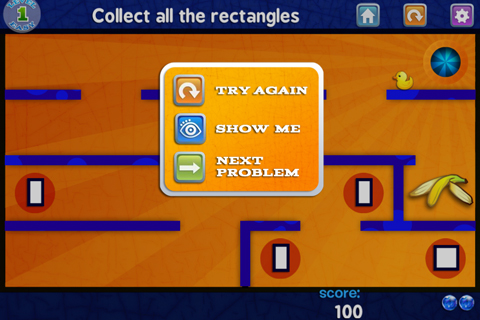
    The “pick the shapes” puzzles are fun. The banana will make your marble slip, but collect all the stars and you’ll get an extra life.
    The ghosts look like badguys — but they’re actually your friends. They let you go through the walls. (Come to think of it, it might be bad if you’re rolling the marble and not dragging it!)
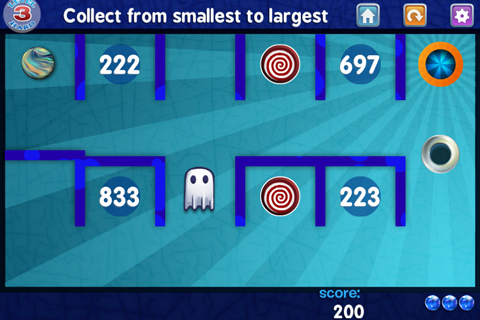
    Collect all three tiny stars and you earn another “life.” Roll over the flashlight and… well, I’ll let you see what happens then!
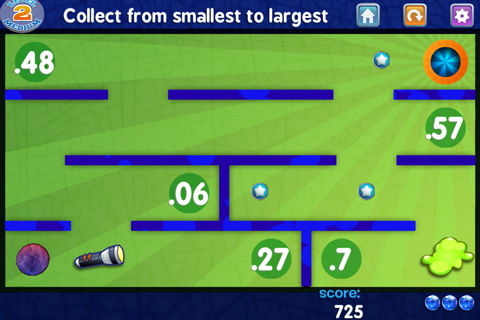
    I like that they use time, but that tiny little clock is hard to see. (But my eyes are a good 30 years older than the target audience!)
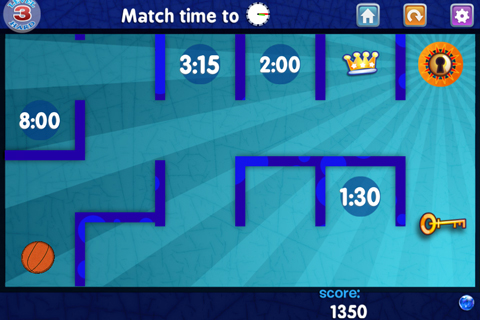
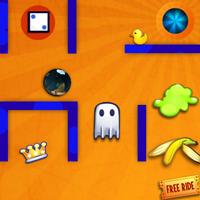
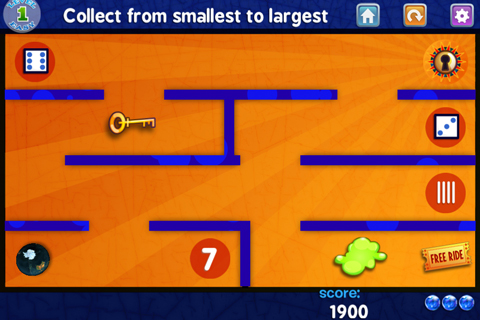
    The key opens the “I’m done” portal.The green slick sends you spinning. The Free Ride ticket give you extra points:
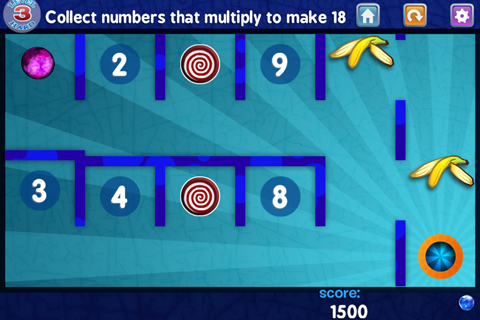
    Here’s a sample of a multiply one. The bananas here will make your marble slip and the swirlies will transport you between them!
    Having problems? Skip it, get the solution or give it another shot:
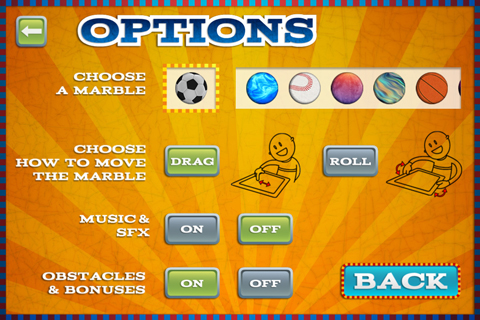
    But at some point the math will be hard enough to turn off the obstacles and bonuses. You can also choose your marble — but you have to earn them first!
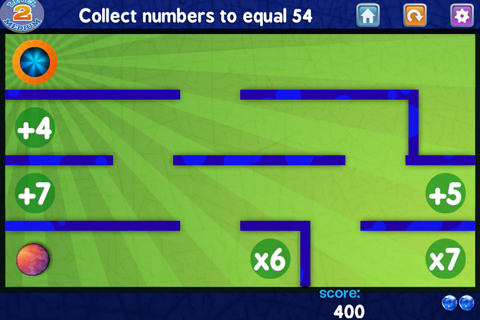
    Here’s a nice order of operations one:
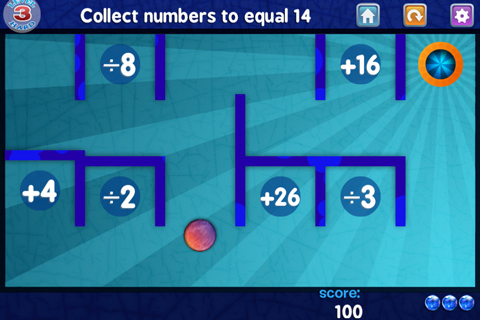
    This one almost killed me. I kept plugging at it, though. It’s from Level 3 of Marble Math.
    Give it a shot!

    Get the Marble Math & Marble Math Junior apps — one or both. Try your hand at them and share them with your kids!

    P.S. The cool folks at Artgig Apps were kind enough to share the app with me free of charge.

    Share your thoughts in the comments or on twitter/x.

    You might also like:
  • Curiosity Based Learning with 100 Floors iPhone App

    Curiosity Based Learning with 100 Floors iPhone App

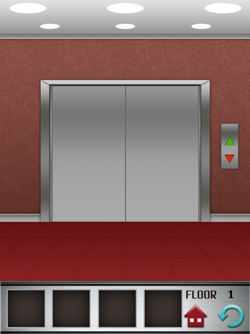
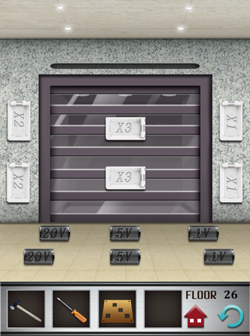
    From Floor 1, you can tell what you have to do.

    I’ve become slightly addicted to this free iPhone game called 100 Floors. It has strange and interesting parallels to leraning math.

    It has no instructions and no hints. And upon first entry to the app, you feel lost, confused and annoyed. (Already starting to sound like a math problem, right?)

    Based on the name of the game and the view of “Floor 1,” it’s clear that the idea is to open each set of elevator doors.

    But with just a bit of patience and curiosity, you find yourself challenged just enough on each subsequent floor to keep going.

    And you have no idea what to do next.

    With each floor you’re not sure what to do.

    So you start doing seemingly random things. You notice yourself bumping the phone. Tilting the phone. Shaking it. Blowing on it (I know, that isn’t a feature yet, but I tried anyway).

    You tap and drag everything on the screen – including the ads.

    (I even yelled into it – just in case that was the key to getting the doors open.)

    And sometimes you just stare at it. Curious.

    Remember – there’s no punishment for failure.

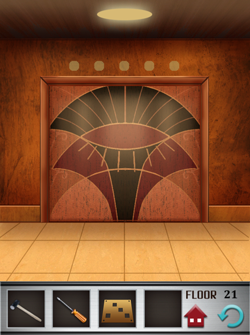
    This one is my favorite!

    If you can’t get the doors open immediately, no big deal. If you look, shake, yell, bump, tap and tilt with no results… okay.

    So what? Who gives a fuzzy red rat’s tail?

    You might turn off the phone and go mow the yard.

    But those closed elevator doors stay in your mind. So you’ll come back at some point. You’ll open the app and check it out.

    Just one more time.

    Just to see…

    And when the doors open – yippee!

    There’s no prize. There’s no grade. There’s no money.

    But the excitement you have from getting those crazy doors open and seeing the green arrow is unimaginable!

    “Cheating” is allowed.

    Sharing a tip is something you do only if you want. Giving or getting a solution isn’t prohibited, but it’s fun to try to get the solution yourself.

    So you choose what to share and what to ask for. Based on your own desires and curiosity.

    And it’s the same as learning math.

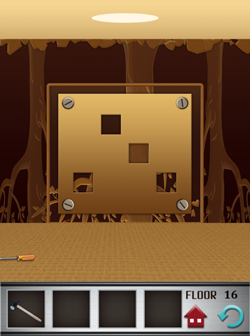
    This one almost killed me. Had to go do something else for a while and come back later.

    So far I haven’t found an official math problem in the game. But the tactics, patience and curiosity that you use are exactly what learning math is all about.

    In each new math problem, students may wonder, “What the heck do I do with this one?” Just like you do with those elevator doors.

    And if there’s no punishment for trying nutty things, their curiosity will take them places.

    Tapping, dragging, shaking and yelling into the phone might have made me look goofy. But Husband was nestled in his chair doing equally insane things to get his elevators to open.

    But there IS punishment in learning math.

    That’s where things diverge.

    Performance based teaching is the basis of the typical math lesson. Math problems are given to the student. And the student is expected to give back the right answer.

    If the right answer isn’t given, there are repercussions. Points are deducted or the failure is publicly noted. Or both.

    And if you don’t have the right answer, you’re just not learning math.

    Period.

    (BTW – that’s a horrible myth!)

    And “cheating” is all or none.

    This one sort of turns out to be a math problem.

    Either the teacher coaches step-by-step, or there is no tutor or teacher at all.

    Think about the last time you did a math problem from a textbook with a teacher watching.

    If you took the wrong path, you were quickly guided back on track. This was either with words, “Are you sure that’s what you need to do?” or with facial expressions.

    Math students aren’t allowed to take or leave tips at will. And they sure aren’t allowed to give them when they want.

    That’s cheating.

    But isn’t that what grownups do when they “guide” students?

    How do we change this?

    How can we make learning math more like playing 100 Floors? How can we get students into the adventurous mode – tapping, shaking and doing anything they can to a math problem?

    How do we get them to cheat on their own terms? And how do we get grownups to stop over cheating?

    Share your thoughts in the comments. And share this article on twitter!

    Related Articles:
  • Math Education Revolution – The Last Piece Is Easy & Cheap!

    Math Education Revolution – The Last Piece Is Easy & Cheap!

    The math education revolution has been growing. Last year Salman Khan and the Gates Foundation brought Khan Academy to everyone in the world with a computer.

    Dan Meyer jumped into the ring with his math class makeover. With his Any Questions? and Three Acts, he’s fighting the good fight to get kids to learn math.

    Social learning math games like Sokikom, iPhone apps like Motion Math and face to face programs like Mathnasium have joined the math education revolution, too. Thousands of tutors are taking part.

    Experts all over are helping kids understand that math is important, necessary and valuable to learn.

    Kids still resist math homework and avoid participating in math class. Why?

    Because everyone knows that math is boring, hard and has nothing to do with real life. Nobody really likes it – unless they’re an engineer or accountant.

    Math teachers are mean and professors write math books just to mess people up.

    Everyone knows this.

    Who is this “Everyone”?

    Grownups.

    Yup – you and me.

    When you hear people talk about math or math education, what do they say? Anything positive?

    The best I’ve ever heard was, “Actually, I kinda like math.”

    Which means, “I know it’s not cool, and I’m sorry for saying it, but I like math.”

    Would you do something nobody liked?

    No! Of course you wouldn’t. At least not on a regular basis.

    If everyone you knew and respected avoided something – you would too. If all your friends jumped off a cliff – so would you.

    We’re human. That’s what we do. We stick together.

    So we’re losing the math education revolution.

    By the very design of our society, Khan Academy, Sokikom, teachers, tutors and everything designed to help kids learn math are failures. The math eduction revolution is bust.

    We want kids to learn math because it’s important. Math is necessary and valuable to learn.

    But since nobody really likes math, or even does math, kids aren’t buying it.

    And I can’t blame them.

    Is it fixable?

    At this point it’s easy to throw in the towel. Give up. Quit. Decide that the world is going to end up like that movie Idiocracy.

    But we’re so close to the solution.

    The solution involves something that’s very cheap – and research based!

    Ready for it?

    The missing piece of the math education revolution is that we need to teach parents positive influence skills to encourage math.

    What? Will that work?

    We have seen this happen with reading – remember the Reading is Fundamental campaign of the 80s? It’s still going strong along with other programs like the “Read 3” program from HEB. Parents are encouraged, even pushed, by teachers to read to their children every day.

    These efforts have changed the culture in our world so that reading is viewed as something “everybody does.” Parents now have positive influence skills in encouraging reading.

    And those skills have extended across our entire culture!

    That’s the missing piece!

    Parents can develop the same skills for encouraging math. And when we do, everything will change.

    Just like it did with reading.

    When parents start talking about math in a positive way, all of society will.

    The math education revolution will succeed!

    It’s your turn…

    If you’re a parent, learn how to use some positive math talk. Join a program like That’s Math, read articles on Math for Grownups or any other math blog that strikes your fancy.

    If you’re a math teacher, blogger, tutor or developer of math products – make something teaching parents how to talk positively about math. We’re developing That’s Math, but there needs to be more of these.

    Feature image by woodleywonderworks on Flickr.com, CC BY.

    Related articles
  • Teaching Little Ones Math with the Toddler Counting iPhone App

    Teaching Little Ones Math with the Toddler Counting iPhone App

    Daughter is addicted to the iPhone.

    It’s sad, really, because we’ve managed to keep her off TV and any screens for two years. And now she thinks the iPhone is the place for cartoons and all sorts of flashy lights and sound.

    But she can also learn math on the iPhone!

    Occasionally I’ll find an app that makes me glad she’s on the iPhone. Like Toddler Counting.

    This app does something grownups don’t think about – it teaches kids the one-to-one correspondence between numbers and objects. That’s a very advanced topic in math that we grownups take for granted.

    Here’s a demonstration of it:

    What do you think? Will you get it for your little one? At $0.99, Toddler Counting’s a deal!

    Un-Disclaimer: I paid for this app and don’t have any affiliation with the folks who created it. Heck – I haven’t even told them I’m writing this!

    Related articles