Most parents aren’t professional mathematicians. But there are a few. This is the seventh in a series of interviews with mathematician parents with the goal of helping parents integrate math teaching into parenting.
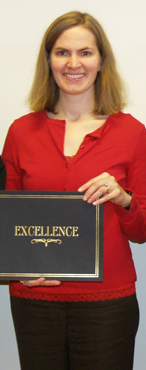
This week we visit with Libby Often, a math teacher at Greater Lowell Regional Technical High School. She’s also an EdD student studying Math and Science Education at the University of Massachusetts Lowell.
MathFour: Hey there, Libby! Thanks for sharing your time. First, can you tell us a little about your degree and career?
Libby: Hello Bon, it’s nice to hear from you.
My undergraduate degree is in history and classical studies. I have the equivalent of an undergraduate major in math as well (but not the degree to show for it!). Additionally, I have an MEd in Secondary Math Education and am currently in the EdD program for Math and Science Education at UMass Lowell. I am a teacher in a technical high school in northeastern Massachusetts, where I have taught math for the past ten years. I am speaking “off the record” here – not as an official school employee 🙂
In high school, I was on the math team and the calculus team, and I cannot recall not enjoying math. Well, actually, I didn’t really enjoy the first semester of linear algebra, and I have struggled with writing proofs, but there was always something interesting!
MathFour: Tell me about your family – how many kids do you have and how old are they? Are any of them more or less interested in math than the others in the family?
Libby: I have two sons, a 10 year old and a 12 year old. Both are in middle school (grades 5 and 7). They both enjoy math, and are successful in it at school. I should add that this is their interest, not mine. Although I did tell my 12 year old that he would need to go into Pre-Algebra in grade 7, and to make sure his grades supported it.
MathFour: Do you have any worries about your sons, academically? In particular, do you think they will do better in math than in other subjects because of your influence?
Libby: I don’t really have any worries about my children now – my younger son has poor handwriting, and both my children hate writing projects. My likes seem to not influence them tremendously, especially at this point.
MathFour: How do you play with your sons? Do you view your playtime as different in any way than other “non-mathematician” parents?
Libby: I don’t really play with my kids now, other than card and board games. When they were younger, I didn’t play with them in a way that was different from what I saw other parents doing.
We do talk about strategy, about piece placement in board games, about probabilities in games like Yahtzee, but I don’t see that as very different from other parents – especially those who play board games. My sons really like video games, and I have utilized their interests in some of my lesson planning, so maybe that is different?
MathFour: Do you think you speak with your sons or behave differently than other parents because you have a math background?
Libby: I really don’t think I speak or behave differently with my children because of my background in math. The main difference might be in the way that I talk to their friends – I invite friends over to work on homework, summer math, projects, and other school work, and that is definitely influenced by being an educator.
What I do like about being involved in math education is seeing the different ways that students are taught to approach problems, and having an opportunity to talk to them, and talk about why these approaches work, and when else they may use them.
MathFour: Have you ever had either of your children express negative thoughts about math? If not, how do you think you will handle it if that happens?
Libby: In general, my kids don’t express negative thoughts about math, unless they have gotten a low quiz or test score and I insist that they go over the answers and correct them. I think my response would be on par with what their goals are, and what type of negative response they were exhibiting.
I would be much more upset if, for example, my son told me I was an idiot because no one would ever need to know how to use fractions, than if he decided he wanted to major in English because he didn’t like math, or that he didn’t want to take AP Calculus.
I try hard to look at the end goal – a happy, well-functioning adult, who can support himself and others. And math is involved in that!
MathFour: Indeed it is, Libby!
Have you ever disagreed with one of your children’s math teachers? What happened and how did you handle it?
Libby: I have disagreed with other teachers, not necessarily the ones teaching my children. Our district is fortunate to have math coaches, and my sons have overall had good teachers, who were interested in the accuracy of what they were teaching. My colleagues at school and I have disagreed on a number of occasions, and the thing is that we all want students to succeed. So we have to come to an agreement about what will lead to student success in understanding and in preparation for what will come next for them mathematically speaking. I would expect to be able to have a similar conversation with my children’s teachers.
MathFour: Now to change direction a little to a more worldview of math. What do you see as the biggest challenge in math education today?
Libby: I think the biggest challenge, and the biggest hope, right now in US Math Education is the new Common Core curriculum. I really like these standards and the clarity with which they are written. There is no longer the room for teachers to say, “I taught them that!” because the standards specify what the child should be able to do.
But at the same time, students are expected to master all the content for, say, grade four, during grade four. In the US, our public education programs take almost everyone – we are not excluding people because of socio-economic status, language, gender, or other protected categories.
But this can be at odds with the idea that a certain concept is mastered in grade four, and then we move on to utilize and deepen that concept in grade five, six, seven, etc. Some students may need more time, for whatever reason, and the curricula that we devise is going to have to address this need for review.
In addition, the math standards for high school are really college preparation standards, and do a great job of developing the quantitative reasoning needed for success in college but at the expense of a lot of skills we used to teach in consumer mathematics. For students to be successful in those areas we need to be sure they are picking up the knowledge somewhere, perhaps in a “transitions to work” course, or in extracurricular programs.
One other thing that I think is very challenging in terms of mathematics education and education in general is that our society tends to be very product focused in a way that works well for business, but not for education. The successful countries don’t see changes in a few months, but over a number of years. So people need to be willing to wait.
MathFour: What can you say to non-mathematician parents that might help them raise their kids to like and appreciate math?
Libby: What advice would I offer to parents who aren’t lovers of math? Admit that to your children, and talk to them about some other things that you don’t love.
Personally, I dislike laundry and ironing, but I am still competent, and the family wears clean and pressed clothes. Also, I am not any good at plumbing work. But I do try to determine what may be causing a problem before I call the plumber, so I can be as helpful as possible. And I treat my plumber like a valuable professional.
Even if kids and parents struggle with “school math,” they should treat it like any other problem – what do I understand, what do I not understand (and believe me, the answer is never “I don’t understand anything!”), what can I do with what I do know?
Ian Stewart says something great in his book Letters to a Young Mathematician about mathematicians and what we can use mathematics for. The essence of it is that if someone trains to be a doctor, or a lawyer, or an electrician, you can SEE that, because there will be a sign “Joe Smith, electrician.”
But mathematics can be more hidden. It is the person who designs the survey to determine who people will vote for, the circuit design in your cell phone, the accountant who does your taxes, the person who wrote your email software. All of these people may have studied math, but their job description doesn’t say it.
The advice I take from that is look for the “hidden math,” and look too at the beauty of it.
Bon: That’s awesome, Libby! Thank you so much for sharing not just yourself, but all this great information!