This morning Daughter and I went to the gym.
When we crossed the street, I exposed her to undo risk by crossing at an angle.
So on our way out, I explained to her that we were walking a little further to get to the car this time. And we would minimize the risk of getting hit by a car by taking the longer route.
(Of course she’s not yet two, so she really didn’t care. But it was important for me to say.)
Crossing at an angle is shorter than going straight across.
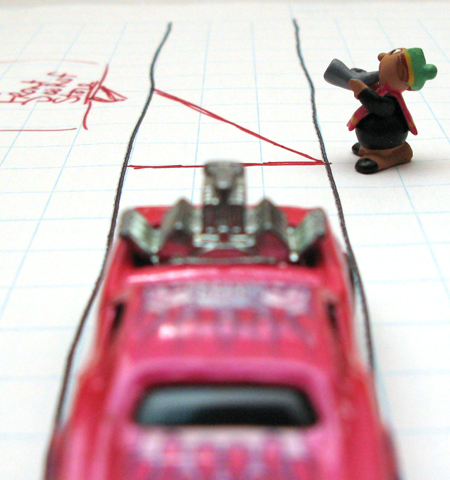
People most often cross the street at an angle. Intuitively we know it’s shorter. Look at the tiny person in this picture. He needs to get to the front door of the store.
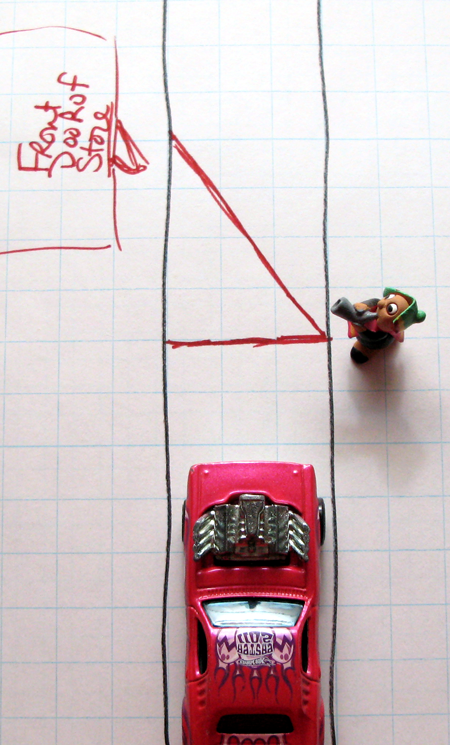
Suppose walking one yard takes 5 seconds. It will take the little guy 15 seconds to cross the street straight across. (And with a toddler, it does take 5 seconds to walk a yard.)
Then he has to walk the four yards along the side to the door. Which means his total time is
3 yards across at 5 seconds per yard = 15 seconds
4 yards up at 5 seconds per yard = 20 seconds
Total walking time = 35 seconds
If he went at an angle, it’s 5 yards total (by the Pythagorean Theorem).
5 yards diagonally at 5 seconds per yard = 25 seconds
Total walking time = 25 seconds!
Crossing at an angle puts you at risk for longer.
For the pedestrian in a hurry (and wearing the shirt that reads “Safety Third”) the angled route is the way to go. But for a parent with toddler in tow, minimizing risk is a better option.
If the little guy were to cross at the angle, he’d be in front of the oncoming cars for 25 seconds. If he were to take the route that is longer overall, he’d be in front of oncoming traffic for only 15 seconds.
Not to mention he keeps the driver happy.
Getting out of the driving area faster means keeping the driver happy. That might not be your goal, but adding some cosmic happy juice into the world of drivers never hurts.
Plus, if someone were to “hypotenuse you” by taking the angled route when you were driving, wouldn’t you get a little annoyed?
Next time you practice safety, practice math!
So be safe. And tell your children why.
It’s all about the math!
Share your thoughts in the comments.