Tag: base 10

  • Can every number be written as a palindrome in some base?

    Can every number be written as a palindrome in some base?

    My muse, Bartholomew, visited me this weekend with a question:

    Can every number be written as a palindrome in some base?

    What’s that mean!?

    Okay — first thing’s first. A palindrome is something that can be written the same way forward as backward. Like mom or 1001. Typically we ignore punctuation, so things like, “Go hang a salami, I’m a lasagna hog,” also count as a palindrome.

    And base means the number system — in our normal world we use base 10. Computers use base 2 (all ones and zeros) and hexadecimal (like the color codes you sometimes see on a computer — hex #ff9900 is the MathFour orange).

    Notice in hexadecimal — using 16 digits — we have to use letters as numbers. I did a video on base 12 arithmetic here — base 12 also uses some letters as numbers.

    So what’s the question again?

    Take any number — say 85. Can you convert it to some other base (like base 2 or base 7 or base 61) so that it looks like a palindrome?

    You can work hard converting numbers — or you can have a spreadsheet or Wolfram Alpha do it for you.

    If you use Wolfram Alpha, put in the statement “convert NUMBER base 10 to base NEW_BASE” — change the blue things, but leave the black ones the same.

    Notice if you convert 85 base 10 to base 84, the result is 1184 — which means every number can be written as a palindrome in the base that is one less than it.

    So 27810 is 11277. And 11 is a palindrome!

    So yes — every number can be written as a palindrome in some base.

    That’s a lame answer!

    You’re right. That’s what mathematicians call a “trivial” solution. It’s true, but it’s pretty lame.

    So let’s rewrite the question to be more interesting.

    Can every number be written as a palindrome in a base less than or equal to 10?

    This lets us use our “normal” digits — and it makes it more natural.

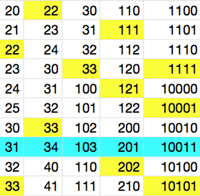
    I put together a spreadsheet to calculate some conversions. The yellow highlights are palindromes. The blue rows — those have no palindromes!
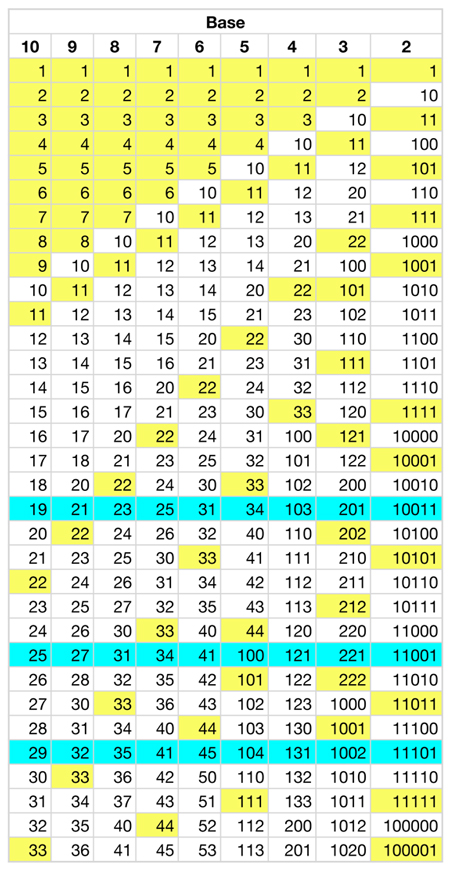
    Not every number can be written as a palindrome!

    That answers the question — but any good mathematician will ask the next question:

    What’s up with the numbers that can’t be written as palindromes?

    I did up to 100 and these numbers didn’t have palindrome conversions:

    19
    25, 29
    39
    47
    53, 58, 59
    69
    75, 76, 79
    84, 87
    90, 94, 95, 96

    Some are primes, some not. One’s even a perfect square!

    I leave the question with you…

    Any thoughts? What happens if you change the question again? Can you ask your children this question?

    Share in the comments — and don’t forget to tweet it!

    You might also like:
  • Numeracy Practice with the Number of the Day

    Numeracy Practice with the Number of the Day

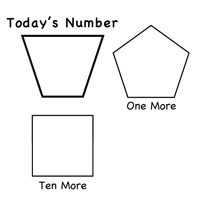
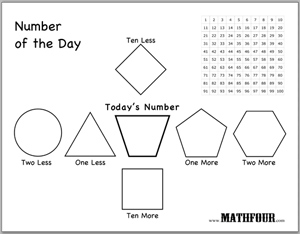
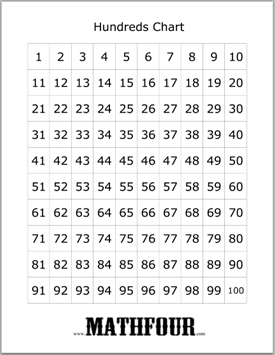
    Inspired by numeracy presentations by Conroe ISD teachers and Flip Flop Math at the recent CAMT conference, I have created my own Number of the Day Worksheet and mini Hundreds Chart.

    I started using a verbal version of this with K8 this week. She has a hundreds chart on her wall (she calls it her “present” because I gave it to her as a random gift one day) but I wanted one to write on too.

    Why a Number of the Day?

    Numeracy, or quantitative literacy, includes having a sense of how numbers work. Specifically in our base 10 system.

    Every number can be related to a multiple of 5 or 10 by counting 1 or 2 up or down. Getting a good handle on how that works is essential in building your child’s numeracy.

    The Number of the Day Worksheet helps children practice how the system works. And the hundreds chart helps them see it graphically — by tens.

    Pick a Number of the Day everyday.

    Create a hundreds chart for your wall, or download this printable one. Each day, let your child pick a number.

    Talk about the number — what does it look like, what does it mean? And what other numbers around it “match”?

    That last question was inspired by K8. She noticed that 84 on the hundreds chart matched the numbers to the right and left of it — the “8” was the same. Numeracy… here we come!

    Fill out the Worksheet

    Even if your child is too young to write, fill out the Number of the Day Worksheet and put it on the fridge. Practice filling in the spots, or talking about them. Let him or her color it or write on it.

    Got stickers? Decorate the sheet!

    I made the spaces in various shapes (notice the pattern?). I’m not sure if different shapes was a great idea, but it seemed fun. It might be a way to engage your older kids in the activity.

    Now… Play!

    Print out the worksheet and the hundreds chart and get your family going. At breakfast each day, choose a number — have each kid pick their own if you want.

    Enjoy it and let me know how it goes in the comments or on twitter/x.

    You might also like: