
Category: Linear Algebra

  • Fahrenheit to Celsius – Graphically!

    Fahrenheit to Celsius – Graphically!

    Part of Wordless Wednesday

    The beautiful and talented Heather at Freebies4Mom.com sent me a post on An Easy Way to Convert Celsius to Fahrenheit.

    It inspired me to draw the graphs of Celsius in terms of Fahrenheit and Fahrenheit in terms of Celsius.
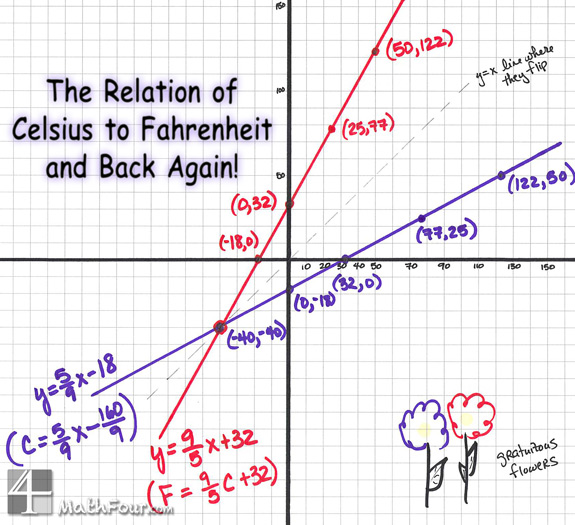
    The conversion from Celsius to Fahrenheit and back again can be strange. One way to understand it is on a graph. And you can use this to teach some linear algebra too!

    Notice these two intersect at (-40, -40). Which means that -40°F is -40°C!

    Use it to convert temperatures.

    The x values on the red line are Celsius – so find the °C you have and then look at the y-value to convert to °F.

    It’s just the opposite on the purple line.

    Okay, fine. This isn’t the greatest way to convert – but it’s exciting to see it graphically. And it might be easier to convert this way for someone who’s more visual.

    Use it to teach math!

    These two lines are inverses of each other. So the coordinates of one are switched to make the other.

    Also, they mirror image across that 45° line. I marked the line with dashes and wrote y=xy=x on it.

    And if you’re into this, their functional composition (both ways) is… x! (not factorial)

    Compare and Contrast…

    Take a look at the way J.D.Roth did it and then look at the graphs I have. Let your students find the way they like the best. And encourage them to create new ways!

    Oh, yeah – and share what happens in the comments!

  • Scalar Factors of Scalar Ratios

    Scalar Factors of Scalar Ratios

    What? Really?

    You can’t get a more dense set of math words crammed into a small space than “scalar factors of scalar ratios” – shoot me.

    @Milehimama, a friend of mine on Twitter and fearless leader of the Houston Blogging Chicks asked me yesterday what was up with this strange math thing. And why her son was being asked to do a table with them instead of doing it the way it seemed most natural to him.

    I could go on and on – not just about the boring-ness of the table, but also the coolness of scalar factors. I’ll spare you (and her) the insane rant/passionate pep rally. I’ve limited my answer to 6 minutes in the video below.

    What I left out was that this works when you’re playing with matrices, polynomials and even the distributive property. Scalar factors are also why things like reducing a fraction works!

    Ready to scale your world? Share with us what you used at home and in the classroom by leaving a comment below!

    Related articles